

 0 Comment
 Customer Reviews

Many companies find themselves in a familiar struggle when managing their operations. The integration of projects, technology, and people often presents a significant challenge. However, the key to breaking this cycle and avoiding decline is to build a substantial return on investments (ROI). The issues typically stem from incorrect estimates, staff unsuitability, or delays in business operations. A robust Enterprise Architecture (EA) is crucial to navigate these pitfalls and setbacks. Conducting a data analysis through an EA Assessment can provide a three-fold benefit:
- Figuring out your current stance on the foundation and company procedures;
- speeding up the execution of upcoming projects reducing identifying unwanted surprises, and;
- detect operational inefficiencies and cut back on costs through necessary alignments.
Let’s better understand how to conduct an architecture assessment by choosing the healthcare industry as an example. It can be divided into 7 steps:
- Gathering requirements: Distinguish between functional and non-functional requirements. It could include managing patient data and appointment scheduling and management of performance and security in the former.
- Review existing architecture: Understand what operations are being carried out (i.e., radiology or pharmacy). Evaluations are easier when the history before the changes is known.
- Review proposed architecture: Review the architectural blueprints, assess new technology, and evaluate encryption and authorizations that safeguard sensitive healthcare data.
- Resolve issues: Find solutions to potential questions such as whether the system can co-exist with third-party applications, if the gaps in fulfilling the legal requirements are being managed, or if the system will hold high-volume data safe.
- Strategize through risk analysis: Assess the risks posed in high-risk areas such as healthcare finance or patient data.
- Suggest enhancements: Enhance processes by providing user training programs for better integration.
- Implement a roadmap: Initiate the procedure by providing a map and timeline to meet goals.
Do you want to reap the benefits of conducting an architecture assessment? You’ve clicked on the ideal link. SlideTeam’s content-ready slides on Architecture Assessment are 100% customizable and editable. These slides can help you carry out technology assessments, design assessments, and software risk assessments. Research your target audience and weave the content into deliverables that best suit your needs. And oh-, make sure you hit the download button more often; making you happy keeps us happy.
Template 1: Analytics Architecture Case Identification Enterprise Data Assessment
This lone slider is not singled out while ensuring deliverables. It showcases a 5 step guide to implementing analytics architecture in an enterprise. It starts with the leaders basing the governance structure and moving within the same track. Well, when the planning’s done, what’s next? Commencement and execution of the analytics journey begins. This paves the way for course correction, where refinement bridges the gap between plans and long-term success. Not to forget, technological expertise is covered within these parameters. Lastly, landing on a decision is an easy by-product of such a cultivated analytics framework. Think again; the download button is here to remain!

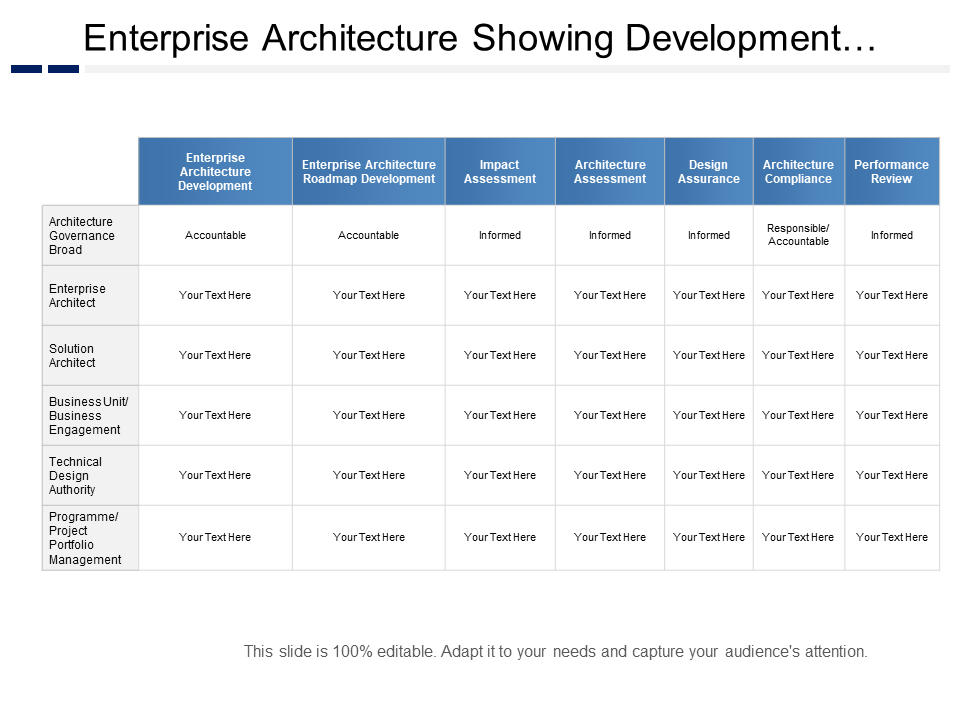
Template 2: Enterprise Architecture Showing Development and Impact Assessment
This single slide presents the RACI (Responsible, Accountable, Consulted, Informed) matrix. It consists of 7 columns and 6 rows. The purpose translates to clearing the roles and responsibilities when approaching various phases. The architecture governance board must remain on track with the impact and architecture assessments, design assurance, and performance reviews for better data analysis. However, they are liable for operations in enterprise architecture development, enterprise architecture roadmap development, and architecture compliance. Similarly, the extent of power can be determined for other players within the ambit of this enterprise model. Download now!
Template 3: Architecture Design of Technology Assessment
The functional process of figuring out the varied impacts of upcoming technology is known as technology assessment. A diligently crafted architectural design for such a pivotal company facet is not much to ask for. This slide invites for the procedure to commence with application reviews of the designs. Moving on, an IT strategy is needed for smooth follow-up of the process & governance. Shared services models require a detailed discussion before reviewing the applications, yet again. This is a repetitive process. While the outcome might not seem like a lot, assessing your technology should not be ignored to gain a competitive edge. Download this slide!
Are you seeking scorecards that help monitor your device's security and server status? Take a look at 10 of these Technology Assessment Templates!
[product_image id=206007]
Template 4: Architecture Design Technology Assessment Mobility Solutions Product Strategy
The optimum product strategy can often be as simple as weighing desired and undesired necessities. The portrayal here depicts whether drawing focus on architecture design alongside another element would naturally weigh lighter on the company. This comparison is made with technology assessment and 2 other elements on the other side, which are intensive alternatives. Due to prioritization, the employees could benefit from better mobility solutions, i.e., secure access to company data. Download and weigh out your odds to successful architectural designs!

Template 5: Software Risk Assessment Tools and Techniques Architecture
Software that acts as a database of confidential company data information is not risk-free. The template exemplifies two sides of the same coin: Risk assessment tools and Risk control tools. The former is a detailed process that helps calculate the potential risk to take potential measures. The tool provides steps for internal threat databases, external threat databases, historical threat databases, configuration management databases, etc. The tools in this category are compliance and incident management tools. Moreover, risk control tools include change management tools, availability management tools, continuity management tools, data security management tools, etc. Download to grab the guide!
Browse through 5 of our best Software Risk Assessment Templates to strengthen security!

Template 6: Enterprise Architecture Showing Assessment Product Evaluation and Selection
Have you ever noticed that the higher the entity stays on a flagpole, the smoother the hoisting? This slider signifies how smooth the result of an enterprise architecture at the top can be. The six aspects to be highlighted from scratch are as follows:
- Enterprise Architecture Assessment
- Enterprise Architecture Planning
- Product Evaluation and Selection
- Enterprise Architecture Implementation
- Enterprise Architecture Governance
- Services
Each pointer can be curated based on your company's requirements. There’s only one way to gain rewards: perfecting the back-end operations and building a strong base. Ease your way through today!

Template 7: Determine Assessment of Firm Current Infrastructure Management Capabilities
This slide measures the company’s management capabilities to serve as a self-improvement feedback form. The company goals can be altered to the desired results for the upcoming stint. The parameters are of 8 kinds, and the numerals of each are compared to the industry standard. These parameters amount to incidents handling rate, average time for client onboarding, successful service requests handling, software packages available, service delay rate, service failure rate, problem escalation rate, and eventually, the customer satisfaction score. Use these numbers to provide fair competition in the market. Download today!
Wondering why there isn’t a guide on carrying out a website assessment? We’ve got you covered with 10 of our Website Assessment Templates!

THE QUALITY OF AN ARCHITECT IS PROOF TO LONGEVITY
The objective of having an architecture assessment is to define goals that help the company's growth. This growth can be streamlined if there is an illuminated pavement ready. This is where SlideTeam comes in! Our slides will ensure you’re always led through to finish the deliverables. Longevity is a by-product of quality.