

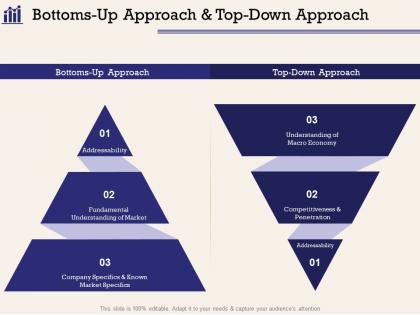
Bottoms up approach and top down approach understanding ppt powerpoint presentation file icon




Try Before you Buy Download Free Sample Product
 Impress Your
 Audience
 100%
100% Editable
 Save Hours
 of Time


Our Bottoms Up Approach And Top Down Approach Understanding Ppt Powerpoint Presentation File Icon are topically designed to provide an attractive backdrop to any subject. Use them to look like a presentation pro.
People who downloaded this PowerPoint presentation also viewed the following :
Bottoms up approach and top down approach understanding ppt powerpoint presentation file icon with all 2 slides:
Use our Bottoms Up Approach And Top Down Approach Understanding Ppt Powerpoint Presentation File Icon to effectively help you save your valuable time. They are readymade to fit into any presentation structure.
FAQs for Bottoms up approach and top down approach understanding ppt powerpoint
Bottom-up presentations start with detailed data, evidence, and specific findings before building to broader conclusions and strategic recommendations, while top-down approaches begin with high-level insights, executive summaries, and strategic outcomes before drilling into supporting details. These contrasting methodologies serve different audiences and purposes, with bottom-up appealing to analytical stakeholders who prefer comprehensive data validation, and top-down resonating with executives seeking immediate strategic clarity and actionable insights.
The choice significantly impacts engagement by aligning content delivery with audience expectations and cognitive preferences. Bottom-up approaches engage detail-oriented audiences like engineers or analysts through methodical data progression, while top-down captures executive attention with immediate strategic insights, ultimately enabling presenters to maintain focus and deliver more compelling, targeted messaging.
**INPUT**: What types of presentations are best suited for a bottoms up approach? **OUTPUT**: Bottoms up presentations work best for data-driven reports, research findings, technical proposals, financial analyses, and project updates where detailed evidence supports conclusions. This approach proves particularly effective in scientific presentations, quarterly business reviews, and audit reports, with many organizations finding that building from specifics to strategic insights enhances credibility and stakeholder buy-in.
A top-down approach proves most effective when presenting to senior executives, during crisis communications, or when audiences need immediate strategic context before details. This method works particularly well in board meetings, investor presentations, and organizational restructuring announcements, where decision-makers require big-picture insights first, ultimately enabling faster strategic decisions and clearer resource allocation priorities.
**INPUT**: How can a presenter effectively transition between bottoms up and top down methods? **OUTPUT**: Presenters can transition effectively by using clear verbal bridges, strategic slide positioning, and consistent visual frameworks that connect detailed data to broader insights. Successful transitions involve summarizing key findings before shifting perspectives, using phrases like "stepping back to see the bigger picture" or "drilling down into specifics," and maintaining thematic consistency, with many executives finding that seamless integration enhances audience comprehension and strategic decision-making.
Audience analysis determines approach selection by evaluating factors like expertise level, decision-making authority, time constraints, and information processing preferences. Executive audiences with limited time often prefer top-down summaries for quick strategic decisions, while technical teams and analysts typically benefit from bottoms-up approaches that build detailed understanding, ultimately enabling presenters to deliver more targeted, persuasive communications.
Visual aids enhance bottoms-up presentations by transforming detailed data into compelling narratives through infographics, interactive dashboards, progressive reveal slides, and layered visualizations that guide audiences from specifics to strategic insights. These tools streamline complex information processing, enable real-time stakeholder engagement, and ultimately deliver clearer decision-making pathways, with many organizations finding that visual storytelling significantly accelerates buy-in for ground-level recommendations.
Common pitfalls include overwhelming audiences with excessive high-level information, failing to provide sufficient supporting details, losing audience engagement through abstract concepts, and appearing disconnected from practical implementation realities. While top-down approaches streamline complex topics, presenters must balance strategic overview with concrete examples, ensuring stakeholders across departments, from finance to operations, can connect broad initiatives to their specific roles and daily workflows.
Storytelling adapts differently across presentation strategies, with top-down approaches using narrative to frame and contextualize high-level conclusions before diving into supporting details, while bottoms-up presentations employ storytelling to weave individual data points and insights into a compelling journey toward strategic recommendations. Both approaches leverage narrative structure to enhance audience engagement and comprehension, with many organizations finding that strategic storytelling ultimately delivers more persuasive presentations and clearer decision-making outcomes.
Yes, approach effectiveness significantly varies with subject complexity, with bottom-up approaches proving more effective for intricate technical topics requiring detailed foundation-building, while top-down methods excel for strategic overviews and executive presentations. Complex financial analyses or technical implementations benefit from bottom-up progression, whereas high-level strategic initiatives and board presentations leverage top-down structures, ultimately enabling presenters to match their delivery method with audience needs and content complexity.
Cultural factors significantly influence presentation preferences through power distance, hierarchy respect, communication directness, and decision-making styles across different societies. High-context cultures like Japan and Germany often favor top-down approaches with executive summaries first, while individualistic cultures prefer bottoms-up methods, with many international organizations finding that adapting presentation structure to cultural expectations enhances stakeholder engagement and business outcomes.
Bottoms up approaches enhance team presentations by leveraging diverse perspectives and collaborative insights, while top down methods work effectively for solo presentations requiring clear executive messaging and streamlined delivery. Team presentations benefit from bottoms up's collective knowledge gathering and stakeholder buy-in, whereas solo presenters often find top down approaches deliver focused narratives and strategic clarity, ultimately enabling more targeted audience engagement.
Feedback enables presenters to refine their approach by identifying which elements resonated with audiences, whether data-driven details or strategic overviews proved most effective, and where clarity gaps emerged. Through systematic collection and analysis, organizations can optimize their presentation strategies, with many finding that audience-specific insights help them seamlessly blend bottom-up evidence with top-down messaging, ultimately delivering more compelling and persuasive communications.
Templates support both approaches by providing flexible frameworks that accommodate granular detail building and high-level strategic messaging, structured layouts for systematic data presentation, and modular designs enabling seamless transitions between specific findings and executive summaries. These presentation tools streamline workflow efficiency by allowing teams to populate detailed analysis while maintaining consistent visual hierarchy, with many organizations finding that standardized templates accelerate both comprehensive reporting and strategic communication processes.
Tools facilitating bottoms-up and top-down presentation approaches include PowerPoint's SmartArt and hierarchy templates, Prezi's zoom-based storytelling, Miro's collaborative mapping features, Lucidchart's organizational charts, and Canva's structured design templates. These platforms streamline content organization by enabling clear data flow visualization, strategic narrative structuring, and seamless audience engagement, with many organizations finding that proper tool selection significantly enhances presentation clarity and stakeholder buy-in across different organizational levels.
-
Editable templates with innovative design and color combination.
-
Great designs, really helpful.
-
Best Representation of topics, really appreciable.
-
I discovered this website through a google search, the services matched my needs perfectly and the pricing was very reasonable. I was thrilled with the product and the customer service. I will definitely use their slides again for my presentations and recommend them to other colleagues.