


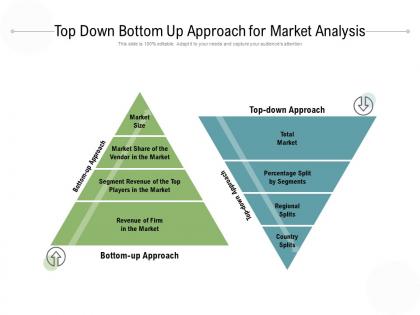
Top down bottom up approach for market analysis




Try Before you Buy Download Free Sample Product
 Impress Your
 Audience
 100%
100% Editable
 Save Hours
 of Time


Our Top Down Bottom Up Approach For Market Analysis generate a lot of fun. Children find them extremely exciting.
People who downloaded this PowerPoint presentation also viewed the following :
Top down bottom up approach for market analysis with all 2 slides:
Activate children's brains with our Top Down Bottom Up Approach For Market Analysis. They will get attracted by their designs.
FAQs for Top down bottom up approach
Okay so for market analysis, start with market size - that'll save you from wasting time on tiny segments. Then map out your target customers and what actually bugs them day-to-day. The competitive part is tricky though - most people just make boring lists instead of figuring out where competitors are weak. Look at direct AND indirect competition. Oh, and don't forget pricing dynamics plus any regulatory stuff that might mess with your plans. Mix hard data (growth rates, demographics) with the softer insights about how people actually buy things. That combo usually tells the real story.
So quantitative data gives you the hard numbers - sales, demographics, conversion rates, all that stuff. But honestly, numbers alone are pretty useless without context. That's where qualitative comes in. Customer interviews and feedback tell you WHY the trends are happening. Like, maybe your Q3 sales tanked because a competitor launched something better - you'd never know that from spreadsheets alone. I always start with the numbers to spot patterns, then talk to actual customers to figure out what's really going on. Trust me, some random customer comment will blow your mind more than any fancy analytics dashboard.
Look, competitive analysis is your secret weapon for figuring out where you actually fit in the market. Check out what your competitors are crushing (then figure out how to do it better) and spot what they're completely ignoring. I swear, half the startups I know skip this step then act shocked when their launch bombs. Map out their pricing, messaging, and positioning - gives you the intel to find your own lane instead of getting steamrolled in a fight you can't win. Honestly just pick your top 3-5 competitors and start there this week.
Honestly, just dig into whatever customer data you've got first - that's where the real insights are hiding. Who's buying from you right now? What do they have in common? From there, maybe throw out some surveys or stalk your competitors' social media comments (kidding... sort of). Focus groups are solid too if you have the budget. The key is building out 2-3 really clear customer profiles instead of trying to be everything to everyone. Don't overthink it at first - you can always refine later once you see what's actually working.
Google Trends is your best friend for this stuff - I check it constantly. Social media analytics are clutch too. If you're doing financial markets, TradingView's pretty solid (Bloomberg Terminal if you've got money to burn). SurveyMonkey works for getting actual consumer opinions, though honestly? I spend way too much time scrolling Reddit just to see what people are really thinking about trends. Web scraping tools help you spy on competitors. Excel's fine for basic stats, or R if you're feeling fancy. Start free, then upgrade once you figure out what data you actually need most.
SWOT analysis is pretty solid for figuring out where you stand in the market - breaks down your Strengths, Weaknesses, Opportunities, and Threats. Sounds super basic, I know, but it actually catches stuff you'd normally miss. You'll see what advantages you have, where competitors could beat you, and which trends might help or screw you over. The cool part is watching how everything connects - like using your strengths to jump on new opportunities. Oh, and definitely get different people on your team involved since they'll spot things you won't.
Okay so first things first - get explicit permission before collecting anyone's personal info. Be totally upfront about what you're doing with their data and protect their identities like your life depends on it. Don't twist your questions to get the answers you want (honestly, that just makes for garbage research anyway). Make sure you're including diverse groups fairly. Avoid reinforcing crappy biases in how you set things up. Oh, and don't oversell your findings - be real about the limitations. Basically treat people like actual humans, not just data points you're mining.
Make tech monitoring part of your weekly routine - Google Alerts for industry buzzwords, social listening to catch customer chatter about new stuff. Most "breakthrough" tech is total BS, but missing real disruptions will kill you. Start small with pilot programs testing IoT data, voice search patterns, behavioral app analytics. See how these tools actually shift customer behavior before everyone else jumps on board. Oh, and automation platforms are worth tracking even if they seem boring - they're usually the ones that sneak up and change everything.
Dude, culture is everything when it comes to buying patterns - seriously can't skip this part. People's values and traditions totally dictate what they want and how they shop. Like, luxury means completely different things depending where you are. Religious stuff, family dynamics, even generational gaps create these super specific market behaviors. Oh and products that seem "universal"? They still get tweaked for local tastes every time. My point is, you've gotta dig into the cultural context of wherever you're selling - trust me, it'll save you from some really dumb (and expensive) assumptions about what people actually want.
Honestly, social media analytics are way better than those old-school surveys that take forever. You can see what people actually think about your brand in real-time - not just the polite BS they tell focus groups. Track your mentions and hashtags to spot trends before they blow up. The demographic breakdowns alone are gold, plus you get free intel on competitors. I'd start monitoring your brand keywords first, then add your biggest competitors. You'll catch market shifts early and find pain points you didn't even know existed. It's basically like having a crystal ball, but with actual data backing it up.
So you'll want to start with TAM, SAM, and SOM - that's your whole market funnel from huge potential down to what's actually realistic. Customer acquisition cost versus lifetime value is huge too. Market growth rate matters because, honestly, there's nothing worse than picking a dying industry. Also grab competitive market share data and demand indicators like search volume or surveys (though surveys can be pretty unreliable sometimes). Growth rate really tells you if you're swimming with the current or against it. Begin with nailing your TAM, then narrow it down to what you can genuinely capture.
Sentiment analysis basically tells you how people *feel* about your market, not just the cold hard numbers. Monitor social media, reviews, news coverage - you'll see if people are getting excited or turned off by your product category or competitors. Honestly, emotions drive way more purchases than logic does (we all know this is true). Short sentences work. But you want to combine this emotional data with your regular analytics rather than trusting it solo. I'd start by tracking sentiment around big launches or campaigns, then see how it matches up with your actual sales. Pretty eye-opening stuff.
Look, market forecasting is like having a heads-up on what's coming next - helps you prep for demand changes and catch opportunities early. You don't want to be guessing blindly about inventory or staffing, trust me on that one. Nobody likes getting stuck with a warehouse full of stuff nobody wants anymore. The whole point is matching your strategy to where things are actually going, not just reacting to today. Oh, and track whatever metrics actually move the needle for your business - sounds obvious but you'd be surprised how many people skip this step.
Honestly, customer feedback is pure gold if you actually dig into it properly. Start tracking patterns in your reviews and support tickets - I use a basic spreadsheet because fancy tools are overkill. Social media comments are where people get real with you, so pay attention there. When you see the same complaints popping up repeatedly? That's usually a gap your competitors haven't noticed yet. Same goes for feature requests. Track how people feel about your stuff over time too - helps you catch market shifts early. Way better than waiting until your sales tank to figure out what's happening.
Ugh, where do I even start? Data sources are always outdated by the time you get them. People get survey fatigue and just click whatever to finish faster - or worse, they lie and give you answers they think sound "right." Small samples that don't actually match your real market are super common too. Competitor data? Good luck getting anything useful without paying through the nose. Oh, and response rates just keep getting worse every year. Honestly the only thing that works is using like three different methods to double-check everything. Also budget way more time than you think for cleaning up messy data.
No Reviews