


Budget plan for product development and commercialization




Try Before you Buy Download Free Sample Product
 Impress Your
 Audience
 100%
100% Editable
 Save Hours
 of Time


Our Budget Plan For Product Development And Commercialization are topically designed to provide an attractive backdrop to any subject. Use them to look like a presentation pro.
People who downloaded this PowerPoint presentation also viewed the following :
Content of this Powerpoint Presentation
Nothing fascinates humans as much as money. People want it to ease their worries, indulge in an extravagant lifestyle, and ensure they can enjoy abundance. In business, however, the budget is what we value more than the allure of money. It is the budget that allows the ball to roll as far as possible and turns money into recurring revenue and, ultimately, profits.
A capital budget is the foundation on which any business stands. Understand how to use this template here.
From the many expenses that businesses can incur, a budget spent on product development is the best use of resources. If the product is well-planned and is tapping into intrinsic and genuine demand, we have a winner. This successful and desirable scenario, however, is possible only after the management can create a working and 10/10 budget plan for product development and commercialization. Most businesses do work on a budget plan for product development. Where they effectively lag is the method of communicating it to stakeholders and ensuring the vision can be replicated and executed across the ranks and files of the organization. Another pain point is the inability to crystallize the business plan and tie costs to specific costs.
Construction projects are the ones where there is most scope for confusion, with the one footing the bill not aware of the exact budgeting. Correct this with the use of our budget plan for construction project here.
At SlideTeam, we have successfully resolved these pain points to the satisfaction of all stakeholders and created best-in-class templates that meet all business requirements. From the types of expenses to item-wise cataloging to number comparisons, we do it all in our templates. Below, we present one such template for your perusal, and we have thousands of others like it. Each of these is 100% editable and customizable, giving you structure and a starting point.
Let’s explore these templates now!
Template 1 Budget Plan for Product Development and Commercialization
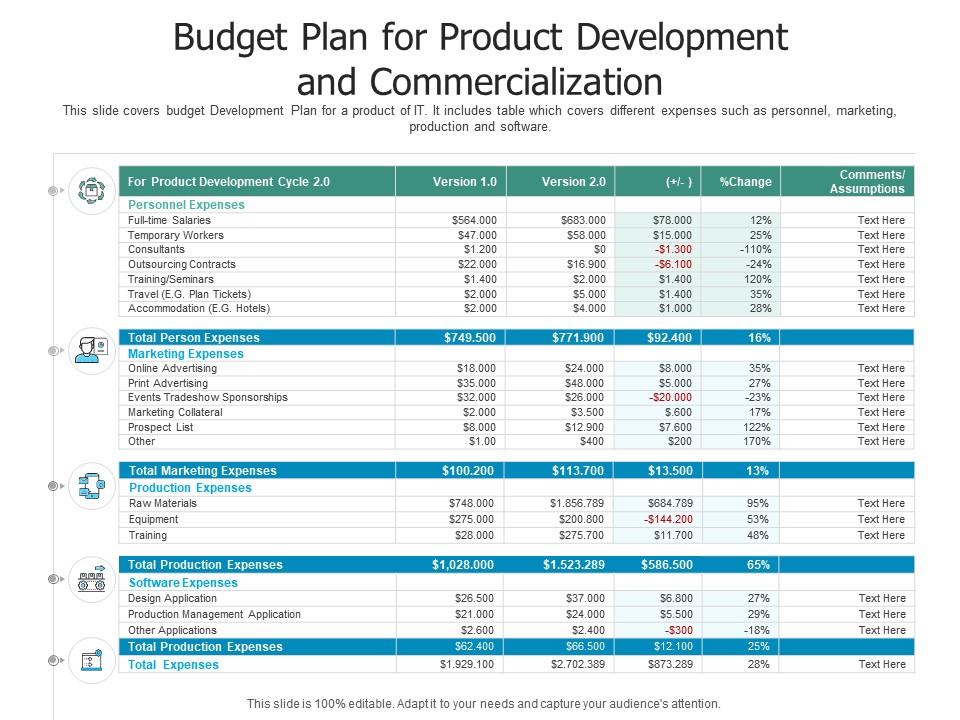
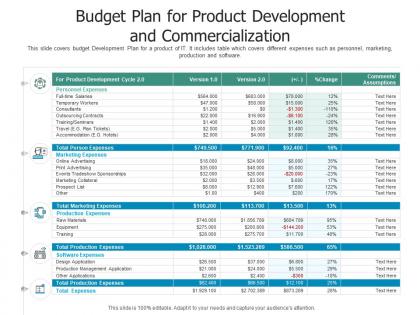
This PPT Template covers budget development plan for a product of the information technology domain/department. It includes a table that covers expenses such as personnel, marketing, production, and software. The main segments of the table include total personal expenses, total production expenses, marketing expenses, and so on. The USP of the slide is the detail it goes into and the hands-on way you can use it to create an excellent budget that optimizes resources. As is the tendency with IT products, the slide ensures that the user mentions the version of the software, whether version 1.0 or version 2.0. The user can also record whether the cost of version 2.0 is more or less than the previous ones in both absolute and percentage terms. The last column on comments/suggestions is critical as it ensures that qualitative checks are also carried out in addition to quantitative ones that are tied to the budget.
The depiction of specified rows for marketing, after segregating it into its components like print advertising and online advertising, is a brilliant practical tool to ensure cost sensitivity. Raw materials, equipment, and training also contribute to the production expenses and are neatly displayed. The icons and color coding add to the appeal of the template as an excellent presentation tool to explain how to make a budget and create a blueprint. This budget plan considers commercialization, as it also adds the travel cost and accommodation of personnel to the expenses sheet. Overall, this PPT Layout is a must-have addition to your portfolio of presentations to ensure you can showcase the mastery you have developed over product budgeting, especially in the field of IT.
CONTROL AND DISCIPLINE KEY TO BUDGET PLANS
All product development needs money as the key input, without which the best-laid plans can never even get off the ground. To ensure businesses do this well, with the required discipline and success, a budget plan for product development and commercialization is an absolute must. The PPT Template from SlideTeam, above, is the best way to understand budget plans and make your record as you develop products and budgets. The key, always, is to ensure that discipline is exercised in the way costs are estimated and then converted into expenses. Each expense must lead toward the bigger goal of product development and commercialization in a budgeted manner.
PS Marketing budget plan with a metrics and result dashboard is the best way to ensure organizations taste success with their budgets. A Marketing Budget plan can be accessed here.
Budget plan for product development and commercialization with all 2 slides:
Use our Budget Plan For Product Development And Commercialization to effectively help you save your valuable time. They are readymade to fit into any presentation structure.
FAQs for Budget plan for product
You'll want to start with the basics: income, fixed stuff like rent and insurance, variable expenses (groceries, gas), plus savings goals. Honestly, those random expenses like car repairs always catch me off guard if I don't plan for them. Track everything for a month first - you'll probably be surprised by what you actually spend vs what you think you spend. The 50/30/20 split works pretty well: needs, wants, savings. But seriously, just pick whatever method you'll actually use. Could be an app, spreadsheet, whatever. Simple beats perfect every time.
Look, handle your needs first - rent, utilities, groceries, debt minimums. That stuff isn't optional if you want to keep the lights on. After that comes the fun stuff like eating out, Netflix, whatever. I'm a big fan of the 50/30/20 thing: needs get half, wants get 30%, then 20% goes to savings and paying down debt faster. Write it all down and be honest about what's actually necessary versus what you just really want. Honestly, most people lie to themselves about needs vs wants. If the math doesn't work? Cut the wants first.
Honestly? Start with Mint since it's free and connects to all your accounts automatically. Super easy setup. YNAB costs like $14/month but it's genuinely better at teaching you how to budget properly - almost like having someone coach you through it. I used to just track everything in a basic spreadsheet which worked fine too, but I'm lazy about updating it. The real trick is picking something you'll actually stick with. Maybe try Mint first and see if you need something more detailed later? Even your phone's notes app works if you're consistent about it.
So basically, start with your fixed stuff - rent, car payment, insurance - since those don't change. They're your foundation. Variables like groceries and gas? Way trickier because they're all over the place (especially when Target gets you, am I right?). I'd suggest tracking your variable spending for like 2-3 months to see what you actually spend, not what you think you spend. Then set ranges instead of exact amounts. Always add a little cushion though - some weeks everything just costs more for no reason. Treat the fixed expenses as untouchable first, then work with what's left for everything else.
Your emergency fund is basically what keeps you from totally screwing up your budget when random stuff happens. I'd treat it like any other bill you have to pay - rent, food, whatever. My car died last year and I had zero saved, so everything went on credit cards (honestly such a nightmare). Having that cushion means you won't wreck your other financial goals when life gets weird. Yeah, 3-6 months of expenses sounds like a lot, but start wherever you can. Even $500 helps. Build this first before you worry about anything else - trust me on this one.
Honestly, budgeting just tricks you into paying your future self first instead of blowing everything on random stuff. Pick one big goal - like saving for a house or whatever - and throw maybe $50-100 at it every month. Sounds boring, I know, but those small amounts actually add up way faster than you'd think. Without some kind of plan, you're basically just hoping money magically appears when you need it. The real win is building the habit first. Once you get used to automatically setting that money aside, it becomes second nature and you'll hit those bigger goals without even thinking about it.
Honestly, the worst thing people do is forget about those random expenses that hit you out of nowhere - car repairs, birthday gifts, that Amazon Prime charge you never see coming. Track your actual spending for like two weeks first instead of guessing where your money goes, because we're all terrible at that. Don't be crazy restrictive with fun money either. Trust me, you'll just end up saying screw it and overspending anyway. Short sentences work. But you also need some breathing room in there for the stuff that actually makes life enjoyable, you know?
Honestly, solo budgeting is SO much easier. You just track your own stuff and call it a day. But with a family? Now you're dealing with everyone's needs, and trust me, someone's always buying random things you didn't plan for. The grocery budget alone becomes this whole thing - instead of just grabbing what you want, you're feeding multiple people. Communication becomes huge too since one person's impulse buy affects everyone. My advice? Start by writing down what each family member actually needs, then figure out who's responsible for what spending. Otherwise you'll be constantly surprised by expenses.
Honestly, budgeting sucks unless you make it feel good somehow. I always set up little rewards when I hit my monthly targets - like that latte I've been craving or a new book. Tracking progress visually is weirdly addictive too. Those cheesy debt thermometer printouts? They actually work on me lol. Automate whatever you can so you're not constantly deciding whether to save or spend. Treat savings like rent - just pay it first. Oh, and start by tracking one week to see where your money's really going. That's usually an eye-opener.
Look, life happens and your budget needs to roll with it. Cover the must-haves first - rent, utilities, groceries. After that? Work with whatever's left. Got some unexpected cash? Maybe treat yourself a tiny bit but don't go crazy (I learned this the hard way lol). Income took a hit? Time to pause the fun stuff temporarily. You've gotta be realistic about your actual situation right now, not what you hoped it'd be. Just update those budget numbers so you're not living in fantasy land.
Dude, you've gotta check your budget regularly because life never stays the same. Your income changes, random expenses hit you out of nowhere, and your goals shift too. I made this mistake once - kept following the same budget for months even after my rent went up like $200. Such an idiot move! Monthly reviews are perfect, but honestly whenever something big changes works too. Don't feel bad about tweaking things constantly. Your budget needs to actually match what's happening in your life, not some fantasy version from six months ago.
Honestly, budgeting is a game-changer for debt because it shows you where all your money's actually going. You'll probably have those "holy crap, I really spent $150 on DoorDash this month?" moments that suddenly give you extra cash for payments. List out all your debts first, then track your spending for like a week or two. Once you see the numbers, you can figure out how much extra to throw at debt while still covering rent and groceries and stuff. The snowball or avalanche methods work great once you know what you're working with. Just make sure your plan isn't so aggressive that you'll quit after two weeks.
Oh man, your brain is literally working against you when it comes to money. You know how you'll grab that $5 coffee instead of saving it? That's present bias - we're wired to want stuff NOW. Then there's this weird thing where a $20 bill from your paycheck feels different than finding $20 on the ground, even though it's the same money. Loss aversion makes cutting your Netflix subscription feel way worse than it actually is. And don't get me started on lifestyle inflation - make more money, spend more money automatically. I swear it's like our brains hate being financially responsible sometimes. Best thing is just knowing this stuff happens so you can catch yourself doing it.
Honestly, ditch the boring spreadsheets - nobody wants to stare at those. Charts and real dollar amounts work way better. Like, show them the 50/30/20 rule with actual numbers they'd see in their own life. Make it hands-on too, have people crunch their own numbers right there in the room. The envelope method is pretty solid for visual learners. Don't just tell them why budgeting's good (they already know that). Show them exactly how to start. Give them one thing they can do when they get home that day.
Honestly, having a good budget is a game changer for cash flow control. You'll catch problems way earlier instead of scrambling later. Different departments actually start talking to each other about what they need - awkward at first but so worth it. The best part? When the market gets weird (and it always does), you can adjust quickly because you know where every dollar goes. Making spending decisions becomes way easier when you have real numbers instead of just winging it. My advice: start by tracking your biggest expenses first, don't overcomplicate it.
-
Great quality slides in rapid time.
-
Great product with highly impressive and engaging designs.
-
I discovered this website through a google search, the services matched my needs perfectly and the pricing was very reasonable. I was thrilled with the product and the customer service. I will definitely use their slides again for my presentations and recommend them to other colleagues.
-
Great quality slides in rapid time.
-
Design layout is very impressive.