


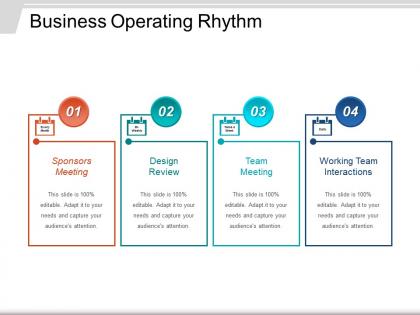
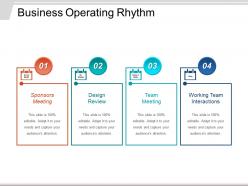
Business operating rhythm




Try Before you Buy Download Free Sample Product
 Impress Your
 Audience
 100%
100% Editable
 Save Hours
 of Time


Have all the answers at your fingertips with our Business Operating Rhythm. They ensure you are first on the button.
People who downloaded this PowerPoint presentation also viewed the following :
Business operating rhythm with all 5 slides:
Our Business Operating Rhythm are globally accepted. Give folks across borders access to your thoughts.


FAQs for
Key components of an effective business cadence include regular strategic reviews, performance tracking meetings, cross-functional alignment sessions, clear communication protocols, and consistent decision-making rhythms. These elements work together by establishing predictable touchpoints, enhancing organizational transparency, and streamlining execution processes, with many companies finding that structured cadences ultimately deliver faster problem resolution and improved operational efficiency.
A consistent business cadence enhances team productivity by establishing predictable rhythms for meetings, reviews, and deliverables, creating clear expectations and reducing coordination overhead. Through regular check-ins and structured communication cycles, teams streamline decision-making, identify bottlenecks faster, and maintain alignment on priorities, ultimately delivering improved project outcomes and operational efficiency across departments.
Business cadence significantly impacts stakeholder communication by establishing consistent meeting schedules, standardizing reporting formats, creating predictable information flows, and ensuring timely decision-making cycles. Through regular quarterly reviews, monthly updates, and weekly check-ins, organizations streamline transparency, minimize information gaps, and enhance trust, with many companies finding that structured communication rhythms ultimately deliver stronger stakeholder relationships and improved strategic alignment.
Technology streamlines business cadence by automating routine processes, providing real-time data analytics, and enabling seamless communication across teams and departments. Through project management platforms, automated reporting systems, and integrated workflows, organizations maintain consistent operational rhythm while reducing manual bottlenecks, ultimately delivering faster decision-making and enhanced productivity in increasingly competitive markets.
Cultural differences significantly influence business cadence through varying communication styles, decision-making processes, hierarchy expectations, and time orientations across global teams. While some cultures prioritize rapid consensus and quick iterations, others emphasize thorough deliberation and formal approvals, with many international organizations finding that adapting cadence frameworks to accommodate these cultural nuances ultimately enhances collaboration and accelerates global project delivery.
Measuring business cadence effectiveness involves tracking key performance indicators, meeting efficiency metrics, decision velocity, goal achievement rates, and team engagement scores. Through analytics dashboards and regular assessments, organizations monitor cycle completion times, stakeholder participation levels, and outcome quality, with many companies finding that consistent measurement drives improved alignment and faster strategic execution.
Businesses should evaluate their cadence quarterly and adjust it based on performance metrics, market changes, and strategic priorities. This regular assessment enables organizations to maintain optimal meeting frequencies, streamline decision-making processes, and enhance operational efficiency, with many companies finding that flexible cadence adjustments ultimately deliver improved productivity and competitive advantage.
Common pitfalls include overloading meetings with too many topics, inconsistent scheduling that disrupts workflow, lacking clear agendas and outcomes, focusing on status updates rather than strategic decisions, and failing to adjust cadence based on business needs. Many organizations find that rigid structures without flexibility, poor preparation by participants, and inadequate follow-through on commitments ultimately undermine operational efficiency and team engagement.
Leaders foster strong business cadence by establishing consistent meeting rhythms, implementing standardized reporting processes, setting clear accountability measures, and maintaining transparent communication channels across all levels. Through regular weekly reviews, monthly strategic assessments, and quarterly planning sessions, organizations streamline decision-making, enhance operational efficiency, and accelerate goal achievement, with many companies finding that structured cadence ultimately delivers improved performance and competitive advantage.
Startups can implement strategies including consistent communication rhythms, data-driven decision cycles, agile planning processes, standardized operational workflows, and regular performance reviews to establish sustainable business cadence. These approaches streamline organizational efficiency by synchronizing team activities, accelerating decision-making, and maintaining strategic focus, with many growing companies finding that structured cadence ultimately delivers predictable growth and competitive advantage.
Business cadence varies significantly across industries based on market dynamics, customer expectations, and operational requirements. Technology companies operate on rapid sprint cycles and quarterly releases, while manufacturing follows seasonal production schedules, and financial services align with regulatory reporting periods, with each sector finding that matching cadence to industry rhythms ultimately delivers competitive advantage and operational efficiency.
Best practices for aligning business cadence with organizational goals include establishing clear quarterly review cycles, implementing cascading goal frameworks, creating regular cross-functional check-ins, setting measurable milestone tracking, and maintaining consistent communication rhythms. These practices streamline strategic execution by ensuring departmental alignment, accelerating decision-making processes, and enhancing operational transparency, with many organizations finding that structured cadence ultimately delivers improved performance visibility and competitive responsiveness.
Visuals and presentation tools enhance business cadence understanding by transforming complex data into clear dashboards, interactive charts, and real-time performance trackers that highlight patterns and trends. Through tools like automated reporting templates and visual scorecards, organizations streamline communication across teams, accelerate decision-making processes, and ensure consistent rhythm monitoring, ultimately delivering improved operational transparency and strategic alignment.
Business cadence significantly affects project management outcomes by establishing consistent communication rhythms, standardizing review cycles, improving resource allocation timing, and creating predictable milestone checkpoints. Through regular cadence meetings, project teams achieve better stakeholder alignment, faster issue resolution, and enhanced progress tracking, with many organizations finding that structured rhythms ultimately deliver improved project success rates and reduced delivery timelines.
Disrupted business cadence creates uncertainty, inconsistent communication, and unpredictable workflows, leading to decreased employee confidence, increased stress, and reduced engagement across teams. When organizations experience irregular rhythms, employees struggle with changing priorities and unclear expectations, ultimately resulting in lower productivity, higher turnover, and diminished trust in leadership's strategic direction.
-
Topic best represented with attractive design.
-
Great experience, I would definitely use your services further.