


Business Plan For Banking Industry Powerpoint Presentation Slides





Try Before you Buy Download Free Sample Product
 Impress Your
 Audience
 100%
100% Editable
 Save Hours
 of Time


The banking industry is transitioning from traditional methods to digital ones, specifically online banking. Grab our insightfully designed Business Plan for Banking Industry that incorporates Digital banking, an efficient and convenient way for individuals and businesses to manage their finances daily. It is customizable and includes essential information such as the executive summary, industry analysis, financial summary, and more. Our Banking as a service deck also educates potential customers about the various services offered by the bank. Additionally, it utilizes a SWOT analysis and Porters framework to help clients evaluate market conditions. Other important sections of our Digital Banking Market PPT include customer profiling, geographic analysis, market sizing, sales funnel, unique value propositions, competitive analysis, and more. Further, it provides a detailed 5 year financial summary, including a revenue model, scenario analysis, balance sheet analysis, cash flow statement, and profit and loss statement. To learn more about this customizable deck, download it from our website. Get access to this powerful template now.
People who downloaded this PowerPoint presentation also viewed the following :
Content of this Powerpoint Presentation
Slide 1: This slide introduces Business Plan for Banking Industry. Commence by stating Your Company Name.
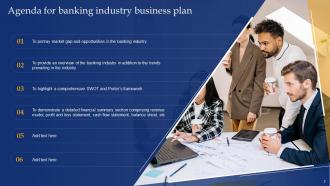
Slide 2: This slide depicts the Agenda of the presentation.
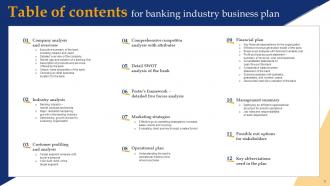
Slide 3: This slide incorporates the Table of contents.
Slide 4: This slide highlights the Title for the Topics to be covered further.
Slide 5: This slide presents the Executive summary of the bank including mission and vision.
Slide 6: This slide showcases a Detailed overview of the bank.
Slide 7: This slide portrays the Market gap and opportunity of a banking firm.
Slide 8: This slide displays the Description of products and services offered by the bank.
Slide 9: This slide mentions the Unique value proposition of the bank.
Slide 10: This slide depicts the Heading for the Contents to be discussed next.
Slide 11: This slide portrays the Unique value preposition of the bank.
Slide 12: This slide reveals the Market analysis and trends of the Banking industry.
Slide 13: This slide continues the Market analysis and trends of the Banking industry.
Slide 14: This slide shows the Major restraints hampering growth in the banking industry.
Slide 15: This slide deals with Determining growth drivers for a banking organization.
Slide 16: This slide depicts the Title for the Ideas to be covered in the following template.
Slide 17: This slide displays the Target segment analysis with buyer’s persona.
Slide 18: This slide continues the Target segment analysis with buyer’s persona.
Slide 19: This slide mentions about the TAM SAM SOM of the target segment.
Slide 20: This slide indicates the Heading for the Ideas to be discussed further.
Slide 21: This slide portrays the Comprehensive competitor analysis with attributes.
Slide 22: This slide continues the Comprehensive competitor analysis with attributes.
Slide 23: This slide reveals the Title for the Contents to be coveerd in the upcoming template.
Slide 24: The slide includes the strengths, weaknesses, opportunities, and threats analysis of the bank.
Slide 25: This slide portrays the Heading for the Topics to be discussed next.
Slide 26: The slide highlights porter’s framework and its implications in the banking industry.
Slide 27: This slide indicates the Title for the Contents to be covered in the next template.
Slide 28: This slide reveals the Effective go-to-marketing strategies to increase sales volume and revenue.
Slide 29: This slide focuses on Evaluating client journey through a sales funnel.
Slide 30: This slide presents the Heading for the Topics to be discussed further.
Slide 31: This slide emphasizes on Understanding the bank’s operational framework to ensure success.
Slide 32: This slide incorporates the Title for the Topics to be covered in the next template.
Slide 33: This slide states the Key financial assumptions of the organization.
Slide 34: This slide exhibits the Effective revenue generation model of the bank.
Slide 35: This slide continues the Effective revenue generation model of the bank.
Slide 36: This slide showcases the Break-even analysis with fixed and variable cost.
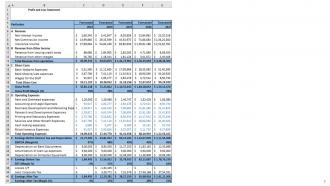
Slide 37: The slides provide a glimpse of the projected profit and loss statement to visualize the platform’s financial performance for the next five years.
Slide 38: This slide continues the projected profit and loss statement to visualize the platform’s financial performance for the next five years.
Slide 39: This is yet another slide continuing the projected profit and loss statement to visualize the platform’s financial performance for the next five years.
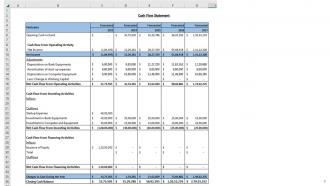
Slide 40: This slide reveals the Consolidated statements of cash flow of the bank.
Slide 41: This slide continues the Consolidated statements of cash flow of the bank.
Slide 42: The slides cover the snapshot of the company's financial position at a specific time.
Slide 43: This slide continues the Comparative balance sheet statement of the bank.
Slide 44: This slide exhibits the Scenario analysis with optimistic, pessimistic, and nominal cases.
Slide 45: This slide continues the Scenario analysis with optimistic, pessimistic, and nominal cases.
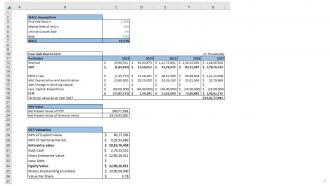
Slide 46: This slide reveals the Discounted cash flow valuation of the bank.
Slide 47: This slide portrays the Heading for the Ideas to be further discussed.
Slide 48: This slide focuses on Deploying an efficient organizational structure for smooth operations.
Slide 49: This slide showcases the Job roles and responsibilities of each department.
Slide 50: This slide continues the Job roles and responsibilities of each department.
Slide 51: This slide represents the Title for the Topics to be covered in the upcoming template.
Slide 52: This slide depicts the Possible exit options for stakeholders.
Slide 53: This slide displays the Heading for the Contents to be discussed further.
Slide 54: This slide elucidates the Key abbreviations used in the plan.
Slide 55: This is the Icons slide containing all the Icons used in the plan.
Slide 56: This slide is used for showcasing some Additional information.
Slide 57: This is the About us slide for stating the company-related information.
Slide 58: This slide incorporates the organization's mission, vision, and goals.
Slide 59: This slide elucidates information related to the Financial topic.
Slide 60: This is the 30 60 90 days plan slide for effective planning.
Slide 61: This slide is used for the purpose of Comparison.
Slide 62: This is the Puzzle slide with related imagery.
Slide 63: This is the Thank you slide for acknowledgement.
Business Plan For Banking Industry Powerpoint Presentation Slides with all 68 slides:
Use our Business Plan For Banking Industry Powerpoint Presentation Slides to effectively help you save your valuable time. They are readymade to fit into any presentation structure.































































FAQs for Business Plan For Banking Industry
Honestly, start with a killer executive summary - investors basically decide if they're gonna keep reading based on that first page. Then hit the big stuff: market analysis (show you actually know your customers, not just guessing), product description, marketing plan, operations, your team, and financials. Oh, and those financial projections? Keep them realistic. I've seen too many business plans with fantasy numbers that make no sense. Each section should connect to the next one naturally. Draft an outline first - it'll save you hours of rewriting later. The whole thing needs to tell one cohesive story about why your business will work.
Look, investors want proof you're not just making stuff up. Solid market data - size, demographics, competitors, trends - shows you actually get your space. It's like showing your work in math class instead of just writing the answer. Way more believable. Recent data from good sources matters too (nobody cares about 2019 stats anymore). The key is connecting those findings back to your actual business opportunity. When you can spot real threats and openings in your research, it builds trust in your judgment. Basically proves you won't crash and burn.
Okay so financial projections are basically your business plan in numbers - revenue, expenses, cash flow for the next 3-5 years. Without them, investors won't even bother looking at your stuff. But honestly? They're just as useful for YOU because you'll be forced to think through all your actual costs and pricing. That's when most people realize their profit margins are way smaller than they thought (happened to my cousin with her bakery idea). Start conservative and map out a few scenarios - best case, realistic, and oh-shit-everything-goes-wrong case. Makes you feel way more prepared.
Your business plan needs to nail "why you over everyone else?" - especially in the executive summary and market analysis parts. Figure out your customer's biggest headache first. Then show how you fix it better than competitors do. Honestly, skip the fluff words like "innovative" or "cutting-edge." Nobody cares about that stuff. Get specific about what actually sets you apart - maybe it's your tech, exclusive deals, or totally different approach to the problem. Here's my test: read your UVP to someone who doesn't know your industry. Do they instantly get why you're different? If yeah, you're golden.
First thing - just Google your competitors and scroll through their websites. I know it sounds basic, but you'd be surprised what you'll find. Check their pricing, what they're selling, how they market stuff. Social media stalking works too, honestly. Customer reviews are pure gold for spotting what they suck at. If you want to get fancy, SEMrush or Ahrefs are solid for seeing their online game. Mystery shopping is clutch if that's your thing. Make a simple chart comparing everyone side by side. The whole point? Figure out what makes you different so people pick you instead.
Look, you really need mission and vision statements - they're what keep you from making random decisions that don't make sense together. Your mission is basically why your business exists and what problem you're fixing. Vision is where you want to end up down the road. Honestly, investors can smell when there's no clear direction from a mile away. I'd write these first, then let them guide everything else - your strategy, marketing, all that stuff. They're kind of like the foundation for your whole plan. Without them you're just winging it.
Honestly, the biggest mistake is being way too rosy with revenue projections - I've seen so many people do this. Do your market research properly first. Vague plans are the worst too. Like, don't just throw out "we'll grab 1% of the market" without actually explaining how you plan to do that. Costs always end up higher than you think, especially marketing stuff. Your executive summary needs to be solid since that's literally all most investors read anyway. Don't spend months perfecting everything before showing anyone - get some friends to tear it apart first and point out where you're being unrealistic.
Figure out who you're actually selling to first - like where do these people spend their time online? Budget for your main channels (social, email, partnerships) though honestly I always screw this part up at first. What makes you different from everyone else? Nail that message down. Set real goals with numbers - maybe 30% more brand awareness by end of Q1. Timeline everything out with specific tactics. The whole thing needs to connect back to how much money you want to make, obviously. Don't overcomplicate it.
Honestly, you can't skip figuring out your target audience - it affects literally everything else. Your pricing, marketing, even which features to build. Without it, you're just guessing and probably wasting money. I've seen too many people skip this step and regret it later. You need those specifics for market size, competition research, all your revenue forecasts. Plus investors want proof there's actual demand. Get detailed about demographics and pain points. The more specific your customer profiles are, the stronger everything else gets. It's like the foundation of your whole plan.
OK so think movie trailer vibes - hit them with the problem first, then your solution and who you're targeting. Competitive advantage comes next. Each part should be like 2-3 sentences tops, don't go crazy with details. Financial stuff and funding needs go toward the end because honestly, numbers mean nothing without context first. Write the executive summary last even though it sits at the front of your deck. Oh and make sure your mom could read it and actually get what you're doing - industry jargon kills these things.
For forecasting, Excel or Google Sheets work great - most investors expect spreadsheets anyway. LivePlan and PlanGuru have nice templates if you want something fancier, but honestly? I've watched people waste weeks obsessing over complex software when a solid spreadsheet gets the job done. Start with basic revenue, expenses, and cash flow projections. You can grab market data from IBISWorld reports or hit up SCORE mentors (they're surprisingly helpful). My buddy went crazy with some expensive tool last year and still ended up redoing everything in Excel. Keep it simple first, then add bells and whistles later.
Honestly, visuals are a game changer for business plans. Investors see so many boring text walls - charts and graphs instantly make your financials way easier to digest. Infographics work great for market stuff too. I'd definitely include product photos or mockups if you have them, adds credibility. Your team photo helps people connect with who's actually building this thing. Just don't go overboard with random graphics that don't mean anything. Each visual should actually back up your main points. Makes everything more memorable and shows you put thought into presentation.
So basically, startup plans are all about proving your idea won't totally flop - you're trying to validate the market and scrape together some initial funding. Growth plans? Those are for when you've actually got customers and money coming in. Now you're figuring out how to get bigger - maybe expand to new markets or launch different products. The growth plan gets way more detailed about operations and hiring people (finally!). Startup plans ask "will this even work?" while growth plans ask "how do we scale this thing?" If you're not surviving on instant ramen anymore, you probably need the growth version.
Honestly, treat your business plan like it's alive - check it every quarter instead of letting it rot in some file. COVID taught me that lesson the brutal way! Map out backup plans for different scenarios because stuff happens. Monthly check-ins are huge for this. You can tweak your target market, adjust money projections, whatever needs fixing. Watch your industry trends and actually listen to what customers are saying. It's more like adjusting your route when you're driving, not completely starting the trip over from scratch.
Focus on both money stuff and day-to-day operations. Revenue growth, profit margins, cash flow - those are no-brainers. Customer retention and market share matter just as much though, since they show if your strategy actually makes sense. I always tell people to watch leading indicators too, like website traffic or your sales pipeline. Honestly, pick maybe 5-7 metrics max that fit your goals and check them monthly. More than that? You'll drive yourself crazy trying to track everything.
-
Professionally designed slides with color coordinated themes and icons. Perfect for enhancing the style of the presentations.
-
It is my first time working with them and that too on a friend's recommendation. I would say, I am not expecting such a worldly service at this low price.