


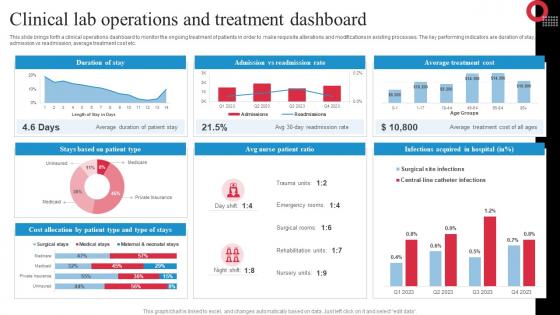
Clinical Lab Operations And Treatment Dashboard




Try Before you Buy Download Free Sample Product
 Impress Your
 Audience
 100%
100% Editable
 Save Hours
 of Time


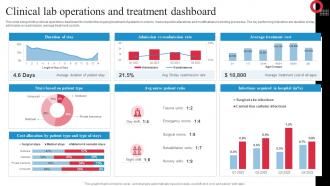
This slide brings forth a clinical operations dashboard to monitor the ongoing treatment of patients in order to make requisite alterations and modifications in existing processes. The key performing indicators are duration of stay, admission vs readmission, average treatment cost etc.
People who downloaded this PowerPoint presentation also viewed the following :
Clinical Lab Operations And Treatment Dashboard with all 7 slides:
Use our Clinical Lab Operations And Treatment Dashboard to effectively help you save your valuable time. They are readymade to fit into any presentation structure.





FAQs for Clinical Lab Operations
Okay so basically you're juggling a million things at once - quality control, compliance stuff, managing people, budgets. The CLIA and CAP requirements alone could drive you crazy. Daily life means scheduling, inventory, new tech rollouts, fixing broken equipment (there's always something). Plus you're constantly translating between your lab team and admin, which is... fun. Building solid relationships with staff makes everything easier though. Industry changes happen fast so staying updated is crucial. Honestly? Don't try mastering everything day one. Pick one area, get good at it, then expand. You'll burn out otherwise.
Look, communication fixes like 90% of lab workflow problems. Set up clear protocols for critical values and regular check-ins with nursing - sounds boring but it works. Use the same terminology so everyone's on the same page about samples and results. Honestly? Most "urgent" calls happen because someone didn't communicate upfront. Structured handoffs are a game changer. Your team can actually tell providers about specimen issues or delays without everything turning into chaos. Fewer errors, less stress, smoother days. Trust me on this one.
Dude, tech totally transforms lab work - cuts out so much tedious stuff and prevents those annoying human errors. LIMS systems handle all your specimen tracking, automated analyzers do the heavy lifting on tests, and integration software connects everything together. Honestly can't picture going back to doing this manually! The magic happens when it all talks to each other seamlessly. Oh, and don't try to fix everything at once - figure out what's slowing you down most and tackle that first. Way less overwhelming that way.
Run QC samples every shift start and when reagent lots change - that's your baseline. Westgard rules will catch systematic errors, but honestly, half the staff just goes through the motions without understanding the control charts. Document everything because auditors eat that up. Throw in some blind QC samples to keep techs on their toes. Don't let people just rerun failed QC until it magically passes - we've all seen that happen. Set up clear protocols for when things go sideways. Train everyone on proper corrective actions so you're not panicking at 2am trying to figure out what went wrong.
Honestly, just bake it into your daily routine instead of panicking before inspections. Do regular internal audits and document everything - I mean everything. Train your staff on current regs and keep those SOPs updated where people can actually find them. Pick someone to be your compliance person who tracks regulatory changes (trust me, this saves so much headache). Quality control works best when it's constant, not crammed. Oh, and make a compliance calendar mapping out required activities for the year - sounds boring but you'll thank yourself later. Track your corrective actions too.
Start with tracking whatever's been driving you crazy - maybe specimen rejections or how long results take. The numbers actually tell you so much once you dig in. Equipment downtime is huge for spotting bottlenecks. Delta checks are great for catching errors before they mess with patient care. I honestly didn't realize how useful reference range data could be until I started paying attention to it. Critical value notifications too - track those turnaround times. It's wild how patterns emerge when you look at this stuff systematically. Don't try to measure everything at once though, you'll burn out.
Start with competency-based programs that actually match what each role needs. I'd build individual development plans and track everything with skills matrices - sounds fancy but it's pretty straightforward. Mix hands-on training with online stuff and pair people with mentors. Cross-training is honestly a lifesaver when someone calls out sick. Document it all since inspectors love that paperwork trail. Don't just do this during onboarding though - that's where most places mess up. Schedule regular check-ins and push continuing education. It keeps people sharp and way more engaged than you'd expect.
Honestly, get an automated system that tracks what you're actually using and sets reorder points. Most labs do just-in-time for stuff they burn through quickly, but keep safety stock for the critical reagents. Trust me on this - I've watched too many labs panic during supply shortages! Don't put all your eggs in one basket with vendors either. The trick is getting your team to actually scan items when they grab them (good luck with that lol). Start by sorting everything into critical vs. nice-to-have, then focus your energy on tracking the expensive or mission-critical stuff first.
Dude, get accredited ASAP. CAP or CLIA will make doctors actually trust your results, which means way more referrals. Insurance companies won't even look at you without it - learned that the hard way. I know a lab that literally doubled their business after getting certified because suddenly they weren't just some random place anymore. The paperwork sucks, not gonna lie. Takes forever too, like 6+ months. But honestly? Best investment you'll make. Physicians start sending patients your way once you've got that stamp of approval.
Honestly? Build in flexibility from the start or you'll regret it. Create workflows that can handle new equipment without a complete overhaul. Train your staff on fundamentals, not just how to push buttons on specific machines. Budget for regular tech updates and find vendors who actually offer decent upgrade paths. Also develop some kind of formal process for evaluating new equipment - do the math on costs vs benefits before you buy. Don't chase every flashy new gadget, but don't let your lab become a museum either. It's all about balance really.
Honestly, it all comes down to patient safety vs keeping things running smoothly. Your decisions should improve patient care, not hurt it - and don't mess with your staff's wellbeing either. I've watched places try to cut costs on testing speed or accuracy and it always blows up in their faces. Privacy's massive too, especially with how you handle data and results. Make sure you're being fair to everyone - patients and staff alike. Oh, and watch out for sketchy vendor relationships when you're picking new tech. Quick test: would you feel comfortable explaining your choice to a regulator? If not, probably reconsider.
Honestly, it's all about not treating people like cattle. Clear pre-test instructions are huge - nobody wants to mess up their fasting because the directions were confusing. Online scheduling is a must these days, and real-time result notifications through patient portals save everyone headaches. Your waiting room shouldn't feel like purgatory either. Good phlebotomists who actually explain what they're doing make a world of difference - some people are terrified of needles. When results come back, don't just dump raw data on them. Explain what it actually means! Survey your current patients first though, see what's driving them crazy.
Start by tracking your costs super granularly - department by department, test volumes, reagents, all of it. Monthly variance reports will be your lifeline (trust me on this). Excel pivot tables are honestly a godsend for spotting trends. Set up KPIs like cost-per-test and revenue-per-FTE to see how you stack up against industry benchmarks. Have regular forecasting meetings with your team so you can catch budget issues before they spiral. The biggest wins come from lean principles - cutting reagent waste and smoothing out workflows. Those small efficiency tweaks? They add up fast.
Build safety right into everything from day one - don't just slap it on later. Train your staff properly on PPE, specimen handling, all that stuff, then actually make them follow it. I swear, labs get way too relaxed about basic things like washing hands and tossing hazardous waste correctly. Monthly safety meetings help keep people engaged. You'll want regular audits too. Chemical storage has to meet regs, keep equipment maintained, have solid protocols for when someone gets exposed. Oh, and create an environment where people can report close calls without getting in trouble - that's huge for catching problems early.
So automation is everywhere right now - labs are going full auto to deal with staffing issues and pump up throughput. AI diagnostics are blowing up too. Point-of-care testing keeps expanding, and these integrated platforms now connect lab results straight to patient decisions. Remote monitoring's changing everything with telehealth integration. Oh, and personalized medicine is creating demand for way more specialized tests. Honestly feels like healthcare tech finally caught up to everyone else! You should probably start figuring out how your current systems work with this stuff because the labs that adapt quickest are gonna dominate.
-
The information is visually stunning and easy to understand, making it perfect for any business person. So I would highly recommend you purchase this PPT design now!
-
I'm happy to discover your PowerPoint presentations and templates. They met my expectations precisely. Very innovative!