

Clothing And Fashion Industry Business Plan Powerpoint Presentation Slides





Try Before you Buy Download Free Sample Product
 Impress Your
Audience
 100%
Editable
 Save Hours
of Time


A clothing store business is a place where clothing related to men, women, and children is sold. The store follows urban casual wear, western wear clothing, and traditional wear clothing. Check out our efficiently designed Clothing and Fashion Industry Business Plan PowerPoint presentation. This presentation covers details regarding the company executive summary, the quick pitch providing information about the business, the clothing market, and the opportunities available with the business. It displays the key to success factors, mission, vision, and the start up summary, including all the necessary expenses. The business plan presentation exhibits the growth potential analysis, including SWOT analysis and Porters five force analysis model, customer analysis, and market sizing, including TAM, SAM, and SOM. The plan also has an offline and online marketing strategy, and a sales funnel for customer retention. The financial summary includes the basic assumptions which are used for estimating the future, scenario analysis showing nominal, optimistic, and pessimistic cases, profit and loss statement, cash flow statement, balance sheet, and providing a DCF valuation model for the business after five years with a graphical representation of all the three financial statements. Get access now.
People who downloaded this PowerPoint presentation also viewed the following :
Content of this Powerpoint Presentation
Slide 1: This slide displays the title Clothing and Fashion Industry BUSINESS PLAN.
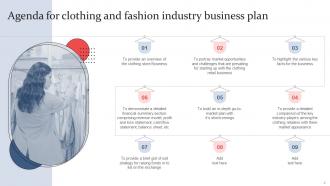
Slide 2: This slide displays the title Agenda for clothing and fashion industry business plan.
Slide 3: This slide exhibit table of content.
Slide 4: This slide exhibit table of content- Company Details.
Slide 5: This slide covers a brief glimpse of what the business will be offering to the customer with market information.
Slide 6: This slide covers a brief glimpse of what the quick pitch of the business to the customers with market information.
Slide 7: This slide provides a detailed information about the business’s incorporation, location, web-address, target market, and about the business.
Slide 8: This slide provides a gist of products and services which the business will offer along with the revenue assumptions for the future growth of the business.
Slide 9: This slide provide a gist about the business mission and vision.
Slide 10: This slide provides a gist for the customers, why to buy products from the store.
Slide 11: This slide exhibit table of content- Company Overview.
Slide 12: This slide provides a gist of company start-up summary.
Slide 13: This slide provides a gist of company key to success.
Slide 14: This slide exhibit table of content- Industry Analysis.
Slide 15: This slide highlights the market gap which the industry is undergoing.
Slide 16: This slide highlights the market gap which the industry is undergoing.
Slide 17: This slide provides a detailed information about the market opportunity.
Slide 18: This slide provides a detailed information about the business’s milestone, the business’s five year growth plan and it’s sales assumption to achieve.
Slide 19: This slide exhibit table of content- Market Performance.
Slide 20: This slide provides a glimpse of industry overview of the global clothing market.
Slide 21: This slide provides a glimpse of market overview concerning with the US clothing market, its growth, demand and future forecast.
Slide 22: This slide provides a glimpse of industry overview concerning with the US clothing e-commerce market, its growth, demand in future.
Slide 23: This slide provides a glimpse of industry overview concerning with the men clothing market, its growth, demand in future.
Slide 24: This slide provides a glimpse of industry overview concerning with the women clothing market, its growth, demand in future.
Slide 25: This slide provides a glimpse of industry overview concerning with the family clothing market, its growth, demand in future.
Slide 26: This slide provides a competitive framework of clothing brand competitive analysis within the already existing market in the USA.
Slide 27: This slide provides a glimpse of industry highlights of the clothing market.
Slide 28: This slide provides a glimpse of industry highlights of the clothing market.
Slide 29: This slide provides a brief gist of industry restraints of the US clothing market.
Slide 30: This slide provides a brief gist of industry restraints of the US clothing market.
Slide 31: This slide exhibit table of content- Customer Analysis.
Slide 32: This slide provides a brief gist of customer analysis of the clothing store business.
Slide 33: This slide exhibit table of content- Growth Potential Analysis.
Slide 34: This slide provides detailed information on porter’s framework.
Slide 35: The slide highlights a swot analysis of the clothing business.
Slide 36: This slide exhibit table of content- Marketing Plan.
Slide 37: This slide provides a brief of go-to-marketing strategies which the company will follow to capture the market.
Slide 38: This slide provides a brief of go-to-marketing strategies which the company will follow to capture the market.
Slide 39: This slide provides a brief of sales strategies which the business will follow to retain and attract the customers.
Slide 40: This slide exhibit table of content- Financial Summary.
Slide 41: This slide represents financial assumptions of the clothing store business plan.
Slide 42: This slide presents revenue model of clothing retail business.
Slide 43: This slide represents breakeven graph.
Slide 44: This slide represents breakeven graph.
Slide 45: This slide represents profit and loss statement.
Slide 46: This slide represents graphs of gross profit of the business and earnings before interest tax & depreciation.
Slide 47: This slide represents graphs of total revenue from operations and earnings after tax.
Slide 48: This slide represents the business’s historical and forecasted cash flow results and the amount of cash the business will introduce to starts its operations.
Slide 49: This slide represents a graph on cash flow analysis and total assets.
Slide 50: This slide represents balance sheet statement.
Slide 51: This slide represents a graph on cash flow analysis and total assets.
Slide 52: This slide represents the different scenarios for deriving final annual profit after tax on the basis of best case, nominal case and worst case.
Slide 53: This slide presents a scenario analysis of annual revenue break-even, annual profit after tax and break-even analysis.
Slide 54: This slide represents the DCF valuation analysis of a business’s financials based on the free cash flow to firm.
Slide 55: This slide exhibit table of content- Management Summary.
Slide 56: This slide represents organizational structure of the business.
Slide 57: This slide represents organizational structure of the business.
Slide 58: The slide highlights the professional summary section of the café. It will include educational background and work experience of the key management.
Slide 59: This slide exhibit table of content- Exit Strategy for the Business Stakeholders.
Slide 60: This slide represents exit strategy for stakeholders such as venture capitalists, private offerings and initial public offer.
Slide 61: This is the icons slide.
Slide 62: This slide presents title for additional slides.
Slide 63: This slide depicts posts for past experiences of clients.
Slide 64: This slide depicts Financial.
Slide 65: This slide displays yearly bar graph for different products.
Slide 66: This slide exhibits yearly profits stacked line charts for different products.
Slide 67: This slide displays Venn.
Slide 68: This slide shows roadmap of company.
Slide 69: This slide exhibits yearly timeline of company.
Slide 70: This slide showcase Magnifying glass.
Slide 71: This slide exhibits ideas generated.
Slide 72: This is thank you slide & contains contact details of company like office address, phone no., etc.
Clothing And Fashion Industry Business Plan Powerpoint Presentation Slides with all 77 slides:
Use our Clothing And Fashion Industry Business Plan Powerpoint Presentation Slides to effectively help you save your valuable time. They are readymade to fit into any presentation structure.








FAQs for Clothing And Fashion Industry Business Plan
Okay so definitely hit the basics first - executive summary, market analysis, who you're actually selling to, and all your product details. Your brand positioning matters a ton, plus pricing and whether you're doing retail, online, whatever. Financial stuff is huge - startup costs, cash flow projections (investors are obsessed with realistic numbers). Marketing plan and competitive analysis too. Oh and honestly? Timeline and seasonal planning are everything in fashion since trends move crazy fast. Supply chain approach is key, and if you're doing any sustainability stuff, definitely include that since it's such a thing now.
Honestly, market research is everything for your clothing business. It shows you who'll actually buy your stuff and what they're willing to spend. Use that info to pick your target customers, set prices that make sense, and figure out where to sell. Your research might even change what you design - like, no point making expensive pieces if everyone wants cheap basics. Plus you need those numbers for realistic sales projections anyway. Start with surveys and check out your competition. That becomes your whole game plan basically.
Okay so first figure out the basics - age, income, where they live. But honestly that's just scratching the surface. What you really want to know is their lifestyle and values, like what actually motivates them to buy stuff. Think about their shopping habits too - are they impulse buyers or do they research everything? Where do they spend time online? That info is super valuable later for marketing. Oh and definitely look at what frustrates them about current fashion options. Once you have all that, make detailed buyer personas so your team can picture exactly who they're creating for.
Your unique value prop is basically the "why should I care?" answer customers need. What actually sets you apart from everyone else? Could be sustainable materials, inclusive sizing, cool tech stuff - whatever solves a problem others ignore. But skip the generic "quality clothes" thing since literally everyone claims that. Here's the test: can you explain it to your mom in one sentence? That's honestly harder than it sounds. Figure out the specific thing your customers can't get anywhere else, then make sure it shows up in your marketing and products. Simple as that.
Dude, you literally can't launch a fashion brand without some sustainability angle now. Customers expect it, investors demand it. Recycled materials, ethical manufacturing, rental models - pick your poison. The shift happened crazy fast too, like within the last 3-4 years. What's nuts is brands ignoring this are actually getting dropped by suppliers and customers alike. Not just a marketing thing anymore. My advice? Build it into your strategy from the start. Way easier than trying to retrofit later when you're already deep into operations.
So first figure out all your costs - materials, labor, overhead stuff, then add your markup on top. Research what competitors are charging so you know where to position yourself. Fashion's super tricky because trends flip so fast! You'll need a plan for markdowns and seasonal sales too. If you're going luxury, explain that premium positioning. Oh and if you're doing both retail and wholesale, make sure those pricing tiers make sense. Basically just show investors you get your margins and won't panic when the market shifts.
Instagram and TikTok are your best bet honestly - fashion just pops on those platforms. Start with micro-influencers in your space since they're way more affordable and their followers actually engage. Don't sleep on email marketing either (sounds boring but it converts like crazy). Facebook and Google ads work great once you figure out who you're targeting, but I'd go organic first. You need to understand your audience before throwing money at ads, you know? Oh and pick like 1-2 channels max when you're starting. Trying to be everywhere at once is exhausting and doesn't work.
Pick 3-4 major behavior shifts hitting your target customers first - sustainability obsessions, Instagram shopping, body positivity, whatever fits. Then connect those directly to your actual business moves: what products you make, how you price them, where you advertise. Most fashion brands screw this up badly by treating trends like afterthoughts instead of the foundation. Update your analysis every quarter because fashion moves ridiculously fast. Oh, and track specific numbers so you know if you're actually nailing these trends or just guessing.
You'll want 3 years of revenue projections, startup costs, and ongoing expenses. Break revenue down by product lines and seasons - fashion's super cyclical so this matters. Inventory costs are massive btw, they'll destroy your cash flow if you're not careful. Don't forget marketing spend, manufacturing, rent, staff costs. The seasonal swings honestly kill most fashion startups financially. Build cash flow projections too, not just P&L. Oh and be conservative with sales estimates - way better to underpromise than oversell to investors and look like an idiot later.
Dude, tech is a total game-changer for fashion businesses. E-commerce platforms let you sell directly to customers everywhere without dealing with retailers taking their cut. Instagram's basically become the main way people discover brands now - influencer collabs are huge. You can use data to spot trends early and figure out what customers actually want. AR try-on stuff is pretty cool for reducing returns too, though I'm not sure how much people actually use it yet. My advice? Don't go crazy trying every new tool. Pick maybe two things that'll solve your biggest headaches first.
Honestly, most people totally lowball their startup costs. Fabric, manufacturing, inventory - it all adds up way faster than you think. And please don't just assume customers will magically find you once you launch. That never works. I get that market research sounds boring as hell, but you've got to know who you're selling to and what competitors are charging. Skip this and you're basically guessing at everything. Oh, and resist the urge to go big right away. Perfect your first collection with whatever budget you have, then expand from there.
Dude, branding is everything in fashion. Like, it's literally why people pay $200 for a basic tee when they could get one for $20 at Target. You're not just selling clothes - you're selling a vibe, an identity. People get emotionally attached to brands that speak to them. That connection is what keeps them loyal and coming back for more. Without it? You're just another clothing company fighting over price, which honestly sucks. Figure out your brand's personality first - then make sure everything from your logo to your social media reflects that. It's way harder to rebrand later.
Track the money stuff first - revenue per customer, margins, inventory turnover. That's what actually matters. Social media engagement and brand awareness surveys are cool too, but honestly I'd get way too caught up in Instagram likes if I were you lol. Customer lifetime value is huge though, don't sleep on that. Return rates and how long it takes to get from design to shelves matter more than people think. Just pick like 5-7 things you can actually check monthly without losing your mind, then add more later.
Honestly, working with influencers is such a game-changer because their followers actually trust what they recommend. Way better than running regular ads that people just scroll past. Find someone whose vibe matches your brand - don't just go for whoever has a million followers, you know? Micro-influencers are where it's at. Their engagement rates are usually way higher and they won't cost you an arm and a leg. Plus they'll create tons of content from one collab - stories, posts, styling videos. I'd start reaching out to smaller accounts in your niche first.
Dude, you've gotta plan for when everything goes to hell. Remember COVID? Factories shut down overnight and suddenly everyone wanted sweatpants. Trade wars can make your overseas production costs explode without warning. Natural disasters, recessions, political chaos - they all screw with your supply chain and how much people want to spend. Honestly, the fashion industry is brutal when global stuff hits the fan. Always have backup suppliers ready to go. Don't put all your production in one country - spread it around. Keep some emergency cash stashed away because you'll need it eventually. Having contingency plans before disaster strikes is everything.
-
This design is not only aesthetically pleasing but it has many uses making the cost worthwhile. The graphics look stunning, and you can edit them as per your needs.
-
I want to express my gratitude to SlideTeam’s presentation design services team for helping me create the best presentation of my life!