

Cloud service models it use cases of cloud computing to achieve business goals




Try Before you Buy Download Free Sample Product
 Impress Your
 Audience
 100%
100% Editable
 Save Hours
 of Time


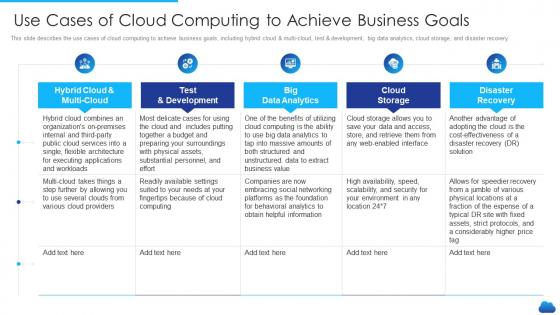
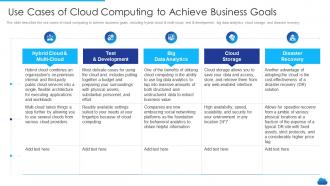
This slide describes the use cases of cloud computing to achieve business goals, including hybrid cloud and multi-cloud, test and development, big data analytics, cloud storage, and disaster recovery.
People who downloaded this PowerPoint presentation also viewed the following :
Cloud service models it use cases of cloud computing to achieve business goals with all 9 slides:
Use our Cloud Service Models It Use Cases Of Cloud Computing To Achieve Business Goals to effectively help you save your valuable time. They are readymade to fit into any presentation structure.








FAQs for Cloud service models it use cases of cloud computing to
IaaS provides virtualized computing infrastructure like servers and storage, PaaS offers development platforms with built-in tools and frameworks, while SaaS delivers complete software applications accessible via web browsers. These models enable organizations to scale operations strategically, with many enterprises finding that combining approaches streamlines resource allocation, reduces infrastructure costs, and accelerates deployment across different business functions.
Cloud service models significantly transform application development by offering Infrastructure as a Service (IaaS) for flexible resource management, Platform as a Service (PaaS) for streamlined development environments, and Software as a Service (SaaS) for ready-to-use solutions. These models enable faster deployment cycles, reduced infrastructure overhead, and enhanced scalability, with many organizations finding that strategic model selection ultimately delivers competitive advantages and accelerated time-to-market.
Organizations should consider security requirements, compliance mandates, cost constraints, scalability needs, and existing infrastructure when choosing cloud models. While public clouds offer cost efficiency and rapid scaling, private clouds provide enhanced security control, and hybrid approaches enable strategic workload distribution, with many enterprises finding that hybrid solutions deliver optimal flexibility while maintaining regulatory compliance and operational efficiency.
Compliance and regulatory requirements significantly influence cloud model selection by determining data residency needs, security controls, and audit capabilities required for specific industries. Financial services often choose private clouds for sensitive data handling, while healthcare organizations leverage hybrid models to balance HIPAA compliance with operational efficiency, ultimately enabling regulatory adherence without sacrificing competitive advantage.
SaaS presents unique security challenges including data sovereignty concerns, limited visibility into provider security controls, integration vulnerabilities, and shared responsibility complexities. While organizations benefit from reduced infrastructure management, they must navigate compliance requirements, data encryption protocols, and access management across multiple applications, with many enterprises finding that strategic vendor assessment and robust identity governance ultimately deliver enhanced security posture.
IaaS offers maximum scalability control through direct infrastructure management, allowing precise resource allocation and custom configurations. PaaS provides automated scaling with built-in load balancing and resource optimization, while SaaS delivers seamless user-level scaling without technical overhead, with many organizations finding that combining these models strategically enhances operational efficiency and competitive advantage.
IaaS typically involves pay-per-resource billing for computing power, storage, and networking, offering granular cost control but requiring more management overhead and potential over-provisioning expenses. PaaS generally features usage-based pricing that includes development tools and runtime environments, streamlining costs by eliminating infrastructure management while potentially increasing per-unit expenses, with many development teams finding that PaaS delivers faster deployment and reduced operational complexity.
APIs serve as essential integration bridges between IaaS, PaaS, and SaaS models, enabling seamless data exchange, service orchestration, and workflow automation across different cloud layers. Through standardized API frameworks, organizations streamline multi-cloud operations, enhance interoperability between platforms like AWS and Azure, and ultimately deliver unified customer experiences while reducing operational complexity.
Organizations can effectively manage vendor lock-in through multi-cloud strategies, standardized APIs, containerization technologies, and maintaining portable data architectures across different service models. By implementing hybrid approaches that distribute workloads strategically, companies in sectors like financial services and healthcare reduce dependency risks while preserving flexibility, ultimately delivering greater negotiating power and operational resilience.
Businesses benefit from multi-cloud strategies when seeking vendor diversification, specialized services, and risk mitigation across different operational needs. Organizations leverage Infrastructure-as-a-Service for scalable computing, Platform-as-a-Service for development environments, and Software-as-a-Service for specific applications, ultimately delivering enhanced flexibility, reduced vendor lock-in, and optimized cost management across diverse business functions.
Cloud service models significantly influence disaster recovery by providing automated backups, geographic redundancy, rapid scalability, and faster recovery times compared to traditional on-premises solutions. Financial services, healthcare organizations, and retail companies increasingly leverage cloud-based disaster recovery to minimize downtime, reduce infrastructure costs, and ensure seamless business continuity, ultimately delivering enhanced operational resilience and competitive advantage.
Emerging cloud trends include edge computing integration, serverless architectures, multi-cloud strategies, AI-as-a-Service platforms, and hybrid cloud optimization. These developments streamline operations by reducing latency, minimizing infrastructure management, and enhancing scalability, with many organizations finding that strategic combinations ultimately deliver faster services, lower operational costs, and significant competitive advantages.
Performance levels in cloud service models vary significantly based on control and resource allocation, with IaaS offering the highest customization for optimization, PaaS providing balanced performance with managed infrastructure, and SaaS delivering standardized performance with limited customization options. High-traffic applications in sectors like e-commerce and financial services increasingly favor IaaS for maximum control, while PaaS streamlines deployment, ultimately enabling organizations to balance performance requirements with operational complexity.
Common misconceptions include believing all cloud models offer identical security levels, assuming SaaS eliminates all IT responsibilities, thinking hybrid clouds are always complex, and expecting immediate cost savings without strategic planning. These misunderstandings can lead to poor vendor selection, inadequate compliance preparation, and unrealistic ROI expectations, with many organizations finding that proper education and phased implementation ultimately deliver better outcomes and competitive advantage.
IT teams assume varying responsibility levels across cloud models, with IaaS requiring comprehensive infrastructure management, PaaS focusing on application development and deployment, and SaaS emphasizing user management and integration. While IaaS teams handle servers, networking, and security configurations, PaaS enables developers to streamline application building, and SaaS allows teams to concentrate on strategic initiatives rather than technical maintenance.
-
It saves your time and decrease your efforts in half.
-
Best Representation of topics, really appreciable.
-
Designs have enough space to add content.
-
Easily Understandable slides.