


Company lean transformation and agile journey




Try Before you Buy Download Free Sample Product
 Impress Your
 Audience
 100%
100% Editable
 Save Hours
 of Time


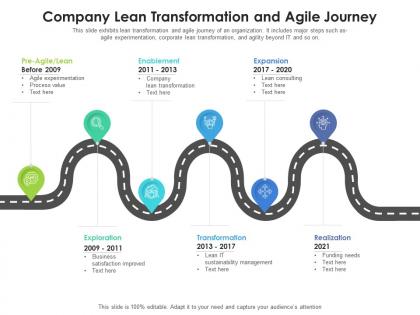
This slide exhibits lean transformation and agile journey of an organization. It includes major steps such as-agile experimentation, corporate lean transformation, and agility beyond IT and so on.
People who downloaded this PowerPoint presentation also viewed the following :
Company lean transformation and agile journey with all 2 slides:
Use our Company Lean Transformation And Agile Journey to effectively help you save your valuable time. They are readymade to fit into any presentation structure.

FAQs for Company lean transformation
Lean Agile Transformation principles include customer-centricity, continuous value delivery, cross-functional collaboration, iterative development, and adaptive planning, fundamentally shifting from rigid hierarchical approaches to flexible, responsive frameworks. Unlike traditional waterfall methodologies that emphasize extensive upfront planning and sequential phases, these principles enable organizations to respond quickly to market changes, reduce waste, and deliver meaningful results faster, with many enterprises finding that this approach significantly enhances operational efficiency and competitive advantage.
Organizations assess Lean Agile readiness by evaluating current culture, leadership commitment, team capabilities, existing processes, and change management capacity. Through comprehensive maturity assessments, stakeholder interviews, and organizational health checks, companies identify transformation barriers and opportunities, while establishing baseline metrics, ultimately enabling strategic roadmap development that ensures sustainable adoption across departments and maximizes competitive advantage.
Key metrics include cycle time, lead time, team velocity, customer satisfaction scores, defect rates, and employee engagement levels. These measurements enable organizations to track operational efficiency, delivery speed, and quality improvements across development teams, with many enterprises finding that combining quantitative performance data with qualitative feedback delivers comprehensive insights into transformation success and competitive advantage.
Leadership and culture are fundamental to Lean Agile success, with leaders setting strategic direction, removing impediments, empowering teams, and fostering psychological safety throughout the organization. Cultural transformation requires consistent messaging, transparent communication, and celebrating incremental wins, with many organizations finding that executive sponsorship and middle management alignment ultimately determine whether teams can sustain continuous improvement and deliver enhanced customer value.
Cross-functional teams can be structured by combining diverse skill sets from development, operations, quality assurance, business analysis, and product management within autonomous units. These teams enhance collaboration through shared ownership of outcomes, co-located workspaces, regular cross-training sessions, and unified success metrics, with many organizations finding that this structure accelerates decision-making while reducing handoffs and communication delays.
Common challenges during Lean Agile Transformation include resistance to cultural change, inadequate leadership support, siloed organizational structures, insufficient training, and unrealistic timeline expectations. These obstacles can be mitigated through comprehensive change management programs, executive sponsorship, cross-functional team formation, and phased implementation approaches, with many organizations finding that early wins and continuous coaching ultimately deliver sustainable transformation and competitive advantage.
Organizations balance agility with regulatory compliance by implementing compliance-by-design frameworks, automated compliance monitoring, and cross-functional teams that include regulatory experts from project inception. Industries like banking, healthcare, and pharmaceuticals increasingly adopt DevSecOps approaches, continuous documentation practices, and risk-based testing methodologies, ultimately enabling faster innovation cycles while maintaining strict regulatory adherence and reducing compliance costs.
Tools facilitating Lean Agile implementation include project management platforms like Jira and Azure DevOps, collaboration software such as Slack and Microsoft Teams, CI/CD tools like Jenkins, and visual management boards including Kanban systems. These technologies streamline workflow visibility, automate repetitive processes, and enhance cross-functional communication, with many organizations finding that integrated toolchains significantly accelerate delivery cycles while improving team alignment and operational efficiency.
Employee training integrates into Lean Agile transformation through cross-functional skill development, continuous learning frameworks, mentorship programs, and hands-on coaching during actual project cycles. Organizations like financial services and manufacturing companies find that embedding learning within daily workflows, rather than separate training sessions, accelerates adoption while building sustainable agile capabilities across teams.
Stakeholder engagement in Lean Agile environments ensures alignment between business objectives and development priorities, facilitates continuous feedback loops, and accelerates decision-making processes. Through regular collaboration and transparent communication, organizations streamline product development, reduce costly rework, and deliver customer-centric solutions more effectively, with many enterprises finding that engaged stakeholders ultimately drive faster time-to-market and enhanced competitive advantage.
Customer feedback loops accelerate Lean Agile transformation by enabling continuous product refinement, faster iteration cycles, and data-driven decision making throughout development processes. Organizations implementing these loops, particularly in software development and manufacturing sectors, experience reduced time-to-market, enhanced customer satisfaction, and improved product-market fit, ultimately delivering competitive advantage through responsive, customer-centric innovation.
Lean Agile Transformation fundamentally reshapes organizational structure by flattening hierarchies, promoting cross-functional collaboration, and establishing autonomous, self-organizing teams that operate with greater decision-making authority. This shift enhances team dynamics through improved communication, faster feedback loops, and shared accountability, with many organizations finding that departments become more interconnected and responsive to market changes, ultimately delivering increased innovation and operational efficiency.
Companies ensure continuous improvement post-transformation by establishing regular retrospectives, implementing feedback loops, maintaining cross-functional collaboration, and creating metrics-driven assessment cycles. Through structured review processes and adaptive planning, organizations in manufacturing, healthcare, and financial services continuously refine their practices, optimize resource allocation, and enhance operational efficiency, ultimately delivering sustained competitive advantage.
**INPUT**: What specific Lean practices are most effective when combined with Agile methods? **OUTPUT**: The most effective Lean practices for Agile integration include value stream mapping, continuous improvement (kaizen), waste elimination, visual management systems, and pull-based workflows. These strategic combinations streamline development processes by reducing bottlenecks, enhancing team transparency, and accelerating delivery cycles, with many software organizations finding that this integration delivers faster time-to-market and improved customer satisfaction. [Word count: 58 words]
Organizations create experimentation-supportive cultures by establishing psychological safety, implementing rapid feedback loops, celebrating intelligent failures, and rewarding learning over perfection. Through dedicated innovation time, cross-functional collaboration, and fail-fast methodologies, companies like Google and Amazon foster continuous improvement, ultimately delivering faster innovation cycles and competitive advantage in increasingly dynamic markets.
-
Excellent design and quick turnaround.
-
Helpful product design for delivering presentation.
-
Good research work and creative work done on every template.