

Company objectives powerpoint slide introduction




Try Before you Buy Download Free Sample Product
 Impress Your
 Audience
 100%
100% Editable
 Save Hours
 of Time


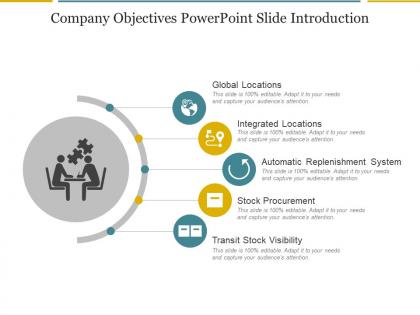
Presenting company objectives PowerPoint slide introduction to establish your company toward continuous success. With the help of this objective for a company PPT layout you can display the objectives that an organization wants to achieve and creating a well drafted plan is essential for the success. Our business goals and objectives presentation slide can be used to define the techniques your organization will use to achieve sales success, to enhance customer service standards and improve branding opportunities. You can also describe in this layout that revenues stay ahead of the costs of doing business and can put focus on controlling costs in both production and operations. This template can also be used to document your financial goals for a business where you can tell investors the financial targets of the company such as such percent growth in revenues and earnings within the next 12 to 24 months time frame. Download this strategic business objectives PowerPoint template and for more visit our website. Folks feel genuinely happy for you due to our Company Objectives Powerpoint Slide Introduction. It helps you convey your joy.
People who downloaded this PowerPoint presentation also viewed the following :
Company objectives powerpoint slide introduction with all 5 slides:
Cool down the air with our Company Objectives Powerpoint Slide Introduction. They are great at handling disputes.


FAQs for Company objectives
Honestly, focus on three big things: keeping customers happy, actually making sustainable money, and not having a toxic workplace. Growth is cool and all, but I've seen too many companies crash chasing revenue without those basics down. You'll also want to stay efficient and competitive - whether that's through innovation or just positioning yourself better than the other guys. Don't let quarterly pressure make you sacrifice your reputation or lose good people though. That stuff bites you later. I'd start by looking at what your leadership actually tracks and rewards.
Honestly, alignment is a game-changer but most companies mess it up. You want people focused on work that actually moves your business forward, not just busy work. Map out how each person's role connects to your main objectives - like, really spell it out for them. Short sentences work here. When employees see how their daily grind ties into the bigger picture, they're way more motivated. Plus you stop wasting resources on stuff that doesn't matter. It's basically getting everyone rowing in the same direction instead of just rowing harder. Start small though - pick one key objective and show people exactly how they impact it.
OKRs are huge right now, especially if you're in tech - they're basically objectives with measurable key results. SMART goals are the old reliable option that still works great. If you need to track different areas like finances and customer stuff, Balanced Scorecard might be your thing. Honestly though? The framework you pick doesn't matter nearly as much as actually sticking with it consistently. For getting everyone on board, just make sure each team level understands how their daily work ties back to the big company goals. I'd say pick whatever feels right for your culture and don't overthink it.
Honestly, it comes down to desperation vs. stability. Startups are scrambling to survive - they're hunting for product-market fit, chasing investors, growing like crazy no matter what it costs them. Meanwhile, big companies can actually think long-term about market expansion and making shareholders happy. Startups change direction every few months when they realize something isn't working. Pretty chaotic, but that's startup life. Enterprises? They've got the luxury of planning years ahead and sticking to it. One thing I've noticed - if you're working at a startup, build flexibility into whatever goals you set. Enterprise folks need everyone rowing in the same direction instead.
Honestly, market research is like having a reality check before you set your goals. It shows you what customers actually want instead of what you're guessing they want. You'll spot opportunities your competitors missed and figure out realistic demand numbers - way better than pulling revenue targets out of thin air and stressing your team later. The data also reveals external trends that could mess with your plans. I've seen too many companies set objectives based on their own wishful thinking rather than what's actually happening in the market. Always test your assumptions with real customer feedback first. Sounds obvious but you'd be surprised how many skip this step.
Look, when goals have actual numbers attached, nobody can wiggle out of accountability. Either you hit the target or you didn't - pretty black and white. It stops those weird conversations where someone's like "but I really tried!" without having anything concrete to show for it. Numbers don't lie, you know? Plus it makes it way easier to spot who actually needs help vs. who's just making excuses. I always tell my team - every goal needs a specific metric and a deadline. Otherwise you're just setting everyone up for confusion later.
Honestly, corporate culture is what decides if your goals actually happen or just die in some forgotten presentation. People work toward stuff when it feels right, not because someone told them to. I've watched companies with killer strategies completely bomb because their culture was trash - like wanting innovation but then freaking out over every tiny mistake. Makes no sense. Strong cultures though? They make people actually care about the objectives. My advice: check if your culture supports what you're trying to do. You'd be surprised how often they're working against each other.
When things get rough economically, forget aggressive growth - you've gotta think survival mode. Cash flow becomes everything, along with keeping your existing customers happy and cutting operational fat. I've watched so many businesses crash because they wouldn't ditch their pre-recession playbook. Build in flexibility with shorter planning cycles and have backup plans ready. Yeah, keep your long-term vision alive, but shift money toward stuff that actually keeps you afloat. Honestly, half the objectives most companies chase are just vanity metrics anyway. Figure out what's truly make-or-break versus what's just nice fluff.
Go with the "stretch but doable" thing - like 10-20% harder than what feels easy right now. Break those big scary goals into smaller pieces so you can actually see you're getting somewhere. I always start with whatever data you have from before, then bump it up based on new resources or changes you're making. Definitely get your team involved though - they'll shut down anything completely insane pretty fast lol. The goal is making everyone feel a little nervous but pumped, not like they want to quit. Oh, and short wins along the way keep morale up when the bigger picture feels overwhelming.
Look, those department silos are killing your productivity. Getting teams to actually work together means marketing finally knows what product is building, sales gets realistic timelines, and engineers understand why customers want weird features. Problem-solving gets so much better when people aren't working against each other. Plus you'll stop doing the same work twice - which honestly drives me crazy when I see it happen. Decision-making speeds up too. My advice? Don't overthink it. Just get two departments in the same room for your next project kickoff and see what happens.
Dude, sustainability is completely flipping how companies set their goals. Investors want it, customers expect it, and employees won't work somewhere that doesn't care - it's crazy how much power that last group has now. ESG scores matter just as much as revenue targets these days. Short-term thinking? That'll get you in trouble with regulators or cost you good people. My old company learned that the hard way. You can't treat profit and impact as separate things anymore. Figure out which green practices actually make sense for your business first, then track both the money and the mission stuff.
Pick 2-3 metrics per goal first - that's the sweet spot. Then grab tools that can auto-pull the data so you're not stuck updating spreadsheets every week (ugh). Monday.com and Asana are pretty solid for this stuff, though honestly most project management tools work fine. Your CRM probably has dashboards too if you're tracking sales-related goals. The trick is setting up those automated feeds upfront. Takes some time initially but saves you tons later. Just make sure you're tracking actual progress, not just feel-good numbers that don't mean anything. Display everything somewhere your team actually looks regularly.
Look, here's the thing - if you set goals that are way too ambitious, your team will just get crushed when they can't hit them. On the flip side, vague objectives leave people wandering around not knowing what they're actually supposed to accomplish. Both are terrible for morale, trust me on this one. When the pressure gets intense, unrealistic targets also make people take shortcuts they probably shouldn't. Set challenging goals that are actually doable. Be super specific about metrics and deadlines. Then test it - can everyone explain the goal back to you clearly? If not, you're not done yet.
Honestly, just start scheduling regular check-ins - maybe monthly or quarterly. Get feedback from your team, customers, whoever matters most to your goals. I swear, half the companies I know completely ignore this step and wonder why they're stuck. Don't be stubborn about your original plan either. Small tweaks beat massive yearly overhauls every time. The whole point is catching what's working (and what isn't) before you're too far down the wrong path. Book your first feedback session in the next month and go in with real questions about where you're at.
Start by figuring out who your key stakeholders actually are - that's half the battle right there. Surveys work well for getting broad input, but don't sleep on one-on-one conversations. Those usually give you the real insights. Town halls are solid too, though you'll always get someone complaining about random stuff like parking spots. Try mixing formal workshops with casual coffee chats - people open up differently in each setting. If you've got remote folks, set up some kind of digital platform where they can drop ideas whenever. Pick maybe 2-3 methods that actually match how your stakeholders like to communicate. Advisory committees are great if you want ongoing feedback throughout the whole process.
-
The content is very helpful from business point of view.
-
Nice and innovative design.