

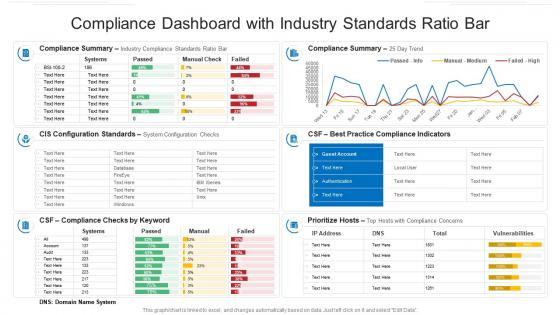
Compliance dashboard with industry standards ratio bar




Try Before you Buy Download Free Sample Product
 Impress Your
 Audience
 100%
100% Editable
 Save Hours
 of Time


Our Compliance Dashboard With Industry Standards Ratio Bar are topically designed to provide an attractive backdrop to any subject. Use them to look like a presentation pro.
People who downloaded this PowerPoint presentation also viewed the following :
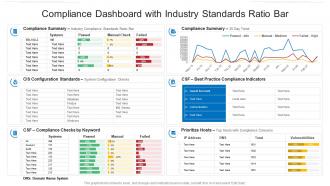
Compliance dashboard with industry standards ratio bar with all 2 slides:
Use our Compliance Dashboard With Industry Standards Ratio Bar to effectively help you save your valuable time. They are readymade to fit into any presentation structure.
FAQs for Compliance dashboard with industry
Okay so you need four key things for your compliance dashboard. Real-time alerts are huge - seriously, you don't want to find out about problems during an audit. Risk scoring helps too, shows you what to tackle first. Make sure you can drill down into detailed reports when needed. Oh, and the visual design? Way more important than most people realize. If it looks like garbage, nobody's gonna touch it. Different people need different views - what your CISO wants to see is totally different from what managers need day-to-day.
So basically, compliance dashboards pull all your regulatory stuff into one spot instead of having you dig through a million different systems when reports are due. The automated data collection is honestly a lifesaver - way fewer manual screwups that'll have regulators breathing down your neck. You can monitor everything in real-time and catch problems early. Most dashboards spit out reports in whatever format the regulators want too, which saves tons of formatting headaches. I'd start with whatever reporting takes you the longest right now and see if you can automate that first.
Start with violation rates and audit findings - those will save your ass when regulators show up. Regulatory deadlines too, obviously. Then add trend data so you can see if things are actually getting better or going to hell. Don't forget completion rates for mandatory training and certs. I usually toss in some operational metrics because honestly, compliance teams hate being seen as just the fun police. Oh, and make sure everything updates daily at minimum - stale data is useless when someone's breathing down your neck asking questions.
So compliance dashboards are pretty much your early warning system - they pull data from everywhere and flag weird stuff before it becomes a real problem. You'll see things like repeated violations, sketchy transaction patterns, or controls that just aren't doing their job. Way better than manually checking everything (which honestly nobody has time for anyway). The whole point is catching issues early so you're not scrambling when auditors show up. Set up alerts though - otherwise you'll just be staring at screens all day wondering what you're supposed to be looking for.
Oh man, don't go crazy trying to show every single metric you have - that's the fastest way to make something nobody wants to look at. Focus on what your stakeholders actually give a shit about first. Also check that your data sources aren't garbage and update often enough to matter. Test it with real people before going live! Honestly, half the dashboards I've seen fail because nobody explains what the numbers mean. Start with maybe 5-7 key things max. You can always add more later once people start using it and giving feedback.
Dude, you gotta fix this at the source or your dashboards will be trash. Set up validation rules that catch bad data before it reaches your compliance stuff - way easier than fixing it later. Regular audits are honestly super boring but you can't skip them. Oh and make sure someone actually owns each metric, otherwise nobody cares when things break. Version control is clutch too so you can see what changed and roll back mistakes. I learned this the hard way - build these checks into your daily workflow instead of playing cleanup afterward.
Tableau, Power BI, and Qlik Sense are your best bets for compliance dashboards. Power BI's probably the easiest win if you're already in Microsoft land. Skip Excel for this - trust me, I've watched people try and it's brutal. ServiceNow GRC or MetricStream work too if you've got them already. Whatever you pick though, check what IT already supports first. Seriously saves you from procurement hell and means someone actually knows how to fix it when stuff breaks. Which it will, because compliance tools are weirdly finicky sometimes.
So basically you just pick the stuff that actually matters for your field. Like healthcare folks need to watch HIPAA violations and data breaches. Financial companies care more about SOX compliance and audit trails. Manufacturing? They're tracking safety incidents and environmental regs mostly. Most platforms let you drag and drop widgets around, which is honestly pretty satisfying. You can set different alert levels and give each team their own view so they're not drowning in irrelevant data. I'd start by writing down your top 5 compliance headaches and work from there.
You really need real-time data for compliance dashboards - trust me on this one. Catching problems instantly beats finding out weeks later that you missed some regulatory deadline. Those "oh shit" moments are what keep compliance people up at night! Plus auditors love seeing that you're actively monitoring instead of just running reports once a month. I'd set up automated alerts for your biggest risk indicators so you don't have to babysit the thing constantly. Way better than staring at screens all day. The dashboard can watch for you while you actually get other work done.
Visual elements are honestly a game-changer for compliance dashboards. Instead of staring at endless spreadsheets, people actually want to use them. Color coding works great - red flags critical stuff, green means you're good to go. Charts help you catch trends without drowning in numbers. Progress bars and icons guide your eye to what matters most. The trick is making your most important metrics the most visually obvious. I mean, getting people to even look at compliance data is already tough enough, right? Start with identifying your key metrics, then make those pop visually. It's like the difference between reading a manual vs. using an app.
Oh man, training is huge - I can't stress this enough. Your dashboard could be amazing but if your team can't read it properly, you're screwed. Focus on the key metrics first, then show them how to spot red flags. The real scenarios are what matter, not boring theoretical crap. Companies skip this ALL the time and then act shocked when nothing improves. Also, definitely do refresher sessions because people forget this stuff faster than you'd think. What's wild is how many places invest in fancy dashboards but won't spend time teaching people to actually use them.
So compliance dashboards hook into your existing stuff through APIs and data connectors - most have pre-built ones for the usual suspects like Salesforce, SAP, whatever you're running. The tricky part? Mapping your data fields correctly. That's honestly where like 90% of projects hit a wall at first. You'll want to figure out which systems actually have your compliance data before diving in (seems obvious but trust me). From there you can set up automated feeds or real-time syncing. Really depends on how up-to-date you need everything to be.
Monthly reviews minimum, weekly if you're dealing with heavy regulations. Automate your data sources - manual updates are where everything falls apart (learned this the hard way). Someone needs to own each dashboard section or it'll just sit there getting outdated. Focus on metrics that actually matter for compliance, not whatever looks pretty. Set up alerts when data feeds break or go south. Oh, and honestly? Start by cutting the dead weight - audit what you have now and ditch anything that doesn't help with actual compliance decisions.
Honestly, compliance dashboards are pretty clutch for spotting bigger trends. Like, if the same department keeps screwing up the same regulations, that's not coincidence - that's a process problem. Real-time data shows you where to actually spend money on training vs. just putting out fires. Also way better than dumping Excel sheets on your executives (they hate that). I'd watch for patterns that keep repeating - maybe you need to totally rethink how certain processes work instead of just fixing each mess individually. The visual stuff makes it super obvious where compliance costs are killing your margins too.
Honestly, the AI automation stuff is where everything's heading - those compliance dashboards can spot weird patterns and flag risks way before they blow up. Real-time monitoring is pretty much expected now instead of looking at stale data from yesterday. Cloud platforms are making it easier to actually integrate with whatever systems you're already using (which is a relief, tbh). There's this whole "compliance as code" movement that sounds super technical but actually makes sense once you dig into it. I'd start checking out vendors with predictive analytics features soon because just reacting to problems after they happen is getting pretty outdated.
-
Editable templates with innovative design and color combination.
-
Editable templates with innovative design and color combination.
-
Best Representation of topics, really appreciable.