


Components Of Information And Communication Technology Telecommunications





Try Before you Buy Download Free Sample Product
 Impress Your
 Audience
 100%
100% Editable
 Save Hours
 of Time


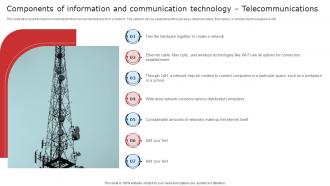
This slide talks about the telecommunications that connect hardware to form a network. The network can be established through wires, ethernet cables, fiber optics, or wireless technologies like wifi.
People who downloaded this PowerPoint presentation also viewed the following :
Components Of Information And Communication Technology Telecommunications with all 6 slides:
Use our Components Of Information And Communication Technology Telecommunications to effectively help you save your valuable time. They are readymade to fit into any presentation structure.





FAQs for Components Of Information And
Emerging technologies shaping telecommunications include 5G networks, artificial intelligence, edge computing, network function virtualization, and Internet of Things integration. These technologies streamline operations by enabling faster data processing, reducing latency, and automating network management, with telecommunications providers finding that strategic combinations ultimately deliver enhanced customer experiences and significant competitive advantages.
5G is revolutionizing industries by enabling ultra-fast data transmission, low latency connectivity, and massive device integration across manufacturing, healthcare, transportation, and retail sectors. Through enhanced automation capabilities, organizations streamline operations, deliver real-time remote services, and create immersive customer experiences, with many finding that 5G ultimately provides significant competitive advantages in increasingly digital markets.
AI enhances telecommunications networks through predictive maintenance, network optimization, automated fault detection, intelligent traffic routing, and dynamic resource allocation. These technologies streamline operations by minimizing downtime, reducing operational costs, and improving service quality, with many telecom operators finding that AI-driven solutions ultimately deliver faster customer experiences and significant competitive advantages.
Telecommunications companies improve customer experience by implementing AI-powered chatbots, personalized service offerings, omnichannel support platforms, predictive network maintenance, and self-service portals. These technologies streamline customer interactions, reduce wait times, and proactively address service issues, with many providers finding that strategic automation ultimately delivers faster resolution times and enhanced satisfaction.
Modern telecommunication networks face security challenges including cyberattacks, data breaches, network vulnerabilities, identity theft, and infrastructure threats from malicious actors. These challenges present both risks and opportunities, with many telecommunications companies finding that strategic security investments in advanced monitoring, encryption, and threat detection ultimately deliver enhanced customer trust, regulatory compliance, and competitive advantage in an increasingly connected landscape.
Satellite communication is rapidly advancing through low Earth orbit (LEO) constellations, enhanced broadband capabilities, integrated 5G networks, and AI-driven optimization systems. These technologies streamline global connectivity by reducing latency, expanding rural coverage, and enabling seamless international communications, with telecommunications companies finding that satellite integration delivers faster services and competitive advantage in increasingly connected markets.
Telecommunications infrastructure creates environmental impacts through energy consumption for data centers and network operations, electronic waste from equipment disposal, carbon emissions from manufacturing processes, and physical land use for towers and cables. While these present challenges, many telecommunications companies are increasingly adopting renewable energy sources, implementing circular economy practices for equipment recycling, and developing more energy-efficient technologies, ultimately delivering reduced operational costs and enhanced sustainability credentials in an increasingly environmentally-conscious business landscape.
Regulatory frameworks significantly impact telecommunications growth by establishing spectrum allocation policies, infrastructure investment requirements, and competitive market structures that either accelerate or constrain development. While regions with streamlined regulations and clear licensing procedures, like parts of Asia and Northern Europe, experience rapid network expansion and innovation, areas with complex bureaucratic processes face slower deployment of advanced technologies, ultimately affecting service quality, coverage expansion, and competitive pricing for consumers.
**INPUT**: What innovations in telecommunications are driving IoT expansion? **OUTPUT**: Key telecommunications innovations driving IoT expansion include 5G networks, edge computing infrastructure, low-power wide-area networks, network slicing capabilities, and enhanced security protocols. These technologies streamline IoT deployment by delivering faster data processing, reducing latency, and enabling massive device connectivity, with many manufacturers and smart city initiatives finding that enhanced network reliability ultimately delivers improved operational efficiency and competitive advantage. [Word count: 60 words]
Telecommunications companies leverage big data analytics by analyzing customer usage patterns, optimizing network performance, and predicting equipment failures before they occur. Through advanced analytics platforms, telecom providers enhance customer experiences with personalized service plans, reduce operational costs through predictive maintenance, and identify new revenue opportunities, with many companies finding that data-driven insights ultimately deliver significant competitive advantages in an increasingly saturated market.
Open-source software enables telecommunications companies to reduce costs, accelerate innovation, customize solutions, and avoid vendor lock-in while fostering industry-wide collaboration. Through platforms like OpenStack and Kubernetes, telecom operators streamline network functions, enhance operational flexibility, and deliver faster services, with many finding that open-source approaches ultimately provide greater competitive advantage than proprietary alternatives.
Telecommunications companies address the digital divide through infrastructure expansion, subsidized service programs, public-private partnerships, mobile broadband initiatives, and community access points. These strategic approaches enable rural connectivity, affordable internet access, and digital literacy programs, with many providers finding that government collaboration and targeted investment ultimately deliver broader market opportunities while enhancing social equity.
Key trends driving telecommunications M&A include 5G network expansion requirements, fiber infrastructure consolidation, edge computing capabilities, cloud service integration, and regulatory changes enabling cross-sector partnerships. These strategic combinations help operators reduce capital expenditures, accelerate service deployment, and enhance customer experiences, with many telecommunications companies finding that mergers deliver greater competitive positioning in increasingly converged digital markets.
Telecommunications companies are adapting through network infrastructure upgrades, cloud-based communication platforms, enhanced cybersecurity measures, and flexible service offerings tailored for distributed workforces. These strategic investments enable seamless connectivity, support scalable video conferencing solutions, and deliver robust data management capabilities, with many providers finding that enhanced remote work services create new revenue streams while strengthening customer loyalty in an increasingly digital business environment.
Cybersecurity serves as the foundation for telecommunications evolution, protecting network infrastructure, customer data, IoT devices, cloud services, and emerging 5G networks. As telecommunications companies expand digital services and connectivity, robust cybersecurity frameworks enable secure innovation, maintain customer trust, and deliver reliable communications while safeguarding against increasingly sophisticated cyber threats.
-
“Thank you to the SlideTeam. Your presentations look really skillful and have made my life so much easier.”
-
The slides are remarkable with creative designs and interesting information. I am pleased to see how functional and adaptive the design is. Would highly recommend this purchase!