

Diapositivas de presentación de Powerpoint de TI de ciencia computacional




Try Before you Buy Download Free Sample Product
 Impress Your
Audience
 100%
Editable
 Save Hours
of Time


El uso de ideas de ingeniería de software y ciencias de la computación para abordar problemas científicos se conoce como ciencia computacional. Implica el uso de hardware de computadora, redes, algoritmos, programación, bases de datos y otros conocimientos específicos del dominio para crear simulaciones de procesos físicos basadas en computadora. Aquí hay una plantilla de TI de ciencia computacional diseñada profesionalmente que brinda una breve idea sobre el proveedor del programa de ciencia computacional y los principios críticos de su enfoque. En esta presentación de PowerPoint, hemos cubierto la necesidad de la ciencia computacional y cómo las empresas pueden usar la ciencia computacional para los negocios. Además, este PPT de Computación científica contiene una diapositiva que muestra una carrera en ciencias computacionales, un programa de ciencias computacionales y una estructura de tarifas. Además, la presentación PPT brinda una introducción a la ciencia computacional, incluidos los componentes de la ciencia computacional, los pilares, las aplicaciones y una comparación entre la ciencia computacional y la ciencia de datos. Por último, esta plataforma de Computación científica comprende una hoja de ruta, un plan de 30-60-90 días para el programa de ciencia computacional y un tablero. Personalice esta plantilla 100 % editable en función de sus necesidades con la ayuda de nuestro equipo de investigación altamente eficiente. Obtenga acceso ahora.
People who downloaded this PowerPoint presentation also viewed the following :
Contenido de esta presentación de Powerpoint
Diapositiva 1 : Esta diapositiva presenta la ciencia computacional (TI). Indique el nombre de su empresa y comience.
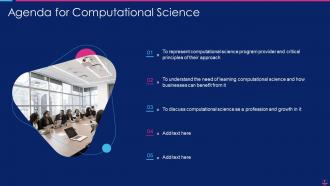
Diapositiva 2 : Esta diapositiva muestra Agenda para la ciencia computacional.
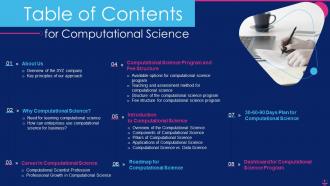
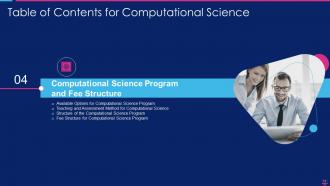
Diapositiva 3 : Esta diapositiva presenta la tabla de contenido de la presentación.
Diapositiva 4 : esta diapositiva muestra el título de los temas que se cubrirán a continuación en la plantilla.
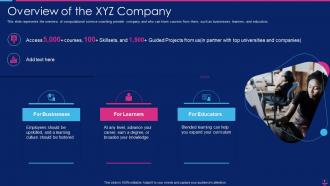
Diapositiva 5 : esta diapositiva representa la descripción general de la empresa proveedora de capacitación en ciencias computacionales.
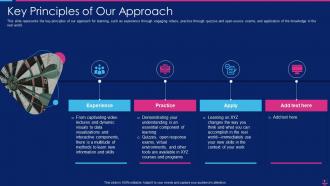
Diapositiva 6 : esta diapositiva muestra los principios clave de nuestro enfoque para el aprendizaje, como la experiencia a través de videos atractivos.
Diapositiva 7 : esta diapositiva muestra el título de los temas que se cubrirán a continuación en la plantilla.
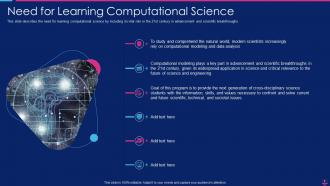
Diapositiva 8 : Esta diapositiva muestra la necesidad de aprender ciencias computacionales.
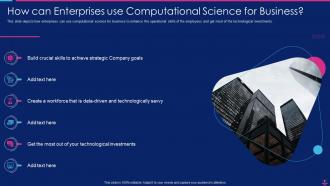
Diapositiva 9 : Esta diapositiva presenta cómo pueden las empresas utilizar la ciencia computacional para los negocios.
Diapositiva 10 : esta diapositiva muestra el título de los temas que se cubrirán a continuación en la plantilla.
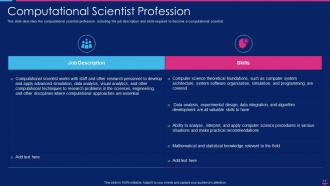
Diapositiva 11 : Esta diapositiva describe la profesión de científico computacional, incluida la descripción del trabajo y las habilidades requeridas.
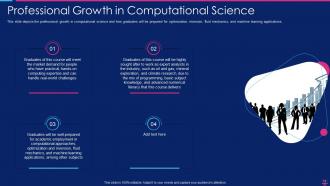
Diapositiva 12 : Esta diapositiva muestra el crecimiento profesional en ciencias computacionales y cómo se preparará a los graduados para la optimización.
Diapositiva 13 : esta diapositiva muestra el título de los temas que se cubrirán a continuación en la plantilla.
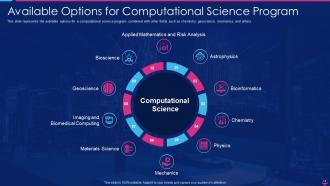
Diapositiva 14 : esta diapositiva presenta las opciones disponibles para el programa de ciencia computacional.
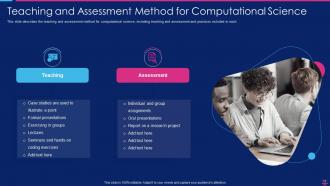
Diapositiva 15 : esta diapositiva muestra el método de enseñanza y evaluación de las ciencias computacionales.
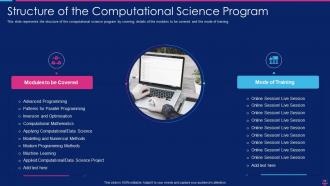
Diapositiva 16 : Esta diapositiva representa la Estructura del Programa de Ciencias Computacionales.
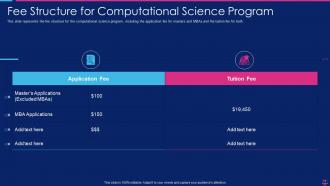
Diapositiva 17 : esta diapositiva muestra la estructura de tarifas para el programa de ciencia computacional.
Diapositiva 18 : esta diapositiva muestra el título de los temas que se cubrirán a continuación en la plantilla.
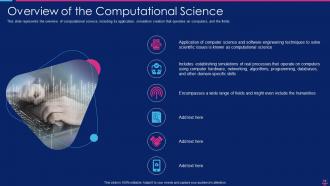
Diapositiva 19 : Esta diapositiva presenta una descripción general de la ciencia computacional.
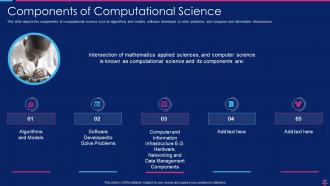
Diapositiva 20 : esta diapositiva muestra los componentes de la ciencia computacional, como algoritmos y modelos, software desarrollado para resolver problemas, etc.
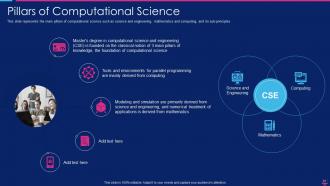
Diapositiva 21 : esta diapositiva representa los pilares principales de la ciencia computacional, como la ciencia y la ingeniería, las matemáticas y la computación, etc.
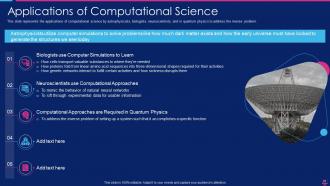
Diapositiva 22 : Esta diapositiva muestra las aplicaciones de la ciencia computacional por parte de los astrofísicos.
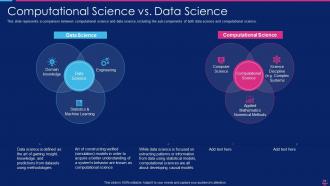
Diapositiva 23 : Esta diapositiva presenta una comparación entre la ciencia computacional y la ciencia de datos.
Diapositiva 24 : esta diapositiva muestra el título de los temas que se cubrirán a continuación en la plantilla.
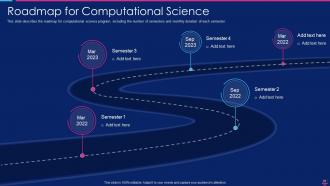
Diapositiva 25 : Esta diapositiva describe la hoja de ruta para el programa de ciencia computacional.
Diapositiva 26 : esta diapositiva muestra el título de los temas que se cubrirán a continuación en la plantilla.
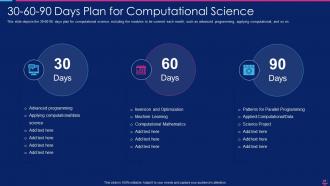
Diapositiva 27 : Esta diapositiva presenta un plan de 30-60-90 días para la ciencia computacional.
Diapositiva 28 : esta diapositiva muestra el título de los temas que se cubrirán a continuación en la plantilla.
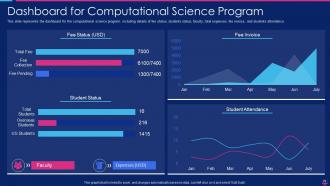
Diapositiva 29 : Esta diapositiva presenta el Tablero para el programa de ciencia computacional.
Diapositiva 30 : esta diapositiva muestra iconos para la ciencia computacional (TI).
Diapositiva 31 : esta diapositiva se titula Diapositivas adicionales para avanzar.
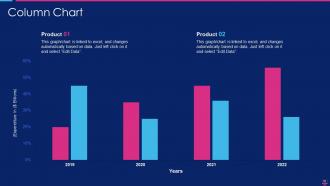
Diapositiva 32 : esta diapositiva muestra un gráfico de columnas con una comparación de dos productos.
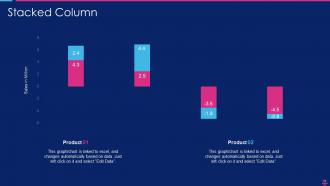
Diapositiva 33 : esta diapositiva representa un gráfico de columnas apiladas con una comparación de dos productos.
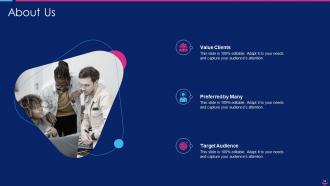
Diapositiva 34 : Esta es la diapositiva Acerca de nosotros para mostrar las especificaciones de la empresa, etc.
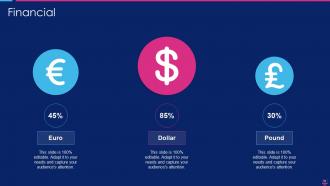
Diapositiva 35 : Esta es una diapositiva financiera. Muestre sus cosas relacionadas con las finanzas aquí.
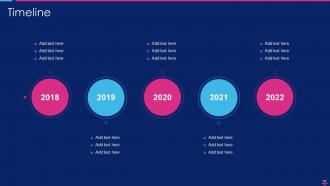
Diapositiva 36 : Esta es una diapositiva de la línea de tiempo. Mostrar datos relacionados con los intervalos de tiempo aquí.
Diapositiva 37 : Esta diapositiva muestra Post-It Notes. Publique sus notas importantes aquí.
Diapositiva 38 : Esta diapositiva contiene Rompecabezas con íconos y texto relacionados.
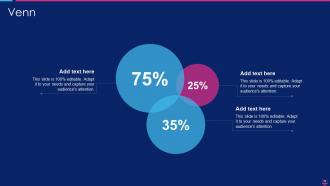
Diapositiva 39 : Esta diapositiva muestra el diagrama de Venn con cuadros de texto.
Diapositiva 40 : Esta es la diapositiva Nuestro equipo con nombres y designación.
Diapositiva 41 : Esta es una diapositiva de agradecimiento con dirección, números de contacto y dirección de correo electrónico.
Diapositivas de presentación de Powerpoint de TI de ciencia computacional con las 46 diapositivas:
Utilice nuestras diapositivas de presentación de Powerpoint de TI de ciencia computacional para ayudarlo de manera efectiva a ahorrar su valioso tiempo. Están listos para encajar en cualquier estructura de presentación.








FAQs for Computational science it
Math and programming are the big ones - Python or C++ are good starting points. Most science people I know struggle with the coding part at first, but honestly it just takes practice. Pick one language and stick with it until you're solid. You'll also need to know whatever field you're working in - could be physics, finance, biology, whatever. Problem-solving skills are huge too. Oh, and being able to explain technical stuff to people who aren't technical? That's basically half the job. Start with one programming language though - everything else builds from there.
So computational science is like being a translator between math/coding and real science problems. You're running simulations and crunching data for stuff that's way too complicated or pricey to test in real life. Biology folks use it for protein folding or genomic work - honestly saves them months in the lab. Physics people do climate models, particle stuff, you name it. The trick is you can't just be good at coding - you need to actually understand whatever field you're diving into. I'd say pick one area that doesn't bore you to death and figure out what problems they're trying to solve.
Dude, big data totally changed the game for computational science. You can't just dump everything into memory anymore - that's ancient history. Now you need streaming algorithms and stuff like Spark for distributed computing. Machine learning helps you find patterns in these crazy massive datasets. Honestly, statistical sampling used to feel like cheating, but now it's basically required. The whole field shifted from "I have a hypothesis" to "let me see what this data tells me." Oh, and definitely learn MapReduce if you haven't. Cloud platforms are pretty much unavoidable at this point.
Honestly, ML is like having a superpower for science stuff. It speeds up simulations that used to take forever, finds patterns in huge messy datasets, and can replace costly experiments with predictions. Drug discovery and climate research have gotten crazy fast because of it. What's cool is how it connects theoretical models to real-world chaos - you know how data never looks like textbook examples? ML handles that gap perfectly. My advice though? Don't go big right away. Find something boring you do repeatedly and try automating it first.
Honestly, simulation models are lifesavers when you need to test stuff without blowing your budget or accidentally breaking things. Think climate modeling, drug testing, traffic patterns - basically anything that's either too risky or way too expensive to mess with in real life. You can run thousands of scenarios in a few hours instead of waiting years for results. My professor always said start simple though - test your model against data you already know works, then gradually make it more complex. The whole point is figuring out how systems behave so you don't screw up when you actually implement something. Pretty neat concept, right?
Dude, start with data privacy - get proper consent before touching anyone's personal info. Bias in your models is massive, especially when real people are affected by the results. Document everything for reproducibility (honestly, it's just basic science at this point). Those GPU farms you're using? Total energy hogs, so maybe think twice about computational waste. Oh and when you publish, just be upfront about what your methods can and can't do. I always ask myself "who could this screw over?" before hitting run. Sounds paranoid but it's saved me from some seriously awkward conversations later.
Honestly, cloud computing totally changed the game for computational science. Instead of begging for time on some university cluster (ugh, the worst), you just spin up whatever you need on AWS or Google Cloud. Scale up for big simulations, then kill everything when you're done. No hardware headaches either - someone else deals with that mess. Your team can collaborate from anywhere now, which is pretty sweet. I'd start with the free tiers to mess around first. Way better than waiting months just to run a simple test.
MATLAB's pretty solid for beginners - tons of built-in stuff, but it costs a fortune. Python with NumPy/SciPy is where most people end up these days. Free, does everything, massive community when you get stuck. R's weird but amazing for stats work, though the syntax takes getting used to. For heavy computational stuff, you'll probably need C++ or Fortran eventually. I'd say start with Python though - my professor always said it covers like 80% of computational work, and honestly he wasn't wrong. You can do data analysis, machine learning, whatever. Just don't expect it to be as polished as MATLAB right away.
Climate modeling basically runs on computational science - it's how we simulate Earth's systems to predict future changes. Ocean currents, atmospheric stuff, carbon cycles, ice melting... all gets modeled through crazy differential equations (honestly the math can be brutal). These simulations are the only way to understand feedback loops that are too complex to study in real life. Environmental researchers use them for pollution tracking, ecosystem predictions, weather extremes. Python or R are good starting points if you want to mess around with climate data yourself. Way more accessible than I thought it'd be.
Ugh, scale mismatches are the absolute worst. Your model's running at microsecond precision while your lab equipment barely catches milliseconds. Then you've got experimental noise making everything messy - sometimes I wonder if half my data is just fancy random numbers. Real experiments never match those clean simulation boundary conditions either. The tricky part? You can't tell if differences come from your model being wrong or just crappy measurements. I'd start with figuring out your measurement uncertainties first, then work backwards to see what resolution you actually need from the model.
Dude, open-source stuff is seriously a lifesaver for computational science. You get incredible tools like NumPy and TensorFlow without dropping thousands of dollars. The collaboration part is pretty amazing too - researchers everywhere can jump in, fix bugs, and share what they've learned. I mean, there's something cool about transparent code that anyone can tinker with. Makes your research way more reproducible, which honestly looks good when you're publishing. Oh, and definitely start contributing to projects you're already using. It'll sharpen your coding skills while helping everyone else out.
Dude, you've got some solid options here. The Human Genome Project is probably your best bet - computational algorithms literally made DNA sequencing possible in a reasonable timeframe. Climate modeling is massive too, plus those weather apps we all obsess over? That's computational science right there. Drug discovery has been completely transformed - DeepMind's AlphaFold just cracked protein folding after decades of scientists banging their heads against it. NASA's Mars missions depend on computational sims for landing, navigation, all that stuff. Honestly, any of these examples will convince leadership that this field actually drives innovation, not just burns through budget.
Honestly, computational science is a total game-changer for drug discovery. Instead of spending months in the lab testing compounds that might flop, you can simulate molecular interactions first. AI predicts which compounds will actually bind to your target proteins. Pretty cool stuff. Machine learning sifts through huge chemical databases to find promising candidates, and molecular dynamics shows exactly how drugs behave in biological systems. The crazy part? You'll test thousands of compounds virtually in the time it used to take to make one. Definitely pick up some basic cheminformatics tools - they're worth it.
So there's a few ways to work around tech limits. First thing - profile your code to find bottlenecks before buying fancy hardware. Algorithmic optimization can squeeze way more performance out of what you already have. Parallel computing helps too by splitting work across multiple processors. Cloud computing is honestly a lifesaver when you need serious computational power your laptop can't handle. When exact solutions are too expensive computationally, scientists create approximate methods instead. Oh, and here's something counterintuitive - sometimes it's smarter to design experiments that work WITH your constraints rather than fighting them constantly.
Honestly, I think computational science is splitting into three big areas. AI/ML is getting baked into everything - not just running models, but actually designing better workflows. Quantum's finally gonna tackle problems we can't solve classically (though probably not the sexy stuff everyone hypes). Edge computing matters more now since you can't always dump huge datasets in the cloud. Here's the thing though - working solo as a pure computational person is getting harder. You really need to pick up some domain knowledge. Biology, materials, climate, whatever. That's where the jobs are. I'd start dabbling in something now if I were you.
-
Excellent work done on template design and graphics.
-
Really like the color and design of the presentation.
-
Great designs, Easily Editable.
-
The Designed Graphic are very professional and classic.