

Cost approach method for real estate valuation complete guide for property valuation




Try Before you Buy Download Free Sample Product
 Impress Your
 Audience
 100%
100% Editable
 Save Hours
 of Time


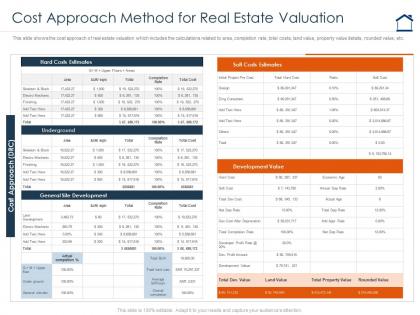
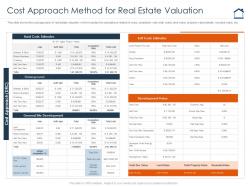
This slide shows the cost approach of real estate valuation which includes the calculations related to area, completion rate, total costs, land value, property value details, rounded value, etc.
People who downloaded this PowerPoint presentation also viewed the following :
Cost approach method for real estate valuation complete guide for property valuation with all 2 slides:
Use our Cost Approach Method For Real Estate Valuation Complete Guide For Property Valuation to effectively help you save your valuable time. They are readymade to fit into any presentation structure.
FAQs for Cost approach method for real estate valuation complete guide
The cost approach method determines property value by calculating the cost to replace or reproduce an asset, minus depreciation, plus land value. Unlike income or sales comparison approaches that rely on market data or revenue streams, this method focuses on actual construction costs and physical deterioration, making it particularly valuable for unique properties, insurance purposes, and new construction where comparable sales data is limited.
The cost approach method is most effectively applied when valuing new or specialized properties, unique assets with limited comparable sales, insurance appraisals, and properties in emerging markets. This method particularly benefits real estate investors, insurance companies, and financial institutions when market data is scarce, with many appraisers finding that it delivers reliable valuations for replacement cost scenarios and specialized facilities.
The key components include land value assessment, building reproduction or replacement cost estimation, depreciation calculations, site improvements valuation, and entrepreneurial profit considerations. These elements work together by establishing current market land values, determining construction costs at today's prices, and accounting for physical deterioration, ultimately delivering accurate property valuations for investment decisions, insurance purposes, and strategic asset management across real estate portfolios.
Depreciation reduces the replacement cost of improvements to reflect their current condition, functional obsolescence, and external factors affecting value. Appraisers calculate physical deterioration from wear and tear, functional obsolescence from outdated design or systems, and external obsolescence from market conditions, ultimately delivering a more accurate assessment of the property's present worth in today's marketplace.
Properties with unique characteristics, specialized functions, or limited market comparables benefit most from cost approach valuation, including government buildings, churches, schools, hospitals, industrial facilities, and custom-designed structures. This method proves particularly valuable for insurance purposes, property tax assessments, and new construction projects, with many appraisers finding that special-use properties lacking sufficient sales data require cost-based analysis to determine accurate market values.
Land value serves as the foundation of the cost approach method, representing the baseline worth upon which replacement or reproduction costs are added. In the cost approach, appraisers combine land value with construction costs and subtract depreciation to determine total property value, with land typically maintaining value better than structures, making accurate land assessment critical for reliable property valuations.
Yes, the cost approach can effectively be applied to both residential and commercial properties, though it's particularly valuable for newer constructions, special-use buildings, and properties with unique features. Commercial appraisers frequently use this method for office buildings, retail centers, and industrial facilities, while residential applications work well for custom homes and new developments, ultimately providing reliable valuation baselines when comparable sales data is limited.
Contractors' estimates directly influence cost approach valuations by providing current construction costs, labor rates, and material pricing that appraisers use to calculate replacement or reproduction costs. These estimates help establish accurate baseline costs for similar properties, with many appraisers finding that updated contractor input enhances valuation precision and market credibility, ultimately delivering more defensible property assessments.
Common challenges include obtaining accurate replacement cost data, estimating depreciation correctly, determining land values separately, and accounting for functional obsolescence in older properties. These valuation complexities require extensive market research and professional expertise, with many appraisers finding that technological obsolescence and changing construction standards significantly impact accuracy, ultimately affecting property investment decisions and lending assessments.
Market demand significantly influences the cost approach's effectiveness by creating disparities between replacement costs and actual market values, particularly in volatile or declining markets. When demand is strong, the cost approach aligns closely with market values, but weak demand can render replacement costs irrelevant, with many real estate professionals finding that alternative valuation methods become necessary.
The cost approach offers greater reliability when comparable sales data is limited, provides precise valuation for unique or specialized properties, and delivers consistent results for insurance and replacement cost purposes. While the sales comparison approach depends heavily on market activity and comparable properties, the cost approach enables appraisers to maintain accuracy in thin markets, ultimately delivering more defendable valuations for institutions requiring detailed cost justification.
Determining appropriate replacement cost involves calculating current construction expenses per square foot, including materials, labor, permits, and contractor fees, then multiplying by the property's total square footage. Professional appraisers analyze local building costs, review contractor estimates, and consult construction cost databases, with many finding that incorporating regional labor rates and material price fluctuations ensures accurate valuations for insurance and assessment purposes.
Local building regulations significantly impact the cost approach through compliance requirements, permit fees, mandatory material specifications, updated safety standards, and regional construction codes. These regulatory frameworks influence replacement costs by requiring specific building methods, materials, and systems, with many appraisers finding that stricter jurisdictions often result in higher estimated values due to enhanced construction requirements and associated costs.
The cost approach method assists insurance valuations by calculating replacement or reproduction costs for damaged assets, establishing accurate coverage limits, and determining fair claim settlements. Insurance companies leverage this approach to assess property values for underwriting, evaluate total loss claims, and ensure adequate policy coverage, ultimately delivering precise risk assessment and faster claim processing while minimizing disputes.
**INPUT**: What software tools are available to streamline the cost approach calculations? **OUTPUT**: Cost approach calculation software includes ARGUS Enterprise, RealData, PropertyMetrics, CoStar COMPS, and specialized appraisal platforms like ACI and WinTOTAL. These technologies streamline valuations by automating depreciation calculations, integrating market data, and generating comprehensive reports, with many appraisal firms finding that digital tools reduce processing time while enhancing accuracy and regulatory compliance. [Word count: 56 words]
-
Professional and unique presentations.
-
Thanks for all your great templates they have saved me lots of time and accelerate my presentations. Great product, keep them up!
-
Nice and innovative design.