

Complete guide for property valuation powerpoint presentation slides




Try Before you Buy Download Free Sample Product
 Impress Your
 Audience
 100%
100% Editable
 Save Hours
 of Time


Valuation of property helps businesses estimate the actual worth of the property. Here is a professionally designed template on Complete Guide for Property Valuation that will provide the ability to track the performance, not in terms of revenue, but terms of the estimated change in value. The purpose of this proposal is to analyze the various approaches related to real estate valuation. Firms can assign a new budget for a new marketing plan and create a new strategy to identify the suitable method. One can present critical takeaways related to property valuation using tables, charts, and infographics. The structured plan helps you to track the effectiveness of the strategic decision-making process. This template lets you exhibit clients property interests and opinions before valuation and presents the companys vision, mission, and objectives. You can display the team members responsible for the project with their names, roles, designation, etc. Businesses get to demonstrate their various marketing goals and ways to achieve them. The proposal shows market segmentation for real estate projects to focus on target buyer client persona. Talk to our experts for all your queries and get access to the market bests template. Download the proposal and book a free demo now.
People who downloaded this PowerPoint presentation also viewed the following :
Content of this Powerpoint Presentation
Slide 1: This is the cover slide for Complete Guide for Property Valuation PowerPoint deck.
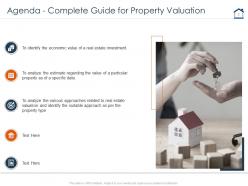
Slide 2: This is the Agenda slide for Complete Guide for Property Valuation PowerPoint deck.
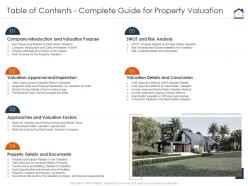
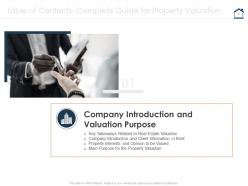
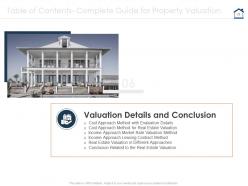
Slide 3: This is the Table of Contents slide that lists out all the essential elements covered in the deck.
Slide 4: This slide presents Company Introduction and Valuation purpose.
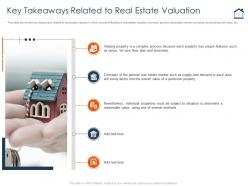
Slide 5: This slide shows the key takeaways related to real estate valuation which covers difficulties in real estate valuation process, general real estate market concepts, ascertaining fair value, etc.
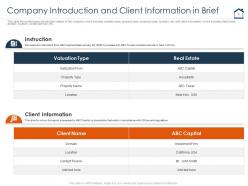
Slide 6: This slide shows the basic introduction related to the company which includes valuation type, property type, property name, location, etc. and client information which includes client name, domain, location, contact person, etc.
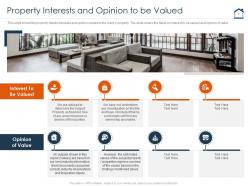
Slide 7: This slide shows the property details interests and opinion related to the client’s property. The slide covers the detail on Interest to be valued and opinion of value
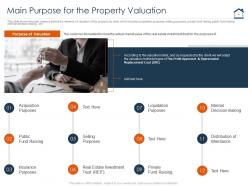
Slide 8: This slide shows the main reasons behind the demand of valuation of the property by client which includes acquisition purposes, selling purposes, private fund raising, public fund raising, internal decision making, etc.
Slide 9: This slide presents Valuation Approval and Inspection.
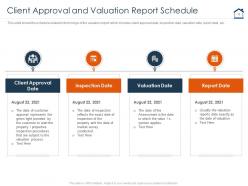
Slide 10: This slide shows the schedule related to the timings of the valuation report which includes client approval date, inspection date, valuation date, report date, etc.
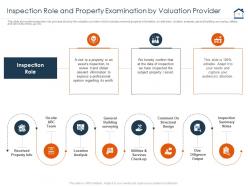
Slide 11: This slide shows the inspection role process done by the valuation provider which includes received property information, on-site team, location analysis, general building surveying, utilities and services check-up, etc.
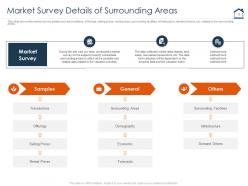
Slide 12: This slide shows the market survey details such as transitions, offerings, selling prices, rental prices, surrounding facilities, infrastructure, demand drivers, etc. related to the surrounding areas.
Slide 13: This slide shows the professional team details of the real estate valuation provider company with their knowledge and skills specifications such as group CEO, head of valuation department, etc.
Slide 14: This slide presents approaches and valuation factors.
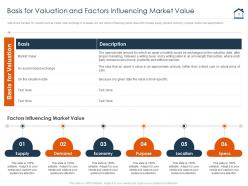
Slide 15: This slide shows the basis for valuation such as market value, exchange of an assets, etc. and factors influencing market value which includes supply, demand, economy, purpose, location and specifications.
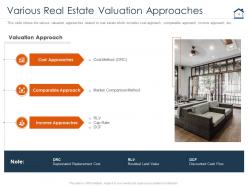
Slide 16: This slide shows the various valuation approaches related to real estate which includes cost approach, comparable approach, income approach, etc.
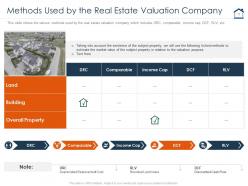
Slide 17: This slide shows the various methods used by the real estate valuation company which includes DRC, comparable, income cap, DCF, RLV, etc.
Slide 18: This slide presents property details and documents.
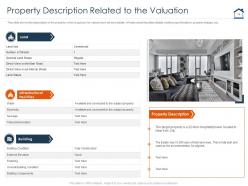
Slide 19: This slide shows the description of the property which is going to be valued such as land details, infrastructural faculties details, building specifications, property images, etc.
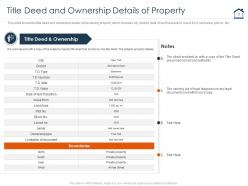
Slide 20: This slide shows the title deed and ownership details of the valuing property which includes city, district, date of last transaction, issue from, land area, plot no. etc.
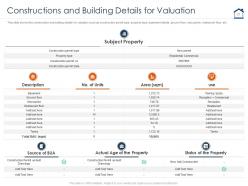
Slide 21: This slide shows the construction and building details for valuation such as construction permit type, property type, basement details, ground floor, mezzanine, restaurant floor, etc.
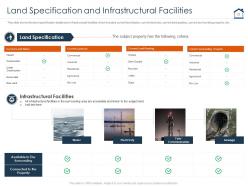
Slide 22: This slide shows the land specification details and infrastructural facilities which includes current land status, current land use, current land grading, current surrounding property, etc.
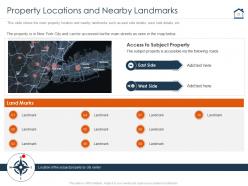
Slide 23: This slide shows the main property location and nearby landmarks such as east side details, west side details, etc.
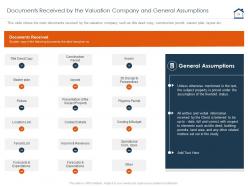
Slide 24: This slide shows the main documents received by the valuation company such as title deed copy, construction permit, master plan, layout etc.
Slide 25: This slide presents SWOT and Risk Analysis
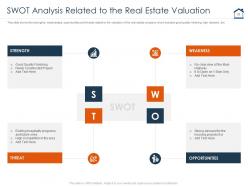
Slide 26: This slide shows the strengths, weaknesses, opportunities and threats related to the valuation of the real estate company which includes good quality finishing, high demand, etc.
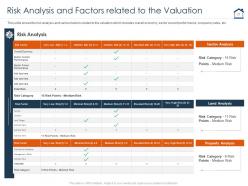
Slide 27: This slide shows the risk analysis and various factors related to the valuation which includes overall economy, sector current performance, occupancy rates, etc.
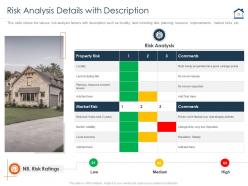
Slide 28: This slide shows the various risk analysis factors with description such as locality, land including title, planning resource, improvements, market risks, etc.
Slide 29: This slide shows the complete Guide for Property Valuation
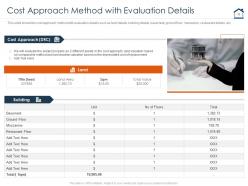
Slide 30: This slide shows the cost approach method with evaluation details such as land details, building details, basement, ground floor, mezzanine, restaurant details, etc.
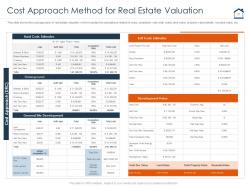
Slide 31: This slide shows the cost approach of real estate valuation which includes the calculations related to area, completion rate, total costs, land value, property value details, rounded value, etc.
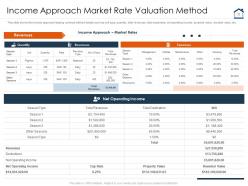
Slide 32: This slide shows the income approach leasing contract method details such as unit type, quantity, total revenues, total expenses, net operating income, property value, rounded value, etc.
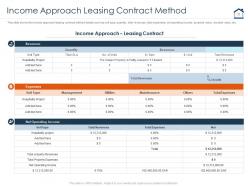
Slide 33: This slide shows the income approach leasing contract method details such as unit type, quantity, total revenues, total expenses, net operating income, property value, rounded value, etc.
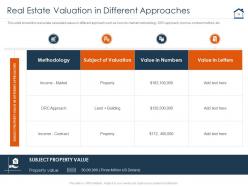
Slide 34: This slide shows the real estate calculated values in different approach such as income-market methodology, DRC approach, Income-contract method, etc.
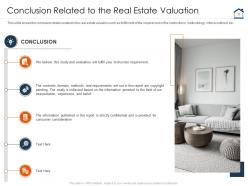
Slide 35: This slide shows the conclusion details related to the real estate valuation such as fulfillment of the requirement of the instructions, methodology, criteria outlined, etc.
Slide 36: This is an Icons Slide. Use it as per your needs.
Slide 37: This is an Additional Slide.
Slide 38: This is an About Us slide that can be used to give a brief overview of the company.
Slide 39: This is Our Mission slide that can be used to state your mission and vision.
Slide 40: This is Our Team slide with name and designation to fill.
Slide 41: This is a Roadmap slide that can be used to present chronological sequence of events.
Slide 42: This is a Timeline slide that can be used to present sequence of events.
Slide 43: This is a creative Puzzle slide to present creative ideas.
Slide 44: This is a Post it Notes slide that can be used to keep important data at one place.
Slide 45: This slide can be used to jot down Quotes.
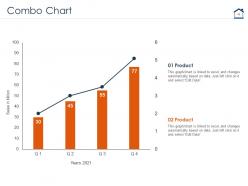
Slide 46: This is a Combo Chart slide that can be used to compare two different products.
Slide 47: This is a Venn Diagram slide that can be used to compare three different elements.
Slide 48: This is a Comparison slide that can be used to conduct comparative analysis.
Slide 49: This is a Thank You slide for acknowledgment. You can share your contact details here.
Complete guide for property valuation powerpoint presentation slides with all 49 slides:
Use our Complete Guide For Property Valuation Powerpoint Presentation Slides to effectively help you save your valuable time. They are readymade to fit into any presentation structure.









FAQs for Complete guide for property valuation
Look, three things matter most: where you are, what shape your place is in, and what similar homes sold for recently. Location is everything - literally the same house can be worth 200k more in a better neighborhood. Then there's condition, especially big stuff like your roof, HVAC, foundation. Recent comps within like half a mile and 6 months basically tell you what people will actually pay. Market trends matter too but honestly? Those first three are like 80% of it. I'd get a CMA from an agent just to see the real numbers instead of guessing.
Honestly, location is everything when it comes to property value. Urban spots get their worth from being walkable and close to transit - plus all those neighborhood perks. Rural properties? Completely different game. Size of the land matters way more, along with natural features and road access. Nobody cares if there's a coffee shop nearby lol. City properties cost more per square foot but you get way less space for your money. Before you even think about buying anything, just map out what's in a 10-minute radius. That'll tell you most of what you need to know right there.
Yeah, upgrades definitely help your property value, but some work way better than others. Kitchen and bathroom renovations usually give you the most bang for your buck. Adding square footage or fixing structural stuff makes a big difference too. Just don't go crazy with luxury finishes if your neighbors haven't - assessors won't care about your $5000 faucet if everyone else has basic ones. Oh, and save all your permits and receipts! You'll need those for the next assessment. Short upgrades work. Longer ones with decent planning work even better.
So basically, property values move with the economy - pretty straightforward stuff. Higher interest rates mean fewer people can get mortgages, which drops demand and prices. Job security matters too - if people are worried about layoffs, they're not house hunting. Population growth pushes prices up since more buyers compete for the same homes. Inflation affects what people can actually afford to spend. I always look at local employment numbers and interest rate trends before making any moves. Oh, and demographic shifts - like if young families are moving into an area, that's usually good for values.
Honestly, it's like two totally different worlds. Residential is pretty straightforward - you just look at what similar houses sold for nearby. But commercial? That's where it gets messy. You're diving into income streams, cap rates, lease agreements, tenant creditworthiness. Commercial properties are investments first, so earnings potential drives everything. I learned this the hard way when I first switched over - kept trying to use comps like residential and it made zero sense. Market approach works for houses because people buy them to live in. Commercial buyers only care about ROI and cash flow projections.
So there are basically three ways appraisers figure out what your place is worth. Most of the time they'll lean heavily on the sales comparison method - that's just looking at what similar houses in your area sold for recently. Then there's the cost approach, which is like "what would it cost to rebuild this from scratch?" Honestly that one seems less reliable to me. For rentals they use the income approach based on rental rates. The sales comp thing is usually what matters most since it shows what people actually paid. They'll adjust for differences - bigger lot, better condition, whatever. Takes about a week usually, sometimes less if you're lucky.
Dude, zoning is everything when it comes to property values. Commercial zoning versus residential? We're talking potentially millions in difference because commercial properties can generate way more income. Industrial might scare off some buyers, but the right investor will pay big for it. The crazy part is zoning can actually change - I've seen property values tank or skyrocket literally overnight because of rezoning decisions. My advice? Always dig into the current zoning rules AND check if there's any talk about changes coming down the pipeline before you make a move.
So here's the deal - your property's condition is huge for appraisals. Fresh paint, working systems, good maintenance? You'll get way higher value. But if stuff's broken or outdated, they basically figure out what it'd cost to fix everything and knock that off your number. I learned this the hard way when my neighbor's place appraised for like 30K less because of a sketchy roof situation. Makes sense though - buyers don't want to inherit problems. If you're not sure how your place looks, maybe get an inspection first? Better to know upfront than get surprised.
Don't use old comps - that's like bringing a flip phone to 2024. Skip different neighborhoods even if they look similar, and definitely check for maintenance issues or weird zoning stuff. Some appraisers try to skip the actual walkthrough which is honestly insane. Fresh data matters since markets move fast these days. Also double-check your math because I've seen people lose thousands over one misplaced decimal. Local market conditions can be totally different even a few blocks away, so pay attention to what's actually happening in that specific area.
Honestly, AVMs are game-changers for speeding up valuations. Instead of spending hours digging through comps manually, they'll crunch massive datasets in minutes. They automatically pull comparable sales and analyze market trends, plus they're actually pretty decent at flagging weird outliers you might miss when you're in a rush. The accuracy has improved a ton recently too - some hit 90%+ in stable markets, which is wild. You'll definitely still need to review their work and make adjustments. But they give you a solid foundation and let you focus your time on properties that actually need the deep dive treatment.
Comps are basically your reality check for what people will actually pay. Look for recent sales - like within 3-6 months - of similar homes in the area. Size, condition, features should match up reasonably well. Without good comps you're just throwing darts blindfolded, which is how properties sit on the market forever or sell way under value. Don't just grab any house in the neighborhood though - actually compare apples to apples. I'd say pull at least 3-5 solid ones, then adjust if there's major differences in square footage or fancy upgrades. Trust me, it's worth the extra legwork upfront.
Oh man, climate change is totally messing with property values right now. Coastal homes? Some have already dropped 10-20% because of flood risk. Wild stuff. Hurricane zones are getting slammed too, and don't even get me started on wildfire areas - insurance costs alone are brutal. But here's the thing - properties in safer spots with decent infrastructure are actually worth more now. Buyers aren't stupid anymore, they're checking flood maps and climate projections before making offers. Smart move honestly. If you're looking at properties, you gotta think about both current risks and what's coming down the road.
Data gaps are gonna be your biggest headache. Finding recent comps is brutal, especially for weird properties or slow markets - sometimes they literally don't exist. Market changes mess things up too since values shift between when you research and actually write the report. Property access is another pain - owners who won't let you in, sketchy neighborhoods, whatever. Honestly the whole thing gets easier once you know your local market really well. Building relationships with agents helps a ton since they can get you into properties and give you the real scoop on what's happening.
It's pretty straightforward - more buyers than homes? Prices shoot up. Too many houses sitting around? They drop. Different neighborhoods are totally different though. Hot areas with barely any inventory will cost you way more than places where they're building like crazy. I learned this the hard way when I was house hunting last year, honestly. Properties get bid up or down based on competition. When you're trying to figure out what something's worth, check recent sales in that exact area first. Current inventory matters too - tells you if you're walking into a bidding war or not.
First thing - check your state's licensing rules because they're all different about who can do valuations. Fair housing laws are critical too, so don't mess around with anything that could look discriminatory. Document everything since these reports sometimes end up in court (learned that one the hard way). You'll want to disclose any conflicts of interest or connections to the property. Also look into zoning issues and title problems before you get too deep. Honestly, if it feels sketchy at all, just call a real estate attorney. Way better than dealing with problems later.
-
Easily Understandable slides.
-
Presentation Design is very nice, good work with the content as well.
-
Qualitative and comprehensive slides.
-
Easily Editable.
-
It saves your time and decrease your efforts in half.