


Funding Ask Pitch With Business Valuation




Try Before you Buy Download Free Sample Product
 Impress Your
 Audience
 100%
100% Editable
 Save Hours
 of Time


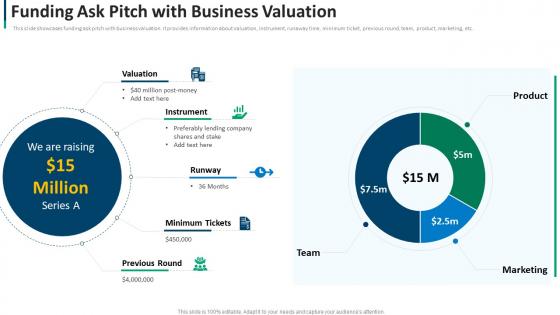
This slide showcases funding ask pitch with business valuation. It provides information about valuation, instrument, runaway time, minimum ticket, previous round, team, product, marketing, etc.
People who downloaded this PowerPoint presentation also viewed the following :
Funding Ask Pitch With Business Valuation with all 7 slides:
Use our Funding Ask Pitch With Business Valuation to effectively help you save your valuable time. They are readymade to fit into any presentation structure.





FAQs for Funding Ask Pitch
Honestly, start with a killer one-pager first - if that doesn't grab them, your full deck won't either. Five things you absolutely need: crystal-clear problem statement, your solution plus proof it actually works, market data showing the opportunity size, why your team has credibility, and realistic financial projections. Don't forget the ask! Seriously, so many people make investors guess what they want. Your exec summary is make-or-break since that's probably all they'll read initially. The whole thing should tell a story that hits them emotionally but - and this is key - back everything up with real numbers. No fluff.
Look, market trends basically shape your entire pitch strategy. Hot markets? You can push aggressive valuations and growth numbers. But when things are down, you've got to focus on defensive plays and managing risk instead. I've literally watched people completely redo their proposals because new market data dropped right before they presented - it's wild how much timing matters. Your investment thesis needs to match whatever's hot right now. Could be ESG stuff, tech disruption, or whatever investors are obsessing over this quarter. Just double-check the latest trends before you lock anything in.
Start with ROI and NPV - they're your bread and butter for figuring out if this thing's even worth it. IRR shows your actual return rate, which is huge. Payback period tells you when you'll see your money back. Honestly? Cash flow projections are where people get really creative with numbers, so dig into those hard. If you're comparing a few options, look at risk-adjusted metrics too. Oh and make yourself a little scorecard ranking what matters most to you - then just use the same one for everything. Keeps you from overthinking it.
Start with the problem and nail down the market size right away. Concrete numbers are everything - "cuts logistics costs by 40%" vs "reduces expenses" is night and day. I can't tell you how many pitches I've sat through that are just fluffy vision statements with zero meat. Your value prop can't be buried on slide 12 because investors make up their minds fast. Focus hard on why YOU can win this market specifically. Oh and make sure your financials actually connect to the value you're claiming to create. Finish with a crystal clear ask that's easy for them to pitch internally.
Look, investors are gonna tear apart your risk section more than anything else, so don't half-ass it. Start by listing the obvious stuff - market swings, competition, operational headaches. But here's the thing: just identifying risks isn't enough. You've gotta show how you'll actually handle them when they pop up. I've seen too many proposals that basically say "we'll figure it out later" and wonder why they got rejected. Make it clear you're not just throwing money at a wall hoping it sticks. Honestly, this section can make or break your whole pitch.
Dude, visuals are game-changers for investment pitches. Numbers on a spreadsheet? Boring as hell. But show that same revenue growth in a clean chart and suddenly investors get it instantly. I've literally watched mediocre pitches become winners just by adding good infographics and mockups. Your market size projections feel real when they're visual, not just bullet points. Product screenshots beat abstract descriptions every day. One thing though - don't overcrowd your slides. Stick to maybe 2-3 visuals max per slide. Clean beats cluttered always.
Dude, biggest mistake is being vague with your numbers and timelines - investors absolutely hate that shit. Also don't do the whole "we'll just capture 1% of this massive market" thing because it sounds super lazy. Your growth projections can't be totally unrealistic, and you better not pretend your competition doesn't exist. I've seen so many decks where the financial assumptions fall apart the second you actually look at them. Oh and have a real exit strategy, not just "we'll figure it out later." Honestly? Get someone to tear your draft apart first - way better than bombing in front of actual investors.
Honestly, the executive summary can make or break everything. Most investors only read that part first anyway - they're drowning in these proposals. You've gotta nail what your business does, market size, why you're different, money stuff, and how much funding you need. Keep it to like 1-2 pages max. Think of it as your elevator pitch but written down. If you can't hook them there, they'll just move to the next one. I probably sound like a broken record, but seriously spend the most time on this section. Everything else won't matter if this part sucks.
Dude, you've gotta tailor each pitch to what they actually want to hear. Angels are looking for that founder-market fit thing - they want your personal story and why you're obsessed with solving this problem. VCs? Hit them hard with growth numbers and market size data, they're all about scale. Family offices are way more conservative, so focus on risk management and stable returns. I swear it's like dating different types of people! Oh and definitely stalk their recent investments first - then rewrite your exec summary to match their vibe and priorities. Institutional folks care about boring stuff like governance structures.
Look, spreadsheets put people to sleep. You need a story that makes investors actually *feel* something about your business. Walk them through what your customers go through - the real frustration, the "holy crap this sucks" moments. Then show how you fix it. Honestly, I've watched mediocre companies get funding just because their pitch told an amazing story. People decide with their gut first, then use logic to back it up later. Your job is creating that lightbulb moment where they go "oh, I totally get this." Paint the picture of success so clearly they can't help but want in.
Dude, the legal stuff is honestly a pain but super necessary. First thing - SEC compliance if you're doing equity/debt. IP ownership needs to be crystal clear, especially with any proprietary tech. Liability protections are huge, and arbitration clauses will save you from courtroom drama later. Governance rights and voting structures should be laid out upfront too. Exit strategies - don't skip this part even though it feels weird planning your breakup before you start. Oh, and seriously get a securities attorney to review everything before you send it. Trust me on that one.
Honestly? Update that thing every 3-6 months minimum. Market conditions change constantly, and stale proposals make you look out of touch - learned that the hard way once. Big market shifts are obvious triggers, but also watch for changes in your risk tolerance or when your original assumptions start falling apart. New regulations can mess things up too. The financial world moves stupidly fast these days. Set a quarterly reminder or you'll totally forget. Oh, and if your financial situation changes at all, that's another reason to refresh it. Trust me, investors notice when your numbers are outdated.
Dude, you absolutely need solid competitive analysis in your pitch. Investors want to see you actually understand who you're up against - both direct competitors and those random companies that might steal your customers. It shows you've done the work and aren't just throwing ideas at the wall. Plus it helps you nail down what makes you different. I've seen too many founders get destroyed in meetings because they couldn't answer basic questions about their competition. You'll look way more credible if you can break down their strengths and weaknesses, then explain how you're gonna beat them.
Dude, case studies are basically your proof you're not bullshitting with made-up numbers. Real examples from past deals? That's gold. Testimonials from other investors who actually worked with you? Even better. Anyone can make Excel look pretty, but showing concrete results from similar situations proves you can actually deliver. I've seen so many pitches that are just wishful thinking - don't be that guy. Pick relevant examples though, not just any random success story. Include the actual metrics and outcomes so they can see exactly what value you brought. Trust builds way faster when there's real track record behind your promises.
PowerPoint works fine, but honestly Canva's templates will make your deck look way more professional without much effort. Excel's still the go-to for financial modeling. DocSend is super useful for tracking - you'll see exactly who opens it and which slides they actually look at, which is kind of addictive once you start using it. PitchBook has solid market data if you need that level of detail. My advice? Start by checking out some successful pitch decks online first. You'd be surprised how much you can learn just from seeing what works.
-
Awesome use of colors and designs in product templates.
-
Good research work and creative work done on every template.