Cost approach method for real estate valuation property valuation methods for real estate investors

Rating:
90%
Cost approach method for real estate valuation property valuation methods for real estate investors
Slide 1 of 6
Favourites Favourites

Try Before you Buy Download Free Sample Product

Audience Impress Your
Audience
Editable 100%
Editable
Time Save Hours
of Time
The Biggest Sale is ending soon in
0
0
:
0
0
:
0
0
Rating:
90%
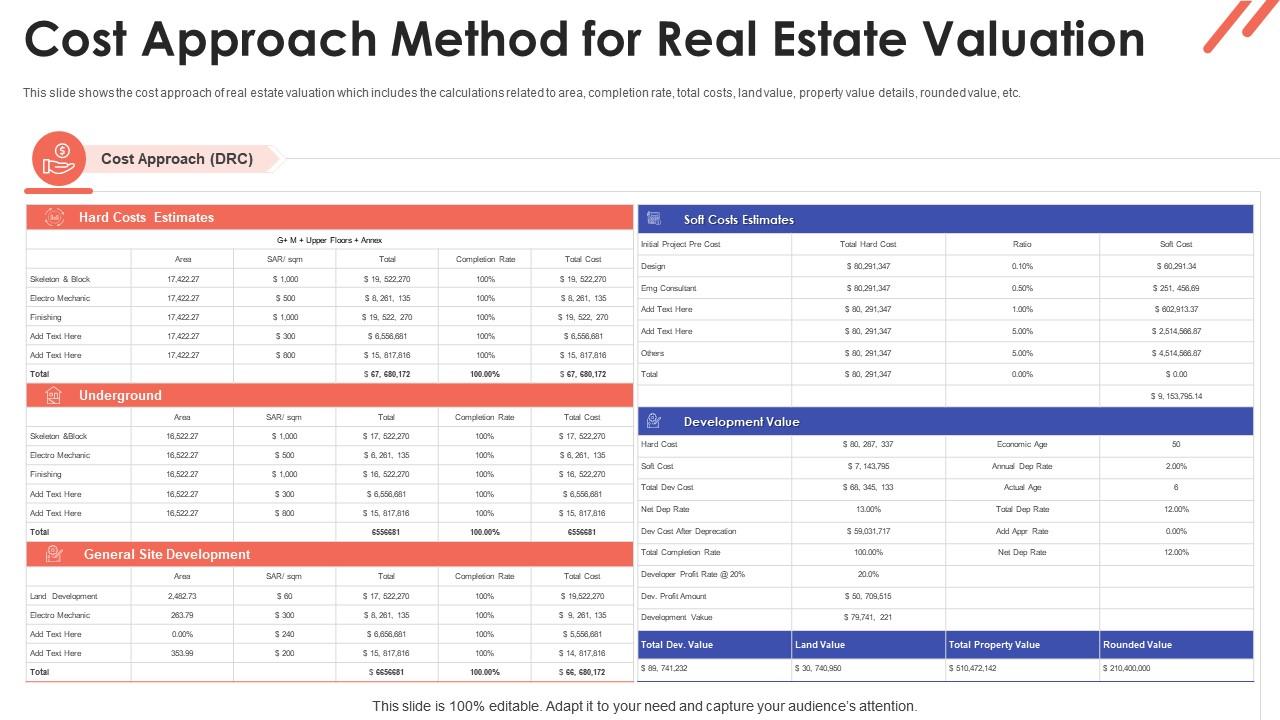
This slide shows the cost approach of real estate valuation which includes the calculations related to area, completion rate, total costs, land value, property value details, rounded value, etc. Deliver an outstanding presentation on the topic using this Cost Approach Method For Real Estate Valuation Property Valuation Methods For Real Estate Investors. Dispense information and present a thorough explanation of Cost Approach, Site Development, Soft Costs Estimates, Development Value using the slides given. This template can be altered and personalized to fit your needs. It is also available for immediate download. So grab it now.

FAQs for Cost approach method for real estate valuation property valuation methods for

The cost approach method includes land value assessment, reproduction or replacement cost estimation, depreciation calculation, and site improvement costs. This valuation method enables appraisers to determine property worth by estimating construction expenses and land values, with many banks and insurance companies finding it particularly effective for new properties, unique buildings, and insurance purposes where market comparables are limited.

The cost approach estimates property value by calculating replacement cost minus depreciation, while income approach focuses on rental income potential and sales comparison analyzes recent comparable property sales. Each method serves different scenarios, with cost approach particularly valuable for unique properties, new construction, and insurance purposes, while income approach suits investment properties and sales comparison works best for residential markets with abundant comparable data.

Properties best suited for the cost approach include newly constructed buildings, special-use facilities like schools and hospitals, unique properties with limited comparable sales, and properties where replacement cost is easily determinable. This method proves most effective for institutional buildings, industrial facilities, and custom-designed structures, with many appraisers finding that newer properties with minimal depreciation deliver the most accurate valuations.

Estimating replacement or reproduction cost is fundamental to the cost approach as it establishes the property's baseline value by calculating what it would cost to recreate the structure today. This assessment enables appraisers to determine accurate depreciation adjustments, insurance valuations, and fair market values, with many financial institutions and insurance companies finding that precise cost estimates ultimately deliver more reliable property assessments and strategic investment decisions.

The cost approach accounts for depreciation through physical deterioration from wear and tear, functional obsolescence from outdated design or systems, and external obsolescence from market conditions or location factors. These adjustments enable appraisers to determine realistic current value by subtracting accumulated depreciation from replacement costs, with real estate professionals finding this method delivers accurate valuations for insurance, taxation, and investment decisions.

**INPUT**: What methodologies are commonly used to calculate replacement cost? **OUTPUT**: Replacement cost methodologies include unit-in-place estimating, quantity survey method, comparative unit method, square footage calculations, and index trending from historical costs. These approaches enable appraisers and real estate professionals to accurately determine current construction expenses by analyzing material costs, labor rates, and market conditions, with many financial institutions finding that comprehensive cost analysis ultimately delivers more precise property valuations and strategic investment decisions. [Word count: 60 words]

Appraisers separate land value from improvements by analyzing comparable vacant land sales, then estimate reproduction or replacement costs for structures, adjusting for depreciation factors like physical deterioration, functional obsolescence, and economic obsolescence. This method enables accurate property valuations by combining current land values with depreciated improvement costs, with many commercial and residential appraisers finding that this approach delivers reliable assessments for newer properties and unique structures.

The cost approach can yield unreliable results in scenarios involving unique or specialized properties, rapidly changing construction costs, properties with significant functional obsolescence, or when market conditions strongly favor income-generating potential over replacement costs. Properties like historic buildings, custom architectural designs, or those in declining markets present challenges, as depreciation calculations become subjective and replacement costs may not reflect true market value, ultimately requiring supplementary valuation methods.

Local building code compliance significantly impacts cost estimation by requiring specific materials, construction methods, safety systems, and professional inspections that increase overall project expenses. These regulatory requirements vary by jurisdiction and property type, with commercial developments, hospitals, and residential projects facing different compliance costs, ultimately affecting the accuracy of replacement cost calculations and final property valuations.

The cost approach excels for unique properties like hospitals, schools, manufacturing facilities, and custom commercial buildings by calculating replacement costs for specialized equipment, architectural features, and infrastructure modifications. These properties often lack comparable sales data, making cost methodology essential for determining insurance values, property taxes, and investment decisions, with appraisers finding that detailed component analysis delivers accurate valuations.

Relying solely on the cost approach presents limitations including market disconnect from actual buyer demand, difficulty accurately estimating depreciation, challenges determining land value in unique locations, and inability to capture income-generating potential. While useful for new construction or special-use properties, this method overlooks market sentiment and investment returns that drive real estate decisions, with many appraisers finding that combining multiple valuation approaches delivers more comprehensive and market-reflective property assessments.

Inflation significantly impacts cost approach valuations by increasing construction materials, labor costs, and equipment expenses, requiring regular updates to cost databases and estimation models. Real estate appraisers must adjust replacement costs using current market rates rather than historical data, with many commercial and residential assessors finding that quarterly cost index updates ensure more accurate property valuations in inflationary environments.

Using historical data in the cost approach can lead to inaccurate valuations due to outdated construction costs, labor rates, and material prices, while current market data provides precise, real-time pricing that reflects today's economic conditions. Many appraisers find that current data delivers more reliable property assessments, enhanced credibility with lenders and buyers, and ultimately stronger investment decisions in an increasingly dynamic real estate market.

Technology and valuation software enhance the cost approach method by automating depreciation calculations, providing real-time construction cost databases, and integrating market data for accurate replacement cost estimates. Through AI-powered analytics and cloud-based platforms, appraisers streamline property assessments, minimize calculation errors, and deliver faster valuations, with many real estate firms finding significantly improved accuracy and operational efficiency.

Common pitfalls include using outdated construction costs, failing to accurately estimate depreciation, overlooking functional obsolescence, and neglecting local market conditions and regulatory changes. These errors significantly impact valuation accuracy, with many appraisers finding that regular cost database updates, comprehensive property inspections, and market analysis ultimately deliver more reliable assessments and stronger client confidence.

Ratings and Reviews

90% of 100
Review Form
Write a review
Most Relevant Reviews
  1. 100%

    by Cordell Jordan

    Graphics are very appealing to eyes.
  2. 80%

    by Dana Owens

    Awesome use of colors and designs in product templates.

2 Item(s)

per page: