


Crisis communication planning model with risk management




Try Before you Buy Download Free Sample Product
 Impress Your
 Audience
 100%
100% Editable
 Save Hours
 of Time


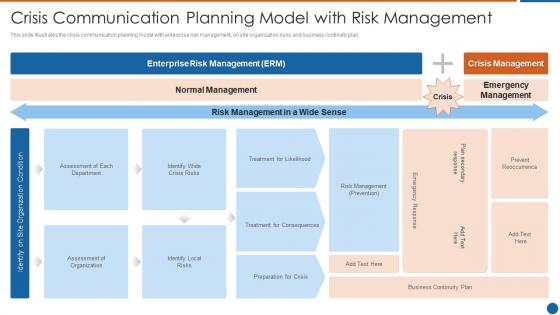
This slide illustrates the crisis communication planning model with enterprise risk management,on site organization risks and business continuity plan.
People who downloaded this PowerPoint presentation also viewed the following :
Crisis communication planning model with risk management with all 6 slides:
Use our Crisis Communication Planning Model With Risk Management to effectively help you save your valuable time. They are readymade to fit into any presentation structure.





FAQs for Crisis communication planning model
Ok so you need 5 things that actually matter. Communication strategy first - who talks to who and how. Then map out everyone's roles so people aren't just standing there confused. Keep your stakeholder contacts updated (trust me, hunting for phone numbers during chaos sucks). Set up clear decision-making rules and who escalates what. Finally, have monitoring procedures to track everything as it unfolds. Here's the thing though - you've got to practice this stuff with mock scenarios. A crisis plan collecting dust won't save you when everything goes sideways.
Set up monitoring for social media mentions, customer complaints, employee feedback - all that stuff. Most crises actually give you warning signs weeks or months ahead, but we're usually too swamped with daily fires to notice. Build dashboards tracking whatever risk indicators matter for your industry specifically. Train your people to flag weird patterns right away instead of hoping things just blow over (spoiler: they rarely do). Oh, and make sure someone's actually watching industry news too. The whole point is catching those weak signals before they turn into full-blown disasters screaming at you.
Honestly, communication can make or break everything during a crisis. Speed matters - get out front fast and stay transparent. Draft templates beforehand because you'll be a mess trying to write when things go sideways. Pick one person as your spokesperson so you're not sending mixed signals everywhere. Regular updates are huge, even if there's nothing new to report. People get way more pissed about silence than actual bad news. And look, when you screw up, just own it. The cover-up always makes things worse - learned that one the hard way. Have your whole plan ready before disaster strikes.
Honestly, just tell them the truth - no sugar-coating because they'll see right through that anyway. Be real about how bad things are, then immediately shift to your game plan and where they fit in. Check in with people constantly. Not just for updates but so they can actually blow off steam, you know? Your consistency matters way more than having all the answers (which nobody does right now anyway). Find little victories to celebrate along the way. Sounds cheesy but it actually works when everything else feels like it's falling apart. People need those moments.
Honestly, the worst thing companies do is wait too long to respond. By then you're already screwed. Quick acknowledgment beats a perfect statement every time - even if you're still figuring things out. Those super polished responses that went through 15 lawyers? They sound fake as hell and people see right through them. Oh, and make sure everyone's saying the same thing. Nothing looks more amateur than your CEO contradicting your PR team on Twitter. Have your crisis plan sorted beforehand because when shit hits the fan, you won't have time to think straight.
Look, scenario planning is just thinking through your worst nightmares before they happen. Pick like 3 things that could really mess up your business - maybe a cyber attack, supply chain going sideways, or some PR nightmare. Then actually walk through each one with your team step by step. What would we do first? Who calls who? Do we even have enough people to handle this? It sounds boring but honestly, most companies panic because they've never thought past "oh shit, now what?" You'll spot the gaps in your plan way before you're in crisis mode scrambling around like headless chickens.
Honestly, I'd start with mass notification systems like Everbridge - they blast messages to your whole team instantly across different channels. For social media monitoring, grab something that tracks what people are saying about you in real-time. Crisis platforms like Noggin are clutch because they put everything in one place instead of having you jump between a million different tools when shit hits the fan (which it will). Oh, and don't overlook boring stuff like backup communication methods. Cloud document sharing too. Before you buy anything new though, figure out what you've already got lying around.
Honestly, you can't just use the same playbook for every crisis - a data breach is totally different from someone getting hurt at work. System outages? Hit people with quick updates and realistic timelines. Financial stuff needs you to be super transparent with investors and make sure you're covering all the regulatory boxes. Reputation hits are the worst though - you've got to own up authentically and stick to your values. Each crisis type has different people freaking out at different levels, so figure out what you're dealing with first. Then grab the right playbook instead of winging it.
Skip the boring PowerPoint stuff and do actual scenario drills instead. Seriously, people just freeze when real shit hits the fan if they've only read about it. Run tabletop exercises every quarter with situations that could actually happen in your industry. Make sure everyone knows their role ahead of time - who calls who, who does what. Practice makes it automatic, you know? We learned this the hard way during our first crisis. Oh, and always debrief after to catch what didn't work. You should probably set up your first session this month while you're thinking about it.
So you'll want to track the obvious stuff first - response times, how fast you bounced back operationally, revenue hits. Stock price recovery tells a story too. But honestly? The soft metrics are just as crucial. Employee morale surveys, customer trust scores, media sentiment - that's where you see if people actually forgive you or just move on. Post-crisis surveys are clutch for gauging public perception shifts (though getting honest feedback is tricky). If you can swing it, set up real-time monitoring during the actual crisis. Way better than just doing damage assessment afterward when it's too late to pivot.
Dude, social media is where crises blow up first, so you gotta be ready. Set up alerts for your brand mentions now - trust me on this one. When shit hits the fan, have one person handle all your accounts so you don't post contradictory stuff. Speed's tricky because bad news spreads fast, but your response can too. Real-time updates are clutch for controlling the story. People actually appreciate transparency when you're actively fixing things. Oh, and pre-write some response templates beforehand - you'll thank yourself later when you're scrambling.
Once things calm down, you gotta do a proper debrief while it's all still fresh. Talk to everyone who was involved - customers too if you can swing it. You'll be shocked what they tell you. Document everything that went sideways and what actually worked. I know it's tempting to just move on (honestly, who wants to relive a disaster?), but skipping this is dumb. Build new processes from what you learned. Test them out regularly. Then spread those lessons around your company so other teams don't step on the same landmine. Turn the whole mess into something useful.
Loop in legal ASAP, even if it feels too early. Document everything - every decision, every call, every action you take. This stuff saves your ass later and helps you figure out what went wrong. Watch your press releases like a hawk though. One wrong phrase about fault and you've just handed someone a lawsuit on a silver platter. Don't forget the boring regulatory stuff either - reporting requirements, employment law if people are getting fired, privacy rules for breaches. Yeah, lawyers are expensive, but way cheaper than the alternative.
Look, the biggest mistake is going quiet - people will just make up their own stories about what's happening. Start talking to your stakeholders right away, even if you don't have everything figured out yet. Figure out who needs to hear from you first (employees, customers, investors, etc.) and adjust what you're saying based on what they actually care about. Honestly, I've seen companies tank just because they waited too long to say anything. Set up regular check-ins, use whatever communication channels work, and don't pretend you know things you don't. Getting ahead of this stuff is way better than playing catch-up later.
Honestly, you need to measure both the nuts-and-bolts stuff and the perception side. Response times, resolution speed, whether you actually hit your communication goals - that's your baseline. Customer satisfaction and sentiment analysis are brutal to look at sometimes, but they tell you if people believed what you were saying. Financial impact matters too, obviously. Track media coverage tone and how much stakeholders still trust you afterward. Oh, and don't skip the internal stuff - did your team hold up okay? Were employees still confident? Set up that dashboard within two weeks while everyone remembers what actually happened.
-
Informative design.
-
Best Representation of topics, really appreciable.