


Critical Path Structure In Project Control Techniques




Try Before you Buy Download Free Sample Product
 Impress Your
 Audience
 100%
100% Editable
 Save Hours
 of Time


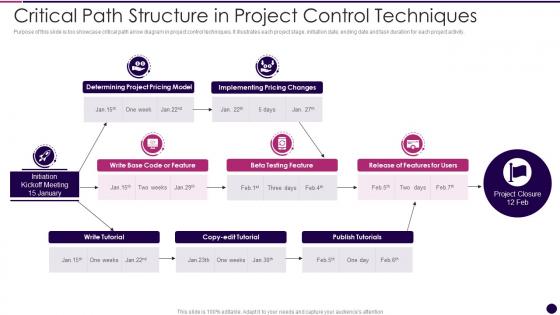
Purpose of this slide is too showcase critical path arrow diagram in project control techniques. It illustrates each project stage, initiation date, ending date and task duration for each project activity.
People who downloaded this PowerPoint presentation also viewed the following :
Critical Path Structure In Project Control Techniques with all 6 slides:
Use our Critical Path Structure In Project Control Techniques to effectively help you save your valuable time. They are readymade to fit into any presentation structure.





FAQs for Critical Path Structure In
The Critical Path Method (CPM) is a project scheduling technique that identifies the longest sequence of dependent tasks determining minimum project duration, unlike methods such as Gantt charts or Agile sprints that focus on timeline visualization or iterative delivery. Through mathematical calculations and dependency mapping, organizations in construction, manufacturing, and software development streamline resource allocation, minimize delays, and enhance project predictability, ultimately delivering faster completion times and competitive advantage in increasingly complex project environments.
CPM enhances project scheduling by identifying the longest sequence of dependent tasks, enabling managers to prioritize critical activities, optimize timelines, and allocate resources strategically. Through this systematic approach, organizations streamline project workflows, minimize delays, and maximize resource efficiency, with many construction firms and manufacturing companies finding that CPM delivers faster project completion and improved cost control.
Key components for determining the critical path include activity identification, duration estimation, dependency mapping, network diagram creation, and forward/backward pass calculations. These elements work together by establishing task sequences, calculating earliest and latest start times, and identifying zero-float activities, with project managers finding that this systematic approach ultimately delivers optimized schedules and resource allocation.
Dependencies between tasks directly determine the critical path by establishing the sequence and timing relationships that create the longest project duration. Tasks with finish-to-start, start-to-start, or finish-to-finish dependencies form interconnected chains, with the longest sequence becoming the critical path, ultimately enabling project managers to focus resources on bottleneck activities that impact overall timelines.
Float or slack time in the Critical Path Method represents the flexibility available for non-critical activities without delaying project completion, enabling project managers to optimize resource allocation, manage scheduling conflicts, and accommodate unexpected delays. This buffer time enhances project resilience by allowing strategic reallocation of resources from tasks with slack to critical activities, ultimately delivering improved timeline management and reduced project risks across complex organizational initiatives.
Project managers use CPM to minimize delays and costs by identifying the longest task sequence, optimizing resource allocation across critical activities, and proactively addressing potential bottlenecks before they impact timelines. Through strategic scheduling and continuous monitoring, organizations in construction, manufacturing, and software development streamline project execution, reduce overhead expenses, and deliver outcomes faster, ultimately gaining competitive advantage in increasingly demanding markets.
CPM tools include Microsoft Project, Primavera P6, Smartsheet, Asana, and Monday.com, along with specialized software like ProjectLibre and GanttProject. These platforms streamline project scheduling by automating dependency mapping, resource allocation, and timeline optimization, with many organizations finding that integrated dashboards deliver enhanced visibility and faster decision-making capabilities.
When project variables change, the critical path can shift entirely as task durations extend or contract, potentially moving bottlenecks to previously non-critical activities while creating new scheduling dependencies. These dynamic changes require real-time recalculation and resource reallocation, with many project managers finding that advanced scheduling software enables rapid path analysis, resource optimization, and timeline adjustments, ultimately maintaining project delivery targets despite evolving constraints.
Real-world CPM successes include NASA's Apollo space missions, construction of major infrastructure like bridges and skyscrapers, pharmaceutical drug development, software releases, and manufacturing plant installations. These projects leverage CPM's scheduling precision to coordinate complex dependencies, minimize delays, and optimize resource allocation, with many organizations finding that systematic timeline management delivers faster project completion and significantly reduced costs.
CPM integrates with Agile methodologies by identifying critical dependencies within sprints, mapping interdependencies between user stories, and establishing baseline schedules for release planning. While Agile emphasizes flexibility, CPM provides structured timeline analysis for complex features, enabling teams to balance iterative development with strategic milestone management, ultimately delivering predictable outcomes in increasingly dynamic project environments.
Project managers face challenges including resource constraints, activity duration estimation errors, complex task dependencies, frequent scope changes, and stakeholder coordination difficulties when applying CPM. While these obstacles can complicate project timelines, many organizations find that combining CPM with agile methodologies and regular schedule updates enables better risk management, enhanced team communication, and ultimately delivers improved project outcomes.
CPM adapts to uncertain projects through rolling wave planning, buffer integration, and scenario modeling techniques. These approaches enable project managers to adjust timelines dynamically, incorporate risk contingencies, and maintain critical path visibility, with many organizations in construction and software development finding that flexible CPM frameworks ultimately deliver better resource allocation and stakeholder communication.
**INPUT**: What metrics can be used to assess the effectiveness of a project utilizing CPM? **OUTPUT**: Metrics for assessing CPM effectiveness include schedule variance, cost performance index, resource utilization rates, milestone completion percentages, and critical path duration changes. These indicators enable project managers to track progress, identify bottlenecks, and optimize resource allocation, with many organizations finding that regular monitoring delivers improved on-time delivery and enhanced operational efficiency. [Word count: 54 words]
CPM enhances stakeholder communication by providing visual project timelines, identifying critical dependencies, defining clear milestones, and establishing realistic deadlines that all parties can understand. This transparency enables project managers to communicate potential delays proactively, align expectations across teams, and facilitate informed decision-making, ultimately delivering improved collaboration and stronger stakeholder confidence throughout project execution.
Project managers need training in network diagramming, activity sequencing, duration estimation, resource allocation, and scheduling software like Microsoft Project or Primavera. These skills enable effective project planning by identifying task dependencies, calculating float time, and managing schedule constraints, with many organizations finding that certified project managers deliver faster project completion, reduced delays, and enhanced resource optimization across complex initiatives.
-
The website is jam-packed with fantastic and creative templates for a variety of business concepts. They are easy to use and customize.
-
Fantastic collection. Loved how we can personalize these templates as per the requirements.