


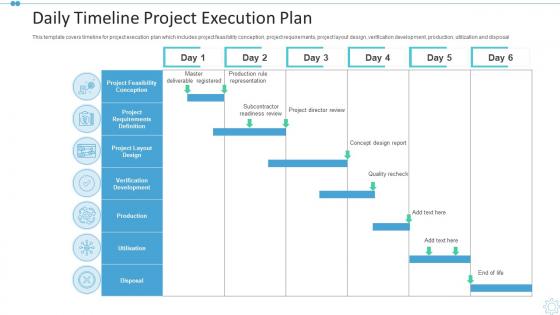
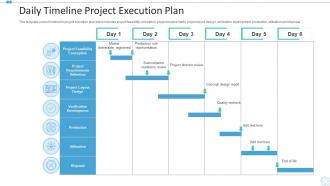
Daily timeline project execution plan




Try Before you Buy Download Free Sample Product
 Impress Your
 Audience
 100%
100% Editable
 Save Hours
 of Time


Our Daily Timeline Project Execution Plan are topically designed to provide an attractive backdrop to any subject. Use them to look like a presentation pro.
People who downloaded this PowerPoint presentation also viewed the following :
Daily timeline project execution plan with all 2 slides:
Use our Daily Timeline Project Execution Plan to effectively help you save your valuable time. They are readymade to fit into any presentation structure.
FAQs for Daily timeline
So there's five main phases: initiation, planning, execution, monitoring, and closing. Initiation is where you define scope and goals. Planning gets into the weeds with timelines, resources, risks - honestly the most boring part but super necessary. Execution is the actual work happening. Monitoring runs alongside to catch problems early. Closing wraps everything up and documents what you learned. Here's what they don't tell you though - you'll bounce between these phases constantly when stuff changes or breaks. Don't get too hung up on doing them perfectly in order. Think of them more like guidelines to keep your project from turning into complete chaos.
Think of scope, time, and cost like a three-legged stool - mess with one leg and the others have to shift too. First thing? Pin down what actually matters most to your stakeholders. Can't compromise on quality? Then you'll need more time or money when scope inevitably grows (because it always does). Document every single change and show the impact before saying yes to anything. I learned this the hard way on my last project - should've been more strict about it. Check in regularly so problems don't blindside you. Oh, and make a simple visual that shows all three constraints. People get it instantly when they can actually see the trade-offs happening.
Honestly, stakeholder engagement can totally make or break your project. You want to map out your top 5 stakeholders first - figure out who actually has influence. Then set up regular check-ins that don't annoy them but keep everyone in the loop. When people feel heard during the process, they're way more likely to use what you build. Makes sense, right? Plus you'll catch problems early instead of dealing with random scope changes later. I learned this the hard way on my last project - wish someone had told me to focus on communication from day one.
Don't wait until stuff goes wrong to think about risk - build it into your planning from day one. During project scoping, figure out what could tank your project and how likely each thing is. Honestly, I've watched so many teams get blindsided because they thought they were invincible. Create backup plans for the big scary stuff and pad your timeline accordingly. Someone needs to own each risk - can't just be everyone's job, you know? Oh, and make it a standing topic in meetings. Way easier to course-correct early than scramble when everything's on fire.
Honestly, daily standups are where it's at - I know they sound like corporate torture but they actually keep everyone on the same page. Get some shared tools going like Trello or Asana so people aren't constantly asking "wait, what's the status on X?" Document stuff somewhere accessible too. Regular check-ins help, and don't skip the random coffee chats even if they're virtual - that informal stuff matters more than you'd think. Oh, and resist the urge to implement everything at once. Pick like two things that vibe with your team first.
Start with the basics - did you hit your timeline, budget, and scope? That's the easy part. Then check if stakeholders are actually happy with what you delivered. Most PMs totally skip the retrospective which is honestly such a waste. Here's what I'd do: schedule a review meeting like 30-60 days after launch while everything's still fresh in people's minds. The real question isn't just "did we deliver" but "did this thing actually solve the problem we set out to fix?" Sometimes projects look successful on paper but don't move the needle business-wise.
Scrum and Kanban are your best bets - they're basically made for agile work. If your team likes structure, go with Scrum's sprints and regular meetings. Kanban's more about workflow and way less rigid. SAFe could work for bigger companies with multiple teams, but honestly? It gets complicated fast. I'd probably skip it unless you really need it. You could also try Lean or just mix different approaches based on what you're building. Really depends on your team's vibe and the project itself. Start with something basic and tweak it as you figure out what works.
Honestly, these tools just handle all the boring tracking stuff for you. No more hunting people down for updates or wondering who dropped the ball. I've used Asana and it's pretty solid - everyone can see what's going on without constant check-ins. The automatic reminders are clutch, and having all your files in one spot saves so much headache. You also get actual data on where things usually go sideways, which is weirdly helpful. If you're starting from scratch though, maybe try Trello first? It's super basic but you'll instantly see why people swear by this stuff.
Honestly, you've gotta overcommunicate like crazy. Daily standups help, but also do weekly one-on-ones where people actually talk about real stuff. Set up shared dashboards so everyone sees progress - otherwise people just disappear into their own bubbles, you know? Be super clear about timezones and when people should respond. Document everything immediately since you can't just tap someone's shoulder later. Oh, and don't skip the fun stuff - virtual coffee chats or random team games. Sounds cheesy but it actually keeps people connected enough to work together properly.
Don't let conflicts just sit there hoping they'll magically fix themselves - trust me, they won't. Talk to each person separately first to figure out what's really going on. Then get them in a room together. I've watched so many good projects completely fall apart because managers were too scared to have these conversations. Keep it focused on how it's affecting the work, not who said what to whom. If they can't agree, you'll have to make the call yourself. Write down whatever you decide so there's no confusion later. The faster you deal with it, the better - small drama turns into big team disasters real quick.
SMART goals basically save you from that nightmare where everyone's working super hard but going in completely different directions. You know what I mean? They force you to get specific about what you actually want to accomplish. Measurable, achievable, relevant, time-bound - all that stuff matters because it kills the guesswork. No more "let's just see how it goes" projects that drag on forever. Your team will actually know what success looks like, and tracking progress becomes way less painful. Honestly, just take whatever goals you've got now and run them through the SMART checklist. You'll probably catch some gaps right away.
Look, clear communication is honestly a game-changer for projects. Nobody's confused about deadlines or what they're supposed to do. You catch problems early instead of scrambling later when everything's on fire. Weekly check-ins work great - plus some kind of shared dashboard so people can actually see what's happening. Clients and your boss stay in the loop too, which saves you from those "what's the status??" panic emails. I learned this the hard way on my last project where we basically winged it. Trust me, a little structure upfront beats chaos every time.
Dude, scope creep will absolutely wreck you - document everything upfront and make changes go through formal requests. Timelines? Always add buffer time because Murphy's law is real. I learned this the hard way lol. Communication saves projects more than anything else. Do weekly check-ins, over-share rather than leave people guessing. Everyone needs to know their role from day one. Kickoff meetings are clutch for getting everyone aligned on what you're actually building. Honestly, most projects die from these basic mistakes, not the technical stuff.
Data analytics will save your sanity on projects, trust me. Instead of staring at endless spreadsheets, you can actually spot patterns in timelines, budget issues, and how you're using resources. I'd start with maybe 3-5 metrics that really matter - stuff like velocity and burn rates. Once you build simple dashboards around those, you'll predict problems way before they blow up your timeline. Don't get caught up in fancy metrics that look impressive but don't help you make decisions. Focus on what actually moves the needle. Your gut plus real data? That's where the magic happens.
Honestly, just pick 4-6 things that actually matter instead of drowning in data. Schedule and budget are obvious - those will kill your project fast if they're off. Then look at scope creep because clients always want "just one more thing." Team velocity shows if people are burning out or slacking. Quality stuff like defect rates matter too, obviously nobody wants to ship junk. Oh and stakeholder satisfaction scores - angry stakeholders make everyone's life miserable. Resource utilization is helpful but don't obsess over it. Pick what fits your specific project and ignore the rest.
-
Good research work and creative work done on every template.
-
Excellent template with unique design.