


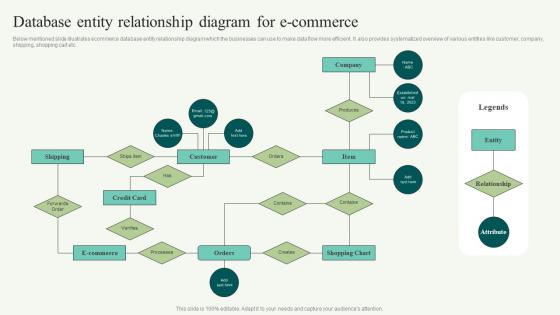
Diagrama de Relacionamento de Entidades de Banco de Dados para E-commerce




Try Before you Buy Download Free Sample Product
 Impress Your
 Audience
 100%
100% Editable
 Save Hours
 of Time


Diagrama de relacionamento de entidades de banco de dados de comércio eletrônico que as empresas podem usar para tornar o fluxo de dados mais eficiente. Também fornece uma visão geral sistematizada de várias entidades, como cliente, empresa, envio, carrinho de compras, etc.
People who downloaded this PowerPoint presentation also viewed the following :
Conteúdo desta apresentação em PowerPoint
"Os clientes não esperam que você seja perfeito. Eles esperam que você resolva as coisas quando algo der errado." - Donald Porter, VP da British Airways
Você só pode resolver as coisas quando conhece os mínimos detalhes sobre seus processos de negócios e tem um banco de dados armazenado para sua referência!
Planejando iniciar um negócio online? Mas confuso sobre como traçar os passos para seu site de comércio eletrônico?
Nós te cobrimos com nossos modelos de PPT 100% prontos para uso e editáveis sobre Diagrama de Entidade Relacionamento (ER) para E-Commerce. Criar uma experiência de compra online sem esforço para seus clientes é a necessidade da hora e nossos modelos vão ajudá-lo a alcançar exatamente isso. Ele mostra como as entidades ou dados interagem dentro de seu sistema estabelecido e quais atributos eles devem ter.
Os diagramas ER utilizam técnicas de modelagem de dados para definir processos de negócios, servindo assim como a base para um banco de dados relacional. Vamos entender isso melhor com a ajuda de um exemplo fácil. Suponha que você esteja planejando se inscrever em um curso. Neste caso, existem duas entidades: você e o curso, e o ato de se inscrever no curso é o relacionamento. Da mesma forma, para um site de comércio eletrônico, as entidades seriam cliente, produto, pedido e pagamento. O diagrama ER ajudará a definir os relacionamentos entre todas as suas entidades dentro do sistema e refletir a estrutura de seus dados armazenados.
Você pode ter uma melhor compreensão dos componentes essenciais que combinam clareza e expressão concisa através de nossos modelos de PPT entity-relationship-diagram-essential-components. Baixe para ter um entendimento aprofundado antes de se aprofundar no diagrama ER real.
Entidade Relacionamento Diagrama para E-commerce 1. Cliente - ID do Cliente - Nome - Endereço - Telefone - Email 2. Pedido - ID do Pedido - ID do Cliente - Data do Pedido - Status do Pedido - Valor Total 3. Produto - ID do Produto - Nome do Produto - Descrição - Preço - Quantidade em Estoque 4. Categoria - ID da Categoria - Nome da Categoria - Descrição 5. Carrinho - ID do Carrinho - ID do Cliente - ID do Produto - Quantidade 6. Pagamento - ID do Pagamento - ID do Pedido - Tipo de Pagamento - Valor Pago - Data do Pagamento
Utilize nosso Diagrama de Relacionamento de Entidade de Banco de Dados para E-commerce para economizar seu tempo valioso. Eles estão prontos para se encaixar em qualquer estrutura de apresentação.





FAQs for Database Entity Relationship Diagram
So you're gonna need the basics first - Customer, Product, Order, Category, and Payment. Those are like your foundation. OrderItem is clutch for connecting orders to products since that's a many-to-many thing. Cart's pretty much mandatory too, obviously people need to dump stuff somewhere before buying. Supplier's good if you care about tracking where inventory comes from. Honestly though? Don't overcomplicate it right away. Reviews and shipping can just be simple fields at first - you don't need separate entities for everything. Build those core relationships first, then add the fancy stuff later when you actually need it.
Look at what each one actually does first. Products are your individual items - SKU, price, description, all that stuff. Categories group them together like "Electronics" or whatever makes sense for your store. Customers are obviously the people buying things. The data they hold is totally different though. Products track inventory levels, categories can have subcategories (which gets messy fast btw), and customers store order history plus preferences. Just sketch them as separate boxes initially, then draw lines between them. Customers purchase products, products fit into categories. Makes way more sense when you see it visually.
So you'll want a one-to-many relationship here - each customer can have tons of orders, but every order belongs to just one customer. Stick a customer_id foreign key in your Orders table that points back to your Customers table. Oh, and don't forget referential integrity constraints or you'll end up with random orders that don't belong to anyone (been there, not fun). You might also think about whether you need extra stuff on the relationship itself - like order timestamps or maybe customer-specific preferences that change how orders get handled. Really depends on what you're building though.
Create a Payment entity that links to your Order - either one-to-one or one-to-many if you're doing split payments. Include stuff like payment_method, amount, transaction_id, payment_status, timestamp. I'd also make a PaymentMethod entity for saved cards and customer preferences. Way cleaner than shoving everything in one table, trust me. Connect it to your Customer entity too. Just reference transaction IDs and avoid storing actual payment details - that's a security nightmare you don't want to deal with.
So inventory management is totally the backbone of your e-commerce ER model. You'll need an Inventory entity tracking quantities and stock levels for each product variant - connects to Products and feeds into Order processing so you don't oversell (learned that one the hard way). The real headache comes when you're dealing with real-time updates across multiple sales channels. Your ER diagram needs to show how stock adjustments happen from orders, returns, and manual updates. Honestly, concurrent transactions will bite you later if you don't plan for them now. It gets messy quick.
Just make separate tables for Promotions and Discounts that connect to your main stuff. Link promotions to products for specific deals, and to orders for things like free shipping. You'll need fields like discount_percentage, start_date, end_date, promo_code. Honestly, throw in a promotion_type field now - trust me on this one. When marketing comes asking for BOGO deals later, you'll thank yourself. Also connect promotions to customer segments if you're doing targeted offers. The whole thing needs to be flexible because marketing will definitely come up with crazy discount ideas you haven't thought of yet.
So you'll need the obvious stuff first - product_id, name, description, price. Then add category, brand, SKU for search/filtering purposes. Stock quantity is crucial, plus weight and dimensions if you're calculating shipping. Average rating and review count help with social proof too. Image URLs are super important - honestly, crappy photos kill sales faster than anything. I'd also throw in status fields like is_active so you can handle out-of-stock items without breaking everything. Start with these basics and add specialized stuff like color variants later depending on what you're selling.
So basically you want your Customer, Cart, Order, and Payment tables talking to each other without making your database cry. Instead of joining everything separately, throw some commonly-used stuff like shipping addresses right into the Order table. Yeah it's not perfectly normalized but whatever - nobody's got time for slow checkouts. Cache those cart totals too so you're not doing math every time someone blinks. One solid query should grab what you need for the whole checkout page. Oh and definitely don't make people wait forever or they'll just abandon their cart and buy from Amazon instead.
So basically, keep vendor stuff totally separate from your main platform - different tables for Vendors, Products, and Storefronts since each vendor needs their own little corner. Payment splitting is where things get tricky though, especially tracking commissions (learned that the hard way). Your User table should handle both regular customers and vendor accounts with proper roles. Oh and inventory per vendor is crucial - can't have vendors selling stuff they don't actually have. Order routing gets complex too. Start with that Vendor-Product-Order foundation and expand from there. Trust me, plan the money flow first or you'll regret it later.
So you'll need a Reviews table that links to both Users and Products with foreign keys. Each review gets user_id, product_id, rating (1-5), review text, and timestamp. Oh and definitely throw in a helpful_votes field - people go crazy for that stuff! One user can write tons of reviews, products can have tons of reviews, but each review belongs to just one user and one product. You calculate averages by pulling all reviews for each product. Honestly, just sketch out those three tables first and how they connect. Makes everything way clearer.
Yeah so adding shipping to your ER diagram gets a bit messy but it's worth it. You'll connect it to orders, customers, maybe products for weight stuff. Tracks costs, delivery status, carrier details - all that good stuff. Oh and you can do multiple shipping methods per order which is clutch for weird cart situations. Database gets more complex obviously, your queries too. But honestly the tracking capabilities you get are pretty solid for customer service. I'd totally add shipping addresses as separate entities btw - people ship everywhere except their billing address half the time.
So supplier-product relationships are basically the core of your inventory setup in ER diagrams. Most of the time you'll want many-to-many since suppliers carry multiple products and products come from different suppliers. Junction tables are where you store the good stuff - wholesale prices, lead times, all that vendor-specific data. Honestly, this is one of those things you really don't want to mess up because it cascades everywhere. Your purchase orders depend on it. Product availability too. Getting the relationship structure right upfront saves you tons of headaches later when you're trying to track stock levels and pricing.
So basically, ER diagrams let you bake security right into your database design instead of scrambling to add it later. I'd separate sensitive stuff like payment details and passwords into their own isolated tables - that way if someone breaks in, they can't grab everything in one go. You can also map out user permissions super clearly (customers definitely shouldn't peek at admin data!). The visual layout helps you spot exactly where you need encryption and audit trails. Pro tip I learned the hard way - mark your sensitive entities in red while designing. Forces you to actually think about protection from day one rather than playing catch-up.
So I'd set up a CustomerSegment entity with a many-to-many relationship to Customer - people bounce between segments all the time. Track stuff like segment_type, criteria_used, and date_assigned so you know how they got there. Honestly, I always create a separate SegmentCriteria entity because marketing teams change their minds constantly and it's way easier to manage. Add some derived attributes to Customer too - total_purchases, avg_order_value, whatever feeds your segmentation. Start basic with "high-value" or "frequent buyer" segments first, then go crazy later.
So primary keys are super important - they stop duplicate records from messing things up. Foreign keys connect your tables properly (like linking customers to their orders). Honestly, constraints will save your sanity - NOT NULL for required stuff, CHECK constraints for valid ranges, UNIQUE where it makes sense. Normalize your data to cut redundancy, but don't get too obsessed with it. Set up referential integrity so you can't accidentally delete a customer who still has orders floating around. Oh, and index the fields you query a lot. These basics will catch most problems early on.
-
The website is jam-packed with fantastic and creative templates for a variety of business concepts. They are easy to use and customize.
-
Great designs, really helpful.