

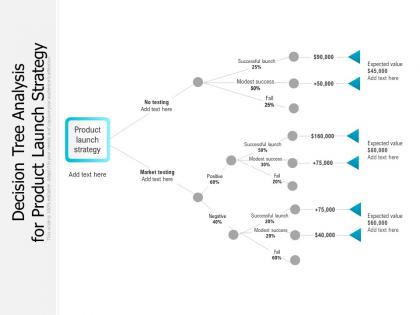
Decision tree analysis for product launch strategy




Try Before you Buy Download Free Sample Product
 Impress Your
 Audience
 100%
100% Editable
 Save Hours
 of Time


Get down to the action with our Decision Tree Analysis For Product Launch Strategy. Exhort them to begin confidently.
People who downloaded this PowerPoint presentation also viewed the following :
Decision tree analysis for product launch strategy with all 2 slides:
Get in on the action with our Decision Tree Analysis For Product Launch Strategy. Ensure you get your piece of cake.

FAQs for Decision tree analysis for
Key components of decision tree analysis include decision nodes, chance nodes, branches, payoffs, and probabilities. These elements work together by mapping decision pathways, quantifying uncertain outcomes, and calculating expected values, enabling organizations in finance, healthcare, and manufacturing to systematically evaluate complex choices and optimize resource allocation for maximum strategic advantage.
Decision tree models handle categorical data by creating binary splits based on category membership, while continuous data is split using threshold values that optimize information gain or variance reduction. For categorical variables like customer segments or product types, the algorithm evaluates which categories should group together, whereas continuous variables such as income or age are split at specific numerical thresholds, ultimately enabling comprehensive analysis across diverse datasets.
Decision trees offer interpretability, handling of mixed data types, automatic feature selection, non-parametric flexibility, and built-in missing value management over other predictive modeling techniques. These capabilities streamline model development by requiring minimal data preprocessing, providing clear visual explanations for stakeholders, and delivering robust performance across diverse datasets, with many organizations finding that decision trees enable faster model deployment and enhanced business user adoption.
Decision tree analysis proves most effective in scenarios involving complex multi-stage decisions, resource allocation challenges, risk assessment projects, and strategic planning initiatives where multiple variables and outcomes must be evaluated simultaneously. Organizations in healthcare, finance, and manufacturing find it particularly valuable for investment decisions, treatment protocols, and operational planning, as it delivers clear visual frameworks and quantifiable insights, ultimately enabling data-driven choices while minimizing uncertainty.
Optimal decision tree depth is determined through cross-validation testing, pruning techniques, and monitoring performance metrics like accuracy and overfitting indicators. Financial institutions and healthcare organizations increasingly use methods such as cost complexity pruning, maximum depth limits, and minimum sample requirements, with many finding that balanced depths between 5-15 levels deliver enhanced predictive accuracy while maintaining model interpretability.
Pruning prevents overfitting by removing branches that don't significantly improve prediction accuracy, creating more generalizable models that perform better on new data. This technique streamlines decision trees by eliminating unnecessary complexity, ultimately delivering more reliable predictions and faster processing speeds, with many organizations finding that pruned models provide clearer insights for strategic decision-making.
Decision tree analysis enhances risk assessment by mapping potential outcomes, quantifying probabilities, and calculating expected values for each decision path. Financial institutions use these models for credit risk evaluation, while healthcare organizations assess treatment risks, and manufacturing companies evaluate operational hazards, ultimately enabling data-driven decisions that minimize exposure and optimize strategic outcomes.
Decision tree analysis faces limitations including overfitting to training data, instability with small data changes, bias toward features with more levels, difficulty handling continuous variables, and challenges with complex relationships. While these constraints can affect accuracy in dynamic business environments, many organizations find that combining decision trees with ensemble methods and regular model updates significantly enhances their predictive reliability and strategic value.
Decision tree output is interpreted by following branches from root to leaf nodes, where each internal node represents a decision point based on feature values, and leaf nodes contain final predictions or classifications. The path through the tree reveals the logical reasoning behind each prediction, with splits showing which attributes most influence outcomes, while node purity measures and feature importance rankings help organizations understand key decision drivers and optimize strategic choices.
Decision trees integrate with ensemble methods like Random Forests through bootstrap aggregating, feature randomization, and parallel model training across multiple tree variations. Random Forests combine hundreds of decision trees trained on different data subsets and feature combinations, reducing overfitting while maintaining interpretability, with many organizations finding that this ensemble approach delivers significantly improved prediction accuracy and robust performance across diverse business applications.
Best practices for creating decision trees include defining clear objectives, gathering comprehensive data, identifying all possible alternatives, assigning realistic probabilities, and validating assumptions with stakeholders. These practices enhance strategic planning by minimizing biases, ensuring thorough analysis, and improving decision accuracy, with many organizations finding that structured approaches ultimately deliver better resource allocation and competitive advantage.
Feature selection significantly impacts decision tree accuracy by reducing overfitting, eliminating noise from irrelevant variables, and focusing the model on truly predictive attributes. Through strategic feature selection, organizations in healthcare, finance, and retail can streamline their decision trees for better generalization, faster processing speeds, and more interpretable results, ultimately delivering enhanced predictive performance and actionable business insights.
When visualizing decision trees for presentations, consider clarity through simplified branching, consistent color coding for outcomes, readable font sizes, and logical flow from left to right. These design elements enhance audience comprehension by minimizing cognitive load, highlighting key decision points, and maintaining visual hierarchy, with many organizations finding that well-structured tree visualizations significantly improve strategic communication and stakeholder buy-in.
Decision tree analysis improves business decision-making by providing visual clarity for complex choices, quantifying risks and outcomes, and enabling systematic evaluation of multiple scenarios. Through structured mapping of decisions and their consequences, organizations streamline strategic planning, resource allocation, and risk assessment processes, ultimately delivering faster, more informed decisions and enhanced competitive advantage.
Yes, decision tree models excel in real-time predictions due to their computational efficiency, simple branching logic, and fast processing capabilities. Financial institutions use them for instant fraud detection during transactions, while e-commerce platforms leverage decision trees for real-time recommendation engines and dynamic pricing, ultimately delivering faster customer responses and enhanced operational efficiency across industries.
No Reviews