


Develop The Employee Journey Map Hr Strategy Of Employee Engagement





Try Before you Buy Download Free Sample Product
 Impress Your
 Audience
 100%
100% Editable
 Save Hours
 of Time


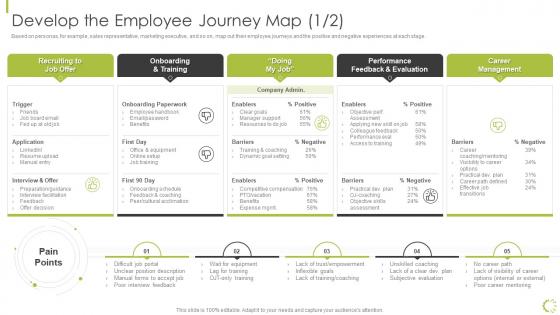
Based on personas, for example, sales representative, marketing executive, and so on, map out their employee journeys and the positive and negative experiences at each stage.
People who downloaded this PowerPoint presentation also viewed the following :
Develop The Employee Journey Map Hr Strategy Of Employee Engagement with all 7 slides:
Use our Develop The Employee Journey Map Hr Strategy Of Employee Engagement to effectively help you save your valuable time. They are readymade to fit into any presentation structure.





FAQs for Develop The Employee Journey Map Hr Strategy
So there are five main stages: pre-boarding, onboarding, development, retention, and offboarding. Basically covers someone's whole journey from when they first apply to their exit interview. Onboarding is huge - screw that up and people bail within months. Development though? That's where you really build loyalty. Each stage affects how engaged people feel, which is obvious but still worth saying. The smart move is mapping out these stages so you catch problems early. Oh, and definitely survey employees at each point - what you think is happening vs. reality can be pretty different. Most companies are way too optimistic about their own processes.
Honestly, you've gotta cast a wide net on this one. Employee surveys and exit interviews are your starting point - that's where people actually tell you what sucks. Then dig into the HR numbers: retention rates, how long promotions take, performance trends. Focus groups are where the magic happens though - people get way more honest in group conversations than filling out some form. Oh, and segment your data! New hires vs. old-timers will have totally different gripes. Regular pulse surveys help too since things change fast. The whole point is getting multiple angles so you're not flying blind.
So for employee journey mapping, Miro and Mural are both solid choices - your whole team can jump in and collaborate live. Lucidchart's good too if you want more structure. Actually, don't overlook just grabbing a whiteboard for the initial brainstorm session! Map everything chronologically from pre-boarding to when people leave, noting pain points and how employees feel at each step. Start basic with sticky notes to get the flow down, then move it digital later. Oh, and sticky notes are weirdly satisfying to move around anyway.
So here's the thing - millennials want growth opportunities and flexibility, while Gen X cares more about stability and decent work-life balance. Remote employees hit different snags during onboarding than office workers do. Women and underrepresented folks often slam into promotion barriers that others never see coming (honestly, it's frustrating how common this is). Parents deal with totally different pressures too. You'll want to survey each group separately to figure out what actually bugs them versus what motivates them. Then customize your benefits and touchpoints around those insights. It's way more personalized than most companies realize.
Honestly, tech is what makes everything click for employees. HRIS systems make onboarding way smoother, and tools like Slack actually help people communicate instead of drowning in emails. Learning platforms are great for skill building too. The analytics piece is huge - you can finally see what's frustrating people and fix it. Mobile apps let employees access stuff on the go, which is clutch. Automation handles the boring HR stuff so your team can do more meaningful work. Just pick tech that solves real problems your people have. Don't fall into the trap of using shiny new tools just because everyone else is.
So employee journey mapping is like putting a microscope on your workplace culture - it tracks how people actually feel from day one to when they quit. You'll catch all the rough spots where things go sideways. Maybe new hires are totally lost their first week, or your star employees suddenly stop caring. Pretty eye-opening stuff, honestly. It shows you the real gap between what leadership thinks is happening versus what employees deal with daily. Focus on fixing the pain points that hit the most people first - those usually give you the biggest bang for your buck.
Honestly, most places mess up the basics. Onboarding is usually a disaster - too much info dumped at once, confusing processes everywhere. Career development? Good luck figuring out how to actually advance. Plus managers are terrible at communicating half the time. The tech systems are always from like 2015 too, which drives me nuts. Best thing you can do is just ask your team what's bugging them most. You'll see patterns real quick. Then focus on the obvious stuff first - better documentation, clear expectations, training that doesn't suck. Regular check-ins help too. Map out where people typically get stuck and fix those spots one by one.
Honestly, once a year minimum but twice is way better if you can manage it. Big changes like restructuring or new tech? That's when you definitely need to update them. I've watched so many companies spend forever creating these gorgeous maps then completely forget about them - such a waste of time and money. Survey your people about what's bugging them first, then see how that lines up with your current maps. Post-pandemic especially, everything's different with remote work and people just expecting more. Short surveys work great for this stuff.
Track your retention rates and satisfaction scores first - those are your bread and butter. New hire time-to-productivity is huge too. Internal mobility tells you if people see a future there, and honestly exit interviews are brutal but so useful. Pulse surveys catch problems before they explode (learned that the hard way). You need before/after data or you're just guessing if stuff actually worked. Monthly dashboard keeps leadership happy when they inevitably ask for proof. Oh and don't sleep on engagement metrics - sometimes those spike before retention improves.
Build feedback collection directly into your mapping process from the start. Pulse surveys and focus groups work great for specific touchpoints you're looking at. Exit interviews are honestly amazing for this - people get brutally honest when they're on their way out! Create ongoing feedback loops so you can update your maps regularly based on what employees actually tell you. Don't make it a one-time deal. Quarterly check-ins help you validate assumptions and spot new pain points. The whole thing needs to be continuous or you'll miss stuff as things change.
So basically, journey mapping shows you exactly where your people are getting pissed off or checking out mentally. Think confusing onboarding processes, dead-end career paths, terrible managers - you know, the usual suspects that drive people to update their LinkedIn profiles. Instead of throwing random perks at the wall and hoping something sticks, you'll actually know where to focus your efforts. I'd start with just one role honestly - map everything from day one through their first promotion. You'll probably find some pretty glaring gaps that explain why people keep bailing on you.
Honestly, you need people from different teams because they all see stuff you'd totally miss. HR catches onboarding headaches, IT finds the system bugs, managers spot weird workflow things. When they help build the map, they actually care about fixing what comes up later - which is kinda the whole point, right? Grab someone from HR and IT for sure, plus maybe two people from different business units. I'm telling you, the blind spots you'll discover are wild. Different perspectives make these maps actually useful instead of just... pretty diagrams nobody acts on.
Your journey map IS your employer brand - like, literally what people experience vs what you claim. Every step from that first job post to their last day either proves or destroys whatever's on your careers page. Bad onboarding? Crickets after interviews? That's your actual brand right there. Honestly, most companies are shocked when they see the gap. Map out one role completely and you'll spot exactly where things fall apart. Those breakdowns are gold though - now you know what to fix instead of just guessing why people keep leaving.
Honestly, don't overthink this - Google Docs or even sticky notes work fine to start. Pick one group first (new hires are usually easiest) and just map out their journey from application through their first 90 days. I know it sounds like a lot, but trust me, breaking it into chunks helps. Talk to people directly! Quick coffee chats or simple surveys work better than fancy tools anyway. Find those 2-3 moments where things either click or fall apart completely - that's where you focus your energy first. The best part? Just listening to your team costs zero but makes a huge difference.
Honestly, the key is tying your journey map straight to business goals - retention, productivity, whatever you're actually tracking. Get leadership involved upfront so they can tell you which touchpoints really matter. I've watched teams create these gorgeous maps that just sit there looking pretty while nothing changes! Real employee data beats assumptions every time. Focus hard on the moments that actually move your metrics. Oh, and don't forget feedback loops - your priorities will shift and the map needs to shift with them. Otherwise you'll be optimizing for stuff that doesn't matter anymore.
-
Fantastic and innovative graphics with useful content. The templates are the best and latest in the industry.
-
Graphics are very appealing to eyes.