


Developing a strategy house example of ppt






Try Before you Buy Download Free Sample Product
 Impress Your
 Audience
 100%
100% Editable
 Save Hours
 of Time


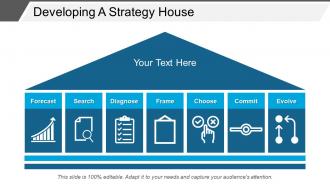
Represent the flow of information within a company system, use our, developing a strategy house example of PPT. The concept of a planned house is shown here. Development of a process and strategic planning is displayed in this strategy house PPT template. The stages in the diagram are forecast, search diagnose, frame, choose, commit, evolve. This is the usual way of modeling and assembling your process of information flow. Besides, you can perceptibly represent the value of such data and process flow through the help of our PowerPoint Slide which also serves to hold your audience’s attention towards the concept of perception. Improves the quality and accuracy of the business processes and elaborate on complex processes through simple steps. Downloading this slide will release its numerous features for your best experience. Find an answer to all the complications with our Developing A Strategy House Example Of Ppt. It allows you to address intricate affairs.
People who downloaded this PowerPoint presentation also viewed the following :
Developing a strategy house example of ppt with all 5 slides:
Handle complacent folk with our Developing A Strategy House Example Of Ppt. Jolt them out of their easy going habits.
FAQs for Developing a strategy house
So basically you need three main parts: your foundation (like your company's core purpose), then 3-5 strategic pillars that are your big focus areas, and finally the actual initiatives that support each pillar. Picture it like building a house - foundation first, then your main rooms. What really makes these work is having metrics at every level so you can actually see if you're making progress. Everything should connect vertically too - your day-to-day stuff rolls up to initiatives, which roll up to pillars, which tie back to your purpose. It's pretty satisfying when it all clicks. Oh, and definitely map out what you've already got before you start building anything new. Save yourself some headaches.
Think of it like a blueprint that connects the dots from your company's big vision down to what your team actually does day-to-day. Start at the top with that high-level mission, then break it into strategic goals, then initiatives, and finally your team's specific targets. Honestly, most companies are terrible at this part. But when you map it out visually, people can finally see how their work matters and connects to everything else. It's pretty satisfying when teams realize they're not just checking boxes - they're actually building toward something bigger. Try sketching out how your current goals link back to the company vision.
Dude, try using a strategy house visual next time you present. Way better than boring bullet points that make everyone's eyes glaze over. The house format shows how your foundation connects to your pillars and vision - people actually get it. I mean, stakeholders can see the whole picture instead of just hearing random pieces. Makes it stick in their heads too, unlike those text-heavy slides we all hate. Honestly, I wish more people did this because it's so much easier to follow. Just sketch it out beforehand and watch your audience actually pay attention for once.
Definitely ditch those generic template pieces and put in stuff that actually matters for your industry. Like, instead of boring "customer satisfaction" metrics, healthcare should track patient outcomes, manufacturing needs safety incidents - you get the idea. Map out what your stakeholders are already obsessing over daily, then work backwards from there. Those key pillars need to match what actually drives success in your sector, not some textbook example. I swear half these templates look like they were written by someone who's never worked a day in the real world! Start with your current strategic priorities and just customize around that framework.
Okay so stakeholder analysis is basically figuring out who actually matters before you start building your strategy. Map out the key players - their interests, how much influence they have, potential drama between them. It's like... you know when you're planning something big and need to think about who's gonna have opinions? Same thing but for business. This stuff directly shapes your vision and objectives because you're designing for real people with real agendas. Honestly, most strategies fail because someone didn't think through the politics early enough. Start by listing your top 10 stakeholders, then rate their influence versus interest. That gives you where to focus first.
Honestly, the best way to tell if your strategy house is working? Check if teams actually bring it up in meetings. I'm talking quarterly planning sessions, prioritization talks - that stuff. If they're not referencing it naturally, you've got a problem. Also run some employee surveys to see if people can explain your strategy consistently (spoiler: they usually can't at first). Track your KPIs against whatever outcomes you mapped out too. But seriously, just audit how often teams mention your framework when they're planning. That'll give you the real picture of whether it's actually useful or just sitting in a deck somewhere.
Oh man, don't overcomplicate it - that's the killer mistake. Keep each level simple and focused, otherwise people just ignore the whole thing. Leadership has to be on board from the start too, or you're basically building a fancy paperweight. I've watched so many pretty strategy houses turn into glorified wall art because they looked good but didn't actually help anyone make real decisions. You need that clear connection between your big vision up top and what people do day-to-day. Honestly? Run it by a few actual decisions first before you call it done.
Don't let your strategy house turn into some dusty document nobody looks at. Schedule quarterly reviews - like, actually put it on your calendar right now. Check if your pillars still make sense against what's happening in the real world. I've watched so many teams build these gorgeous frameworks that become totally irrelevant after six months (kinda heartbreaking honestly). For long-term stuff, say "moving toward" instead of "we will definitely achieve" - gives you wiggle room. Make updates feel routine, not like you screwed up the first time.
Honestly, PowerPoint or Google Slides are your best bet - boring but everyone knows how to use them. Miro and Mural are cool if you want the whole team collaborating in real-time during workshops. There are also specialized tools like Cascade or ClearPoint, though I've never actually used those myself. My advice? Just grab a template online and throw it into whatever software your team's already comfortable with. Don't overthink it - the content matters way more than which fancy tool you pick.
Honestly, it's just way more visual than those boring planning docs nobody reads. With a strategy house, everything connects - your vision's the roof, strategic themes are the pillars, and your capabilities are the foundation. Makes so much more sense than random bullet points scattered across different sections. Your team can actually see how stuff relates to each other instead of squinting at spreadsheets. Plus people remember visual stuff better (or maybe that's just me?). The whole thing feels less corporate and more like something you'd actually use. Start with a whiteboard sketch and see what happens.
Look, metrics are literally the only way you'll know if your strategy isn't total garbage. I've watched so many companies create these beautiful strategic plans that sound amazing in meetings, then completely bomb because nobody bothered defining what success looks like. You need 3-5 solid metrics that actually matter - not just feel-good numbers. Make them specific and measurable, obviously. Track them consistently or you're just guessing. Honestly, most people skip this part and wonder why their strategies fail. Don't be flying blind when you could just... measure the right things?
Think of it like giving your team a map instead of just telling them "go north." Everyone can literally point to the same visual and know what you're talking about. No more of those painful meetings where Sarah thinks "customer focus" means one thing and Mike thinks it's something totally different. New people get up to speed way faster too - they don't have to decode all your inside jokes and weird team shorthand. Honestly, it just cuts through so much BS. When someone asks how their random project fits into the bigger picture, boom - you've got an actual answer right there on the wall.
Oh man, they're literally everywhere once you notice! Apple's whole thing with syncing hardware, software, and services? That's a strategy house. Manufacturing companies use them to get lean ops, quality, and supply chains working together. Healthcare gets messy though - trying to balance patient care, costs, AND compliance is honestly a nightmare. Banks do it too for risk, customer stuff, and going digital. The cool part is you can totally customize the framework for whatever matters in your industry. Makes strategic planning way less chaotic when everything actually connects.
Look at which initiatives hit multiple strategic pillars at once - that's where you'll get the most value. Map everything against your strategy framework and score impact vs effort. High-impact, low-effort stuff first to build some wins. Honestly, the boring foundational work usually has to happen before the sexy growth projects, even though everyone wants to skip ahead. I know it sucks but that's just how it goes. Check your resource needs and timeline dependencies too. Don't let teams chase shiny objects when the basics aren't solid yet.
So basically, you map out everyone's role super clearly and tie their daily stuff to the big picture goals. Having it visual really works - like literally put that strategy on the wall where people can't ignore it. Each person needs to see how their piece connects to everything else. Monthly check-ins are huge for keeping people honest about what they actually delivered. Honestly, I think the visual part is underrated - there's something about seeing it that makes it stick better than just talking about it. Connect individual work directly to outcomes and you'll get way better accountability.
-
Topic best represented with attractive design.
-
Awesomely designed templates, Easy to understand.