


Devops consulting proposal it powerpoint presentation slides




Try Before you Buy Download Free Sample Product
 Impress Your
 Audience
 100%
100% Editable
 Save Hours
 of Time


This PowerPoint presentation document is a proposed offering for DevOps consulting companies. It includes the problems faced by client organizations and the proposed solutions offered by DevOps consulting services. Here is a professionally designed template on DevOps Consulting Proposal IT that can be helpful for certified DevOps professionals to solve a specific problem or educate employees to use DevOps tools and work according to DevOps principles. This template also covers details about the DevOps as a Service delivery model for a set of tools that facilitates collaboration between an organization's software development team and operations team. This DevOps as a Service proposal presentation ensures that all actions taken in the software delivery process can be tracked. This proposal provides solutions to bring Operational Efficiency to the organization. Book a free demo with our research team and customize this 100% editable template based on your specific business needs. Get access to it now.
People who downloaded this PowerPoint presentation also viewed the following :
Content of this Powerpoint Presentation
Slide 1: This slide displays title i.e. 'DevOps Consulting Proposal(IT)' and your Company Name.
Slide 2: This slide presents cover letter for the proposal.
Slide 3: This slide exhibits table of contents.
Slide 4: This slide also shows table of contents.
Slide 5: This slide covers the introduction of the company wherein we have focused on establishment year, insights, factsheet and recent achievements.
Slide 6: This slide covers the facts that make ABC consulting company different from other companies such as deep knowledge pool and industry tie-ups etc.
Slide 7: This slide covers the DevOps consulting company key feature what work they do and how they do it.
Slide 8: This slide covers the problems faced by the client’s organization such as not availability of 24*7 support for devOps engineers, cloud maintenance, etc.
Slide 9: This slide depicts that DevOps implementation requires adequate planning and guidance from experts and mentioned are the consulting services.
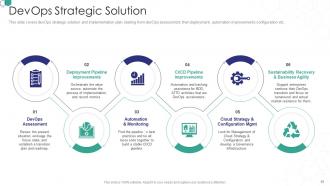
Slide 10: This slide covers devOps strategic solution and implementation plan starting from devOps assessment, then deployment, automation improvements configuration etc.
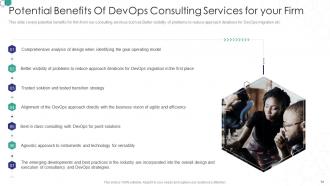
Slide 11: This slide covers potential benefits for firm from our consulting services such as Better visibility of problems to reduce approach iterations.
Slide 12: This slide covers the DevOps transformation services such as tools optimization, performance testing, defining TOM, cloud readiness and migration etc.
Slide 13: This slide covers the solution of the problems faced by the clients such as monitoring, containers, metrics, analytics, logs, performance security etc.
Slide 14: This slide covers the solution of the problems faced by the clients such as automated build testing, automated deployment, etc.
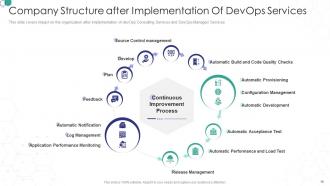
Slide 15: This slide covers impact on the organization after implementation of devOps Consulting Services and DevOps Managed Services.
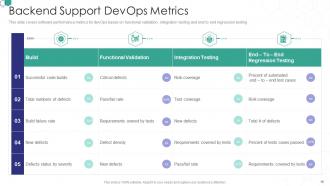
Slide 16: This slide covers software performance metrics for devOps based on functional validation, integration testing and end to end regression testing.
Slide 17: This slide covers the other services such as build & release automation, Infrastructure automation, training, log management etc.
Slide 18: This slide depicts that ABC company use all the leading DevOps tools to automate & measure the performance of the delivery pipeline.
Slide 19: This slide covers the DevOps roadmap to identify the key steps and timeline for launching the devOps initiatives by the consulting company.
Slide 20: This slide covers the pricing of devOps services such as economic services, mid to high range services and highest in cost spectrum.
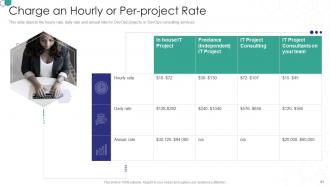
Slide 21: This slide depicts the hourly rate, daily rate and annual rate for DevOps projects or DevOps consulting services.
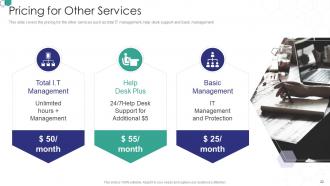
Slide 22: This slide covers the pricing for the other services such as total IT management, help desk support and basic management.
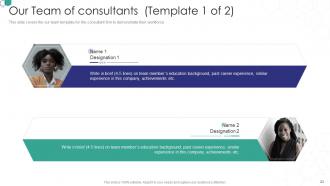
Slide 23: This slide covers the our team template for the consultant firm to demonstrate their workforce.
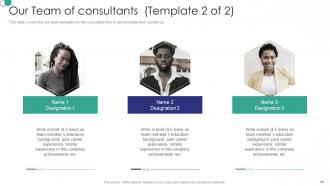
Slide 24: This slide covers the our team template for the consultant firm to demonstrate their workforce.
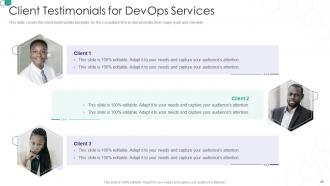
Slide 25: This slide covers the client testimonials template for the consultant firm to demonstrate their major work and clientele.
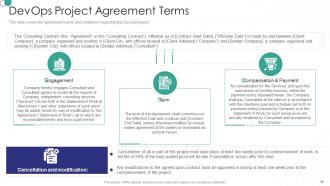
Slide 26: This slide covers the agreement teams and conditions regarding the DevOps project.
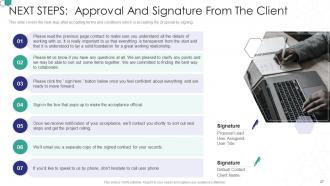
Slide 27: This slide covers the next step after accepting terms and conditions which is accepting the proposal by signing.
Slide 28: This slide contains contact details of the company.
Slide 29: This slide presents title for additional slides.
Slide 30: This is the icons slide.
Slide 31: This slide shows about your company, target audience and its client's values.
Slide 32: This slide exhibits monthly line charts for different products. The charts are linked to Excel.
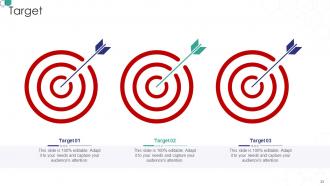
Slide 33: This slide presents targets of the company.
Slide 34: This slide depicts 30-60-90 days plan for projects.
Slide 35: This slide highlights comparison of products based on selects.
Slide 36: This slide exhibits yearly timeline.
Slide 37: This slide displays Venn.
Slide 38: This slide displays puzzle.
Slide 39: This slide depicts posts for past experiences of clients.
Slide 40: This is thank you slide & contains contact details of company like office address, phone no., etc.
Devops consulting proposal it powerpoint presentation slides with all 40 slides:
Use our DevOps Consulting Proposal IT Powerpoint Presentation Slides to effectively help you save your valuable time. They are readymade to fit into any presentation structure.
-
DevOps Consulting Proposal IT
-
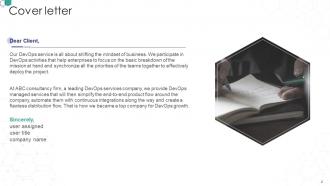
Cover letter
-
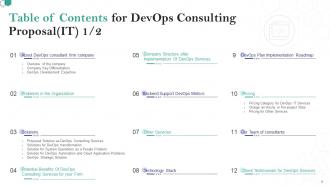
Table of Contents for DevOps Consulting Proposal IT 1 2
-
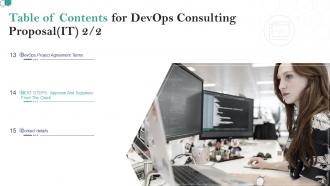
Table of Contents for DevOps Consulting Proposal IT 2 2
-
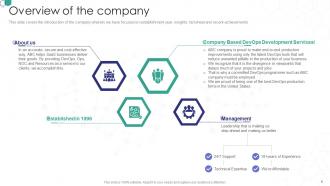
Overview of the company
-
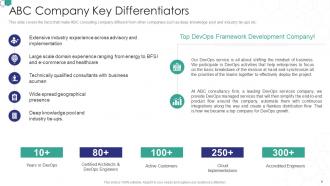
ABC Company Key Differentiators
-
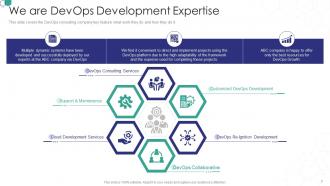
We are DevOps Development Expertise
-

Problems in the Organization
-
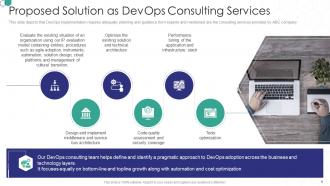
Proposed Solution as DevOps Consulting Services
-
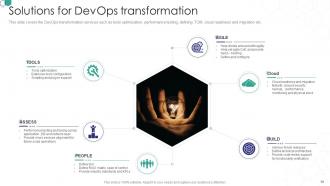
Solutions for DevOps transformation
-
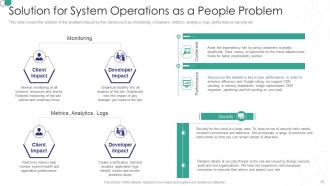
Solution for System Operations as a People Problem
-
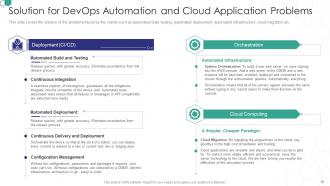
Solution for DevOps Automation and Cloud Application Problems
-
DevOps Strategic Solution
-
Potential Benefits Of DevOps Consulting Services for your Firm
-
Company Structure after Implementation Of DevOps Services
-
Backend Support DevOps Metrics
-
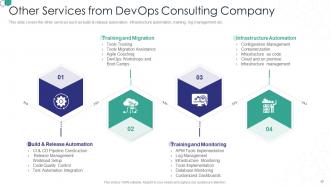
Other Services from DevOps Consulting Company
-
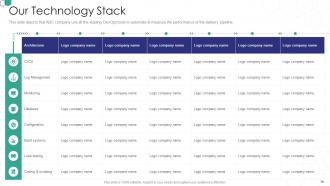
Our Technology Stack
-
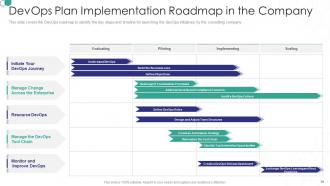
DevOps Plan Implementation Roadmap in the Company
-
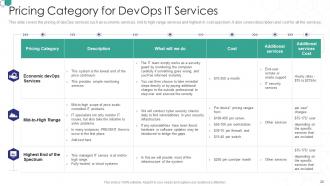
Pricing Category for DevOps IT Services
-
Charge an Hourly or Per project Rate
-
Pricing for Other Services
-
Our Team of consultants Template 1 of 2
-
Our Team of consultants Template 2 of 2
-
Client Testimonials for DevOps Services
-
DevOps Project Agreement Terms
-
Next Steps Approval And Signature From The Client
-
Contact Us
-
Additional Slides
-
DevOps Consulting Proposal IT Icons Slide
-
About Us
-

Line Chart
-
Target
-
30 60 90 Days Plan
-
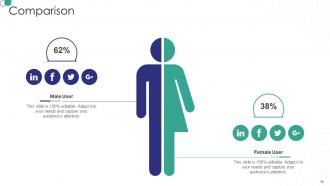
Comparison
-
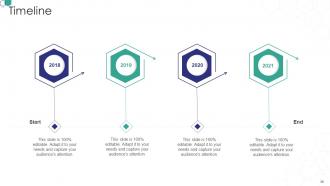
Timeline
-
Venn
-
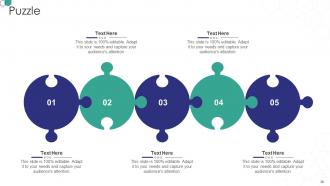
Puzzle
-
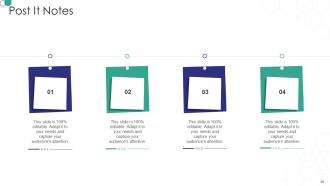
Post It Notes
-
Thanks for Watching
FAQs for Devops consulting proposal it
Look, you want to stop losing sleep over releases - that's priority one. Right now I bet your deployment process is a mess of manual steps that break constantly. So we need to automate that pipeline and get your dev/ops people actually talking to each other instead of pointing fingers. Also setting up proper monitoring so you catch problems before customers do. Infrastructure as code is huge too, though honestly that one's harder to sell to management. But yeah, faster releases, fewer disasters. Let's just map out what's currently making you want to quit, then tackle the worst stuff first.
Start by doing a maturity check across five areas: culture, automation, monitoring, how often you deploy, and incident response. Interview everyone - devs, ops, security, management. They'll all give you totally different answers about how "mature" they think things are, which is actually pretty telling. Map what they're doing against DORA metrics or standard DevOps frameworks. That gap analysis tells you where to start first. Oh, and here's something I learned the hard way - always check their actual metrics and tools. People sometimes think they're more advanced than they really are. The numbers don't lie.
Start with Jenkins or GitLab CI for your pipeline - that's the foundation. Docker's great for containers, then Kubernetes if you need orchestration later. Terraform handles infrastructure as code really well. Most teams totally mess up monitoring though, so grab Prometheus or DataDog early. Don't sleep on Git workflows either. Ansible's solid for config management but honestly? Pick maybe 2-3 tools first. I've seen too many teams try to do everything at once and just burn out. Get your CI/CD working smooth, then add containerization. Monitoring can come after you're not pulling your hair out with deployments.
Honestly, focus on the DORA metrics first - deployment frequency, lead time, recovery time, and failure rates. Those actually tell you something useful. Don't chase vanity metrics that just make pretty charts though, learned that the hard way. Business stuff matters too: customer satisfaction, revenue impact, how your team's actually feeling about the work. Pick maybe 3-4 things to track consistently instead of going crazy with data. Oh, and definitely get your baseline numbers before changing anything - otherwise you're just guessing if things got better. Start small, measure regularly, then expand from there.
Honestly, getting leadership on board first is huge - if they're not breaking down silos themselves, forget it. I'd start small though, like pick some low-stakes project with a mixed team so people can see wins without freaking out. Training is where most companies cheap out, but that's dumb because usually people aren't being difficult, they're just scared of stuff they don't get. Oh, and definitely make a big deal about early wins. Share those stories everywhere because momentum is everything with this kind of change.
Start by setting up CI/CD pipelines that run tests automatically when you push code - unit tests, integration tests, security scans, the whole deal. I'm partial to Jenkins or GitLab CI since they just work and play nice with everything else. You'll want different environments (dev, staging, prod) so code gets validated at each step before going live. Honestly, the automated rollback feature is a lifesaver - no more panic debugging at 2am when something breaks. Focus on automating your most critical test suites first, that's where you'll actually feel the difference right away.
Honestly, you gotta tackle those silos first - that's where everything falls apart. Get everyone on the same communication platform, whether it's Slack or Teams or whatever. Both teams need to be in planning sessions from the start, none of this throwing code over the wall nonsense. I've watched that disaster play out way too many times. Regular cross-team standups help a lot. Make sure people actually understand the bigger picture, not just their own little metrics. Oh, and don't try to fix everything at once - pick one small project as a test run first. You'll thank me later.
Look, we build security right into your development process instead of tacking it on later. Your CI/CD pipelines get automated vulnerability scanning and proper secrets management from the start. Honestly, I've watched too many teams pull all-nighters fixing security holes they could've caught early. We set up infrastructure as code with security policies baked in, plus train your developers on secure coding practices. The whole "shift left" approach means catching problems before they become expensive headaches. Your team ends up shipping faster because security flows with your workflow rather than blocking it.
Dude, you gotta dig into each industry's actual problems first. Healthcare? They're obsessed with HIPAA and data security - lead with that. Fintech wants bulletproof audit trails and regulatory stuff. Manufacturing is honestly kinda funny because they're running these dinosaur systems that somehow keep chugging along, but they need integration help. Figure out what's keeping them up at night, then show how your DevOps fixes those exact issues. Talk their language, not generic tech speak. Case studies from similar companies work way better than buzzwords. Oh, and always start with their biggest compliance headache - that's what gets their attention.
Honestly? It's mostly about people being stubborn. Dev teams and ops teams have never worked together before, and they don't trust each other at all. We always start with tiny pilot projects so they can figure out they don't actually hate each other. Plus your tech stack is probably a complete mess - way too many random tools nobody talks about. I'd focus on getting everyone in the same room first, then worry about processes later. Oh, and definitely tackle the mindset stuff before you even think about new tools. That order matters way more than people realize.
Honestly, we jump straight into mapping out how you're currently deploying stuff and figure out what's making everyone want to pull their hair out. From there, we build a pipeline that actually fits how your team works - not some cookie-cutter setup that looks good on paper but sucks in real life. Automated testing, proper environments, training your people on the new flow - all that gets handled. Most teams are doing daily deploys by week 3 instead of those nightmare monthly pushes. We don't just set it up and disappear either, which is nice because let's be real, that's what usually happens with consulting gigs.
Honestly, start simple with just 2-3 metrics that actually matter to your team. Deployment frequency is huge - if you're going from weekly to daily releases, you're crushing it. Lead time shows how fast you deliver features, while MTTR tells you how quickly you recover when things break (and they will break, trust me). Change failure rate is my personal favorite to track - watching it drop over months feels so satisfying. You can add system uptime and team velocity later, but don't overwhelm yourself initially. Pick what aligns with your business goals first, then expand once you've got those dialed in.
Look, instead of tacking compliance on at the end (which sucks), we bake it right into your CI/CD from the start. Automated policy checks, audit trails, governance gates - all built into your deployments. Way better than those soul-crushing manual approval processes everyone hates. Security scans run automatically, compliance dashboards actually make sense, and your role-based access doesn't fight your team structure. Honestly, the goal is making compliance invisible to devs while keeping auditors off your back. Just grab your top 3 compliance headaches and we'll show you how to automate them away.
Dude, budget like 20% of your team's time for DevOps training that first quarter. Focus on CI/CD pipelines, infrastructure as code, monitoring - the usual suspects. But honestly? The tech part is way easier than getting people to actually work together differently. I've seen teams nail the tools but still throw work over the wall like it's 2010. Pair up your senior folks with newer people and do some learning sprints where they can mess around without breaking production. Oh, and don't go crazy trying to fix everything - pick one or two processes and actually get those right first.
Honestly, I just block out time weekly to check Reddit and Discord DevOps communities - GitHub trending repos are insane for finding what's actually hot right now. DevOps Weekly newsletter is solid, plus I follow people who aren't just pushing vendor stuff. Every few months I'll spin up whatever looks interesting in a sandbox. My clients are surprisingly good sources too since they're always testing random tools and love venting about what worked (or didn't). Oh, and don't try following like 20 sources - pick 2-3 good ones and actually stick with them. That's where most people mess up.
-
Nice and innovative design.