


Diversity and inclusion training on inclusive leadership and traits of an inclusive leader edu ppt




Try Before you Buy Download Free Sample Product
 Impress Your
 Audience
 100%
100% Editable
 Save Hours
 of Time


This deck contains PowerPoint slides on inclusive leadership. With practical examples, it explains the multiple characteristics of inclusive leadership, such as curiosity, cultural intelligence, collaboration, commitment, courage, and cognizance.
People who downloaded this PowerPoint presentation also viewed the following :
Content of this Powerpoint Presentation
Slide 2
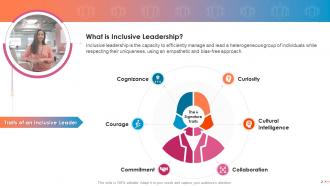
This slide provides information regarding the definition of inclusive leadership. It also contains details of major characteristics of an inclusive leader such as cognizance, curiosity, cultural intelligence, collaboration, commitment, and courage.
Instructor’s Notes:
The key traits of inclusive leaders are:
- Commitment: They exhibit a strong sense of personal responsibility for change to make the work environment rich in diversity and inclusion by regularly challenging the status quo and introducing D&I policies
- Courage: They don't shy away from sharing their opinions (even if politically or culturally unpopular) to achieve better diversity and inclusion at the organization. Also, they have the humility to accept their shortcomings and eagerly seek help from others to overcome them
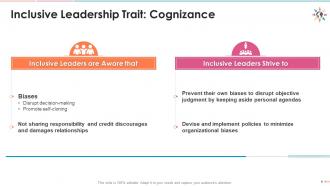
- Cognizance: They are well aware of their own biases and the organization's limitations and always exert considerable efforts to avoid making subjective decisions to ensure "fair play“
- Curiosity: They have an open mindset and listen to other's perspectives to minimize their blind spots and improve decision-making
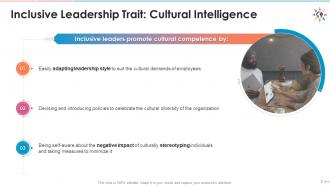
- Cultural Intelligence: They have awareness regarding the cultural practices of others and quickly change their management style to accommodate different cultural norms
- Collaboration: They promote diverse thinking and ensure team composition & processes are focused on achieving better cohesiveness
Slide 3
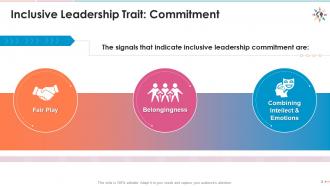
The slide provides information regarding the major characteristics such as fair play, belongingness, and combining intellect and emotions that reflect an inclusive leader's commitment towards creating diversity and inclusion-rich environment.
Instructor’s Notes:
The signals that indicate inclusive leadership commitment are:
- Fair Play: Inclusive leaders have a deep sense of fairness
- Belongingness: They spend time, energy, and resources towards creating a culture of belongingness
- Combining Intellect and Emotions: They can successfully merge the intellect (D&I Business Case) with the emotions of employees (view employees as more than resources)
Slide 4
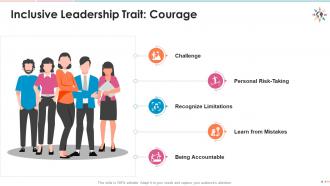
The slide highlights how an inclusive leader showcases courage such as challenge, personal risk-taking, recognizing limitations, learning from mistakes, and being accountable to make the work environment diverse and inclusion-rich.
Instructor’s Notes:
The inclusive leaders exhibit courage in the following way:
- Challenge: They regularly challenge the preexisting cultural norms of the organization
- Personal Risk-Taking: They act on their convictions & personal principles without any fear of backlash
- Recognize Limitations: They recognize their limitations and actively seek feedback to improve themselves
- Learn from Mistakes: They admit mistakes and learn lessons from them
- Being Accountable: They hold themselves and others responsible in case of failure to achieve any set D&I objective
Slide 5
The slide provides information regarding the inclusive leader’s trait, i.e. awareness of biases. It also contains details of disruptions caused by individual and organizational biases and how inclusive leaders overcome them.
Slide 6
The slide highlights how an inclusive leader showcases courage such as challenge, personal risk-taking, recognizing limitations, learning from mistakes, and being accountable to make the work environment diverse and inclusion-rich.
Instructor’s Notes:
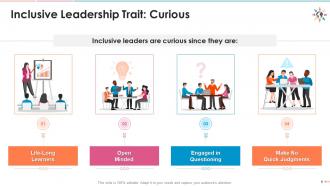
The inclusive leaders are curious since they are:
- Life-Long Learners: They are lifelong learners as they are genuinely interested in learning new things
- Open-Minded: They support new ideas and promote diverse thinking in team members
- Engage in Questioning: They engage in respectful questioning to understand different perspectives of team members
- Make No Quick Judgments: They refrain from making quick judgments
Slide 7
This slide provides information regarding the cultural intelligence trait of an inclusive leader by showcasing how they promote cultural competence.
Slide 8
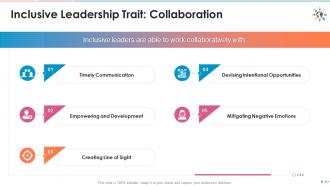
This slide provides information regarding the techniques followed by the inclusive leader to achieve better collaboration at work, such as timely communication, empower and development, devise intentional opportunities, and mitigating negative emotions.
Instructor’s Notes:
The inclusive leaders ensure collaboration at work
- Timely Communication: By clearly communicating needs in a timely manner
- Empowering and Development: By empowering and developing employees by providing opportunities and appreciating good work
- Creating Line of Sight: Ensuring a clear line of sight to provide purpose and meaning to each employee at work
- Devising Intentional Opportunities: By intentionally creating opportunities for innovation
- Mitigating Negative Emotions: By understanding how different individuals respond to change and, hence, mitigating their negative emotions accordingly
Additional Slide 1
This slide contains icons related to Diversity and Inclusion in the same color theme that can be used by you to provide additional information of your own.
Additional Slide 2
This slide can be edited by anyone to provide information about your organization. The slide is using the same color theme and similar design elements as the main deck.
Additional Slide 3
This slide contains editable 30-60-90-day plan and is completely editable to suit presenter’s needs.
Additional Slide 4
This slide contains a roadmap template which you can edit to communicate your roadmap in an impactful way.
Additional Slide 5
This fully editable slide contains Activity Calendar for Diversity & Inclusion activities that you can plan for your teams.
Additional Slide 6
This fully editable slide contains timelines for your plan around implementing Diversity & Inclusion agenda in your organization.
Diversity and inclusion training on inclusive leadership and traits of an inclusive leader edu ppt with all 15 slides:
Use our Diversity And Inclusion Training On Inclusive Leadership And Traits Of An Inclusive Leader Edu Ppt to effectively help you save your valuable time. They are readymade to fit into any presentation structure.
FAQs for Diversity and inclusion training on inclusive leadership and traits of an inclusive
Listen, the biggest thing is creating space where people actually feel safe to speak up. Notice who's talking in meetings and who isn't - then invite those quieter voices in. Ask questions instead of just assuming stuff. We're all biased honestly, but good leaders own that fact. Show real curiosity about different perspectives, not just polite nodding. When someone raises concerns about fairness or feeling excluded, actually do something about it. Oh, and amplify voices that usually get ignored - that makes a huge difference. Start with small changes and build from there.
Anonymous surveys work great for this stuff - ask people if they actually feel heard and whether leadership gets different viewpoints before making calls. 360-degree feedback is solid too, especially tracking if leaders boost underrepresented voices or call out bias. Some teams I know do "inclusion audits" where they track who talks in meetings and promotion patterns by demographics (kinda nerdy but useful). You'll want to measure both how people feel AND what's actually happening with outcomes. Honestly, just pick one approach that won't overwhelm your team and grow from there.
Honestly, you can't build an inclusive team without emotional intelligence - it's like trying to cook without tasting the food. Reading the room matters so much. When you understand how your words hit different people, that's when real belonging happens. The tricky part? Managing your own biases and knee-jerk reactions. Self-awareness helps you catch those moments when you're making assumptions about someone. Empathy lets you actually see things from their angle. And yeah, social skills keep you from getting all defensive during those awkward inclusion conversations. Try this: pause before responding in meetings and think about what everyone else might be feeling.
Listen, psychological safety is huge - people won't speak up if they're scared of getting shut down. Actually hear out different viewpoints, especially ones that challenge you. Don't let the same loud people dominate every meeting either. I've watched so many brilliant ideas get buried because quieter folks assumed nobody cared what they thought. Ask real questions and follow through on feedback. Oh, and own your mistakes - that vulnerability thing is contagious in a good way. Maybe start by checking in with each person individually about what'd make them feel more included?
Honestly? The hardest part is dealing with people who think diversity stuff is somehow "reverse discrimination" - ugh. Your own unconscious bias will trip you up too, which is humbling. It's mentally exhausting constantly considering equity in every decision. Creating psychological safety while still calling people out when needed? Super tricky balance. Oh, and you can't just flip a switch and fix everything (I learned that the hard way). Start with getting real about your own blind spots first. Build up a few allies slowly rather than trying to change the whole culture overnight.
Honestly, inclusive leadership works because people stop walking on eggshells and actually share their real ideas. You get way better solutions when your team isn't scared of being judged - plus diverse viewpoints catch problems you'd totally miss otherwise. The productivity boost is real too. Less turnover, people give a damn about their work, and you're not constantly dealing with drama. Oh, and here's something that actually works: call on your quiet team members during meetings. Like, directly ask them what they think. It shifts everything pretty fast and you'll be surprised what they come up with.
You can't just sit back and hope people will speak up - you've got to actively make room for different voices. I always start meetings by straight-up asking for varied viewpoints, and I rotate who's presenting stuff. Honestly, I've watched way too many leaders claim they want diversity while they're the ones talking nonstop. Your team composition matters too - make sure you've actually got people with different backgrounds and thinking styles. Oh, and when someone shares a perspective that's totally different from yours? Get curious about it instead of jumping straight into why your way works. You'll be surprised what you learn.
Honestly, people just stick around when they don't feel like crap at work. If your team feels heard and valued, they're gonna be way more engaged - it's not rocket science. Nobody wants to hide who they are or worry about getting judged for speaking up. Growth opportunities tend to be more fair too when leaders actually listen to everyone. I've seen it work firsthand. Try asking for different opinions in your next meeting instead of just nodding along with the usual voices. You'll probably be surprised how much more invested people get when they know their thoughts actually matter.
So mentorship is honestly amazing for this. You get exposed to people's real experiences - not just what you read about diversity but actual stories from different backgrounds. I've found it's the only way someone will actually call you out on your blind spots without making it weird. Cross-cultural mentoring especially helps you develop better empathy and cultural awareness. The trick though? Make it bidirectional. You should be learning just as much as you're teaching, maybe more. People feel safer giving you honest feedback about your leadership when there's that mentor relationship foundation already built.
Track the hard data first - recruitment, retention, promotion rates by demographics. Numbers tell the real story. But honestly, survey fatigue is so real right now, so mix in focus groups and casual one-on-ones too. Watch who actually speaks up in meetings and whether people from different backgrounds are moving into leadership roles. Psychological safety scores help, but consistency matters more than perfect metrics. Don't just take one snapshot - that's useless. Set your baseline this quarter and build from there. Oh, and the demographic breakdowns are where you'll see the biggest gaps usually.
Oh man, start with your language - ditch "guys" for "team" (honestly makes such a difference). Ask the quiet people directly what they think instead of letting the loud ones dominate. When you're running meetings, mention that there's usually more than one way to solve stuff. Here's something I learned the hard way - actually praise people when they do inclusive things well! It reinforces the behavior way better than just correcting mistakes. Don't try to overhaul everything at once though. Pick one thing, get comfortable with it, then add more. The whole point is making it feel genuine, not like you're checking boxes.
Honestly, feedback is everything when it comes to inclusive leadership. You can't see your own blind spots - like, ever. Getting input from people with different backgrounds shows you when you're accidentally shutting someone out or making weird assumptions. The hard part? People need to feel safe enough to actually tell you the truth about touchy stuff. Ask specific questions instead of generic ones - "How can I better support different perspectives in meetings?" hits different than just "Am I doing okay?" Oh, and actually mean it when you ask. People can smell fake curiosity from a mile away.
Honestly, diverse hiring is like a cheat code for inclusive leadership. You get access to way more talent from the jump, plus when your team already has people from different backgrounds, you're gonna hear perspectives you might've missed otherwise. Short sentences work. Those different viewpoints naturally push you toward better decisions because someone's always there to point out your blind spots - and trust me, we all have them. The real trick though? Don't just hire diverse people and call it a day. You've gotta actually listen to what they're saying and let those voices influence how things get done.
Here's the thing - diverse teams just come up with better stuff. When everyone thinks alike, you're stuck with the same boring solutions over and over. But mix up perspectives? That's when people start throwing out those crazy "what if we..." ideas that actually work. Your quieter team members probably have the best insights too, honestly. They're just not shouting over everyone else. So ask them directly next time you're brainstorming. Create that safe space where people aren't afraid to sound stupid, and you'll catch blind spots your team didn't even know existed. Just don't be one of those leaders who asks for input then ignores it - that's worse than not asking at all.
So many good options! I'd start with LinkedIn Learning or Coursera - they've got solid tracks on unconscious bias and inclusive communication stuff. Harvard Business Review has great case studies too if you're more of a reader. Podcasts are honestly underrated for this - I always listen during drives and pick up random insights. Oh, and if you want something more interactive, Catalyst and Center for Creative Leadership do amazing workshops. Just pick whatever fits how you actually learn best, then you can always add more later. Don't overthink it!
-
Design layout is very impressive.
-
Very well designed and informative templates.
-
Professional and unique presentations.
-
The content is very helpful from business point of view.
-
Editable templates with innovative design and color combination.