


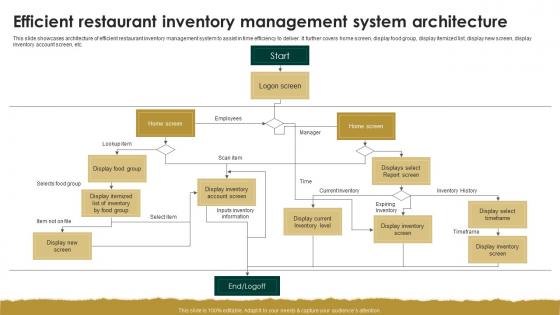
Efficient Restaurant Inventory Management System Architecture




Try Before you Buy Download Free Sample Product
 Impress Your
 Audience
 100%
100% Editable
 Save Hours
 of Time


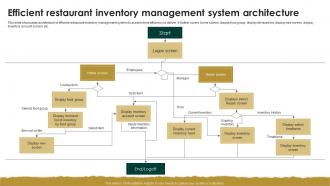
This slide showcases architecture of efficient restaurant inventory management system to assist in time efficiency to deliver. It further covers home screen, display food group, display itemized list, display new screen, display inventory account screen, etc.
People who downloaded this PowerPoint presentation also viewed the following :
Efficient Restaurant Inventory Management System Architecture with all 9 slides:
Use our Efficient Restaurant Inventory Management System Architecture to effectively help you save your valuable time. They are readymade to fit into any presentation structure.








FAQs for Efficient Restaurant Inventory
Honestly, you'll want to nail three things: real-time tracking, automated reordering, and waste monitoring. Start with tracking though - that's your foundation. You need to know what's actually sitting on shelves vs what the computer says you have. Nothing worse than running out of tomatoes mid-dinner rush, trust me. Once that's solid, set up automated reordering based on your par levels. Saves you from constantly babysitting inventory orders. Waste monitoring is huge too - it'll show you patterns like what spoils fast or gets prepped too much. The tracking part is honestly where most places mess up first.
Honestly, automating your inventory will save you so much time each week. There are apps that track everything in real-time and set up automatic reorder points. The barcode scanning alone makes counting way less painful. Some systems even connect to your POS system - they know what's selling and adjust counts automatically. Pretty neat, right? You can get ones that predict future needs based on your sales patterns too. I'd start simple with a basic inventory app first. Once your team gets the hang of it, then you can add the fancier features.
Ugh, where do I even start? Forecasting demand is brutal - you're always guessing wrong. Your ingredients spoil crazy fast, and if you don't have digital tracking, you'll be drowning in paperwork. Spoilage waste absolutely murders your profits. Then there's unreliable suppliers, zero storage space, and your staff "forgetting" to update inventory counts. Seasonal stuff makes it worse too - tomato avalanche one week, then you can't find a single decent one anywhere. Seriously though, get some kind of digital system going first. Train everyone to log stuff immediately or you're screwed.
Dude, bad inventory is like a money vampire. You're throwing away spoiled food, running out of stuff customers actually want, and your cash is just sitting there in overstock. Menu items keep going unavailable which pisses people off - honestly, nothing screams "amateur operation" like constantly being out of basics. Your food costs go through the roof while you're losing sales. Staff gets frantic trying to figure out substitutions. It's chaos. Track your daily waste first, then figure out proper minimums for each ingredient. That'll stop most of the bleeding.
Check your sales from last year around the same time - that's your baseline. Then factor in seasonal stuff and any new menu items you've added. Your POS system probably does most of this automatically now (seriously, when did restaurant tech get so good?). Weather's huge too - rain kills foot traffic, nice days bring crowds. I'd focus on your top 20 sellers first since that's like 80% of your business anyway. Oh, and don't forget about local events or festivals coming up - those can totally throw off your normal patterns.
Start tracking everything daily - seriously, FIFO saved my ass once I stopped being lazy about it. Your par levels should come from real usage data, not random guessing. I learned this the hard way after throwing away way too much wilted lettuce. Order smaller amounts more often instead of those giant bulk orders that seem like deals. Train everyone to repurpose stuff - roasted veggies from dinner service? Tomorrow's soup base. Do weekly waste audits to see what's actually getting tossed and why, then tweak your orders.
Dude, you gotta train your staff properly or you're screwed. Seriously - I've watched places hemorrhage money because nobody knew basic stuff like FIFO rotation or portion control. Your team needs to understand how to receive inventory, where everything goes, and actually use whatever tracking system you have. Servers recording comp meals wrong? That adds up fast. Kitchen staff eyeballing portions instead of measuring? Same problem. Oh, and make sure they get why accurate counts matter for your profits - people work better when they understand the "why" behind procedures. Start with counting basics and work up from there.
Label everything with dates right when it comes in - that's step one. Set up your storage so older stuff stays up front where people can actually reach it. Most places fail here because everyone gets lazy and just shoves new inventory wherever it fits. Clear bins help a lot since you can spot-check dates without digging around. Daily rotation checks are clutch, even if it's just a quick scan. Oh, and those dispenser things for dry goods? Total lifesaver since they automatically use the old stuff first. Train your team to always grab from front to back - sounds obvious but you'd be surprised how often that gets ignored.
Honestly, Toast is probably your best bet - integrates seamlessly with most POS systems so you're not doing double entry forever. BevSpot's solid too if you've got a heavy bar program. Smaller places can get away with MarketMan or Orderly just fine. Look, anything's better than those nightmare Excel sheets I see everywhere (seriously, how are people still doing that?). Just make sure whatever you pick plays nice with your current POS. Your staff will thank you for not making them learn something totally foreign. I'd test drive 2-3 free trials first - you'll know pretty quickly which one clicks with how your team actually works.
Dude, start tracking your sales data - you'll be shocked at what patterns pop up. Which items fly off shelves on Tuesdays vs weekends? Seasonal stuff? Connect your POS to inventory tracking for real-time numbers. Set automatic reorder points so you don't run out of bestsellers. Honestly, most people don't realize how much money they're losing on slow inventory just sitting there. You can actually predict demand for holidays and events once you have enough data. Start with basic sales reports first. Don't overwhelm yourself trying to do everything at once - build up to the fancy forecasting tools later.
Look at your past sales data first - figure out what sells when. I usually order 2-3 weeks before I expect things to pick up. Multiple suppliers are clutch because your main guy will definitely run out right when you need him most. Oh, and make yourself a calendar with all the important dates marked out - holidays, local festivals, whatever. Trust me on this one, I got completely wrecked my first summer because I wasn't paying attention to patterns. Try to get flexible contracts too if you can swing it. Way better than being stuck with tons of inventory you can't move.
Look, inventory audits are basically your sanity check - they tell you what's actually on your shelves vs. what your computer thinks you have. You'll catch theft, stuff going bad, and ordering screwups that kill your margins. I watched one place find out they were over-ordering peppers by like 30% because nobody bothered checking real usage. Pretty embarrassing honestly. The numbers help you see patterns - which ingredients always run out during rushes or what sits there rotting. Do weekly counts on expensive stuff, monthly for everything else. Sounds boring but it'll save your ass.
Dude, running out of popular menu items is like kicking customers in the gut when they're already hungry. People walk in craving that specific dish, and you're basically slamming the door on them. They get pissed and bounce to your competitor down the street. Your servers spend half their shift apologizing awkwardly, the kitchen's scrambling to push substitutions nobody really wants. Honestly, it messes up your whole vibe. Here's the thing though - disappointed customers don't usually come back. They just remember you as that place that never has their stuff.
Honestly, just be smart about what you spend on. Premium ingredients matter for your main dishes and stuff with good profit margins - customers actually notice that quality. But things like cooking oils, cleaning supplies, or anything that gets buried under spices? Go cheap, nobody cares. We used to waste money on fancy vanilla for milkshakes until I realized it was pointless lol. Track your costs per dish so you know what's actually worth splurging on versus what's just eating your profits for no reason.
Dude, barcoding is a game changer. No more writing stuff down by hand - just scan and you're done in seconds. The accuracy alone will blow your mind, no more stupid miscounts messing up your food costs. Real-time data shows you what's actually selling vs what's just taking up space, so ordering gets way smarter. Honestly, I was skeptical at first but the time savings are insane. Start with your expensive inventory first to see how it works, then roll it out everywhere once you realize how much easier your life just got.
-
I've been looking for a good template source for some time. I'm happy that I discovered SlideTeam. Excellent presentations must try!
-
Good research work and creative work done on every template.