

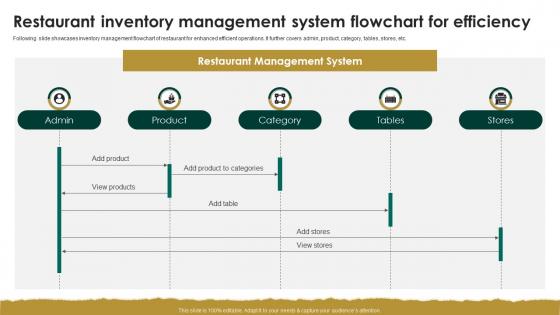
Restaurant Inventory Management System Flowchart For Efficiency




Try Before you Buy Download Free Sample Product
 Impress Your
 Audience
 100%
100% Editable
 Save Hours
 of Time


Following slide showcases inventory management flowchart of restaurant for enhanced efficient operations. It further covers admin, product, category, tables, stores, etc.
People who downloaded this PowerPoint presentation also viewed the following :
Restaurant Inventory Management System Flowchart For Efficiency with all 9 slides:
Use our Restaurant Inventory Management System Flowchart For Efficiency to effectively help you save your valuable time. They are readymade to fit into any presentation structure.








FAQs for Restaurant Inventory Management System
Key components include automated tracking systems, real-time stock monitoring, supplier integration platforms, cost analysis tools, and waste reduction protocols. These technologies streamline operations by minimizing food spoilage, optimizing purchasing decisions, and maintaining consistent menu availability, with many restaurant chains finding that strategic inventory management reduces costs by 15-20% while enhancing customer satisfaction.
Accurate inventory tracking enhances restaurant profit margins by reducing food waste, preventing over-ordering, and optimizing menu pricing based on actual costs. Through real-time monitoring systems, restaurants streamline purchasing decisions, minimize spoilage losses, and identify high-margin items, with many establishments finding that precise tracking delivers cost reductions of 2-8% while improving operational efficiency.
Technology solutions for restaurant inventory management include cloud-based inventory systems, POS integration platforms, automated ordering software, barcode scanning applications, and AI-powered demand forecasting tools. These technologies streamline operations by reducing manual counting errors, automating reorder processes, and providing real-time stock visibility, with many restaurants finding significantly lower food costs and improved operational efficiency.
Restaurant owners can prevent food waste through implementing FIFO (first-in, first-out) rotation, conducting regular inventory audits, utilizing digital tracking systems, setting precise par levels, and establishing supplier delivery schedules aligned with consumption patterns. These practices enable restaurants to reduce spoilage by up to 30%, optimize purchasing decisions, and improve profit margins, with many establishments finding that automated inventory management ultimately delivers significant cost savings while maintaining food quality standards.
Staff training ensures accurate inventory tracking, proper food handling procedures, efficient stock rotation practices, and consistent portion control measures. Well-trained teams reduce waste through better understanding of expiration dates, storage requirements, and ordering protocols, while improving cost management and operational efficiency, ultimately delivering better profit margins and streamlined restaurant operations.
Restaurants should conduct full inventory counts weekly, with high-value items like alcohol and proteins counted daily, and dry goods assessed bi-weekly. This strategic combination of counting frequencies enables accurate cost control, minimizes waste, and prevents stockouts, with many establishments finding that consistent inventory schedules ultimately reduce food costs by 3-5% while streamlining operations.
Signs include frequent stockouts of popular items, excessive food waste from spoilage, inaccurate inventory counts during audits, rising food costs without menu price increases, and staff spending excessive time on manual tracking. These inefficiencies significantly impact profit margins and customer satisfaction, with many restaurants finding that streamlined inventory systems reduce waste by 15-20% while improving operational efficiency and menu consistency.
Restaurants can utilize inventory data by analyzing consumption patterns, tracking seasonal demand fluctuations, monitoring supplier performance metrics, and identifying optimal reorder points for each ingredient. This data-driven approach enables establishments to reduce food waste by 20-30%, minimize stockouts during peak periods, and negotiate better supplier contracts, ultimately delivering significant cost savings and improved operational efficiency.
Just-in-time inventory management reduces food waste, minimizes storage costs, ensures fresher ingredients, improves cash flow, and optimizes kitchen space utilization. This approach enables restaurants to streamline operations by ordering precisely what's needed when needed, ultimately delivering enhanced food quality and profitability while reducing spoilage costs significantly.
Restaurants can effectively manage seasonal menu items by implementing flexible ordering schedules, establishing relationships with multiple suppliers, utilizing predictive analytics for demand forecasting, and maintaining strategic buffer stock for popular items. Many establishments enhance efficiency by integrating seasonal inventory tracking with their POS systems, enabling real-time adjustments and minimizing waste, while maximizing profitability during peak seasonal periods.
Small restaurants face limited storage space, manual tracking systems, and difficulty negotiating supplier terms, while large establishments struggle with complex multi-location coordination, extensive supplier networks, and standardization across different units. While smaller operations can adapt quickly to menu changes, larger chains benefit from economies of scale and sophisticated technology, with many finding that strategic inventory solutions help both segments minimize waste and optimize cash flow.
Restaurants can balance inventory through demand forecasting, automated reordering systems, strategic supplier partnerships, and real-time tracking technologies. These approaches streamline operations by analyzing sales patterns, adjusting portions based on seasonality, and implementing just-in-time delivery methods, with many establishments finding that strategic inventory management reduces food waste while ensuring consistent service quality and improved profit margins.
Customer feedback influences inventory management through demand insights, quality assessments, portion size evaluations, menu preference analysis, and seasonal trend identification. This feedback enables restaurants to optimize stock levels, reduce waste from unpopular items, adjust purchasing based on customer satisfaction scores, and ultimately enhance operational efficiency while improving customer experiences and profitability.
Restaurants can integrate inventory management with POS systems through API connections, cloud-based platforms, and real-time data synchronization that automatically updates stock levels with each sale. This integration enables automated reordering, reduces food waste, and provides comprehensive sales analytics, with many restaurant chains finding that seamless integration ultimately delivers improved operational efficiency and better profit margins.
**INPUT**: What are best practices for forecasting inventory needs based on sales trends? **OUTPUT**: Best practices include analyzing historical sales data, tracking seasonal patterns, monitoring weather impacts, calculating food waste ratios, and implementing automated reorder points. Through predictive analytics and POS integration, restaurants streamline purchasing decisions, reduce spoilage by up to thirty percent, and maintain optimal stock levels, ultimately delivering consistent menu availability while minimizing carrying costs. [Word count: 56 words]
-
“The presentation template I got from you was a very useful one.My presentation went very well and the comments were positive.Thank you for the support. Kudos to the team!”
-
Really like the color and design of the presentation.