


Employee Coaching Playbook Powerpoint Presentation Slides




Try Before you Buy Download Free Sample Product
 Impress Your
 Audience
 100%
100% Editable
 Save Hours
 of Time


The coaching playbook emerges as a training guideline for employees at the workplace. It caters as a game plan for optimizing employee performance and leveraging existing talent pools. Grab our readymade and 100 percent editable Employee Coaching Playbook template. It covers workforce coaching program criteria based on different learning practices, talent growth for employees, various employee coaching methods, the importance of coaching for employees and employers, and engaging employees across the firm. The playbook covers a workforce coaching program highlighting a game plan for an employee coaching roadmap for a successful employee coaching program. The workforce required coaching across different departments, objectives of coaching offered to employees, trainee competency assessment matrix, workforce coaching requirements identification form, employee skills and knowledge requirements, and workforce coaching meeting schedule. Different coaching modules highlight effective employee onboarding, skills enhancement, sales team coaching, and an efficient customer support team. Moreover, it caters to trainers and coaching initiatives for employee coaching, communication skills coaching for executives, etc. Workforce coaching effectiveness and cost estimation are highlighted along with the workforce coaching performance tracking dashboard. Get access now.
People who downloaded this PowerPoint presentation also viewed the following :
Content of this Powerpoint Presentation
Slide 1: This slide introduces Employee Coaching Playbook. State Your Company Name and begin.
Slide 2: This slide shows Agenda for Training Playbook Template.
Slide 3: This slide presents Table of Contents for Training Playbook Template.
Slide 4: This slide shows title for topics that are to be covered next in the template.
Slide 5: This slide displays Workforce Training Program Criteria Based on Different Learning Practices.
Slide 6: This slide provides information regarding talent growth for employees by addressing skills gap.
Slide 7: This slide represents Various Kinds of Employee Training Methods.
Slide 8: This slide showcases training for employees and employer by addressing various benefits to employees.
Slide 9: This slide shows Providing a compelling job descriptions for attracting qualified applicants.
Slide 10: This slide shows title for topics that are to be covered next in the template.
Slide 11: This slide presents Developing Game Plan for Employee Training.
Slide 12: This slide displays Roadmap for Successful Employee Training Program.
Slide 13: This slide represents Addressing Workforce Required Training across Different Departments.
Slide 14: This slide showcases Objectives of Training Offered to Employees.
Slide 15: This slide shows Addressing Trainee Competency Assessment Matrix.
Slide 16: This slide represents Workforce Training Requirements Identification Form.
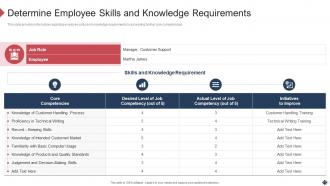
Slide 17: This slide showcases Determine Employee Skills and Knowledge Requirements.
Slide 18: This slide shows Addressing Workforce Training Meeting Schedule.
Slide 19: This slide shows title for topics that are to be covered next in the template.
Slide 20: This slide displays HR checklist for efficient employee onboarding process from hiring to employee performance tracking.
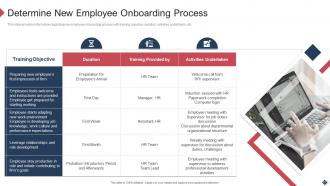
Slide 21: This slide represents Determine New Employee Onboarding Process.
Slide 22: This slide shows title for topics that are to be covered next in the template.
Slide 23: This slide presents Determine Employee Skill Enhancement Plan at Workplace.
Slide 24: This slide displays Workforce Upskilling Initiative through Different Training Delivery Channels.
Slide 25: This slide represents Determine Employee Training Log for Skills Enhancement.
Slide 26: This slide shows title for topics that are to be covered next in the template.
Slide 27: This slide provides information regarding sales team training plan by addressing sales skills.
Slide 28: This slide represents Addressing Sales Meeting Plan for Team Training.
Slide 29: This slide showcases Ensuring Effective Communication Training among Sales Team.
Slide 30: This slide shows title for topics that are to be covered next in the template.
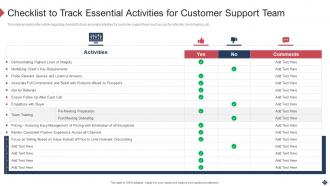
Slide 31: This slide presents Checklist to Track Essential Activities for Customer Support Team.
Slide 32: This slide shows title for topics that are to be covered next in the template.
Slide 33: This slide displays Key People Involved in Providing Employee Training.
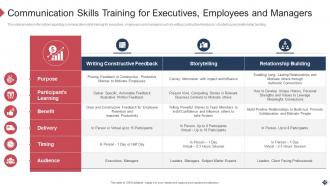
Slide 34: This slide represents Communication Skills Training for Executives, Employees and Managers.
Slide 36: This slide showcases Motivating Employees for Active Participation in Training Programs.
Slide 37: This slide shows title for topics that are to be covered next in the template.
Slide 38: This slide presents Determine Workforce Training Program Effectiveness.
Slide 39: This is another slide continuing Determine Workforce Training Program Effectiveness.
Slide 40: This slide provides information regarding workforce training cost estimation.
Slide 41: This slide shows title for topics that are to be covered next in the template.
Slide 42: This slide presents Determine Workforce Training Performance Tracking Dashboard.
Slide 43: This is another slide continuing Determine Workforce Training Performance Tracking Dashboard.
Slide 44: This slide displays Icons for Employee Coaching Playbook.
Slide 45: This slide is titled as Additional Slides for moving forward.
Slide 46: This slide presents Bar chart with two products comparison.
Slide 47: This slide provides Clustered bar chart with two products comparison.
Slide 48: This is Our Mission slide with related imagery and text.
Slide 49: This is About Us slide to show company specifications etc.
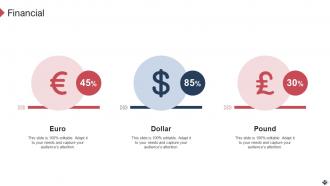
Slide 50: This is a Financial slide. Show your finance related stuff here.
Slide 51: This is Our Team slide with names and designation.
Slide 52: This is a Timeline slide. Show data related to time intervals here.
Slide 53: This slide presents Roadmap with additional textboxes.
Slide 54: This is a Thank You slide with address, contact numbers and email address.
Employee Coaching Playbook Powerpoint Presentation Slides with all 59 slides:
Use our Employee Coaching Playbook Powerpoint Presentation Slides to effectively help you save your valuable time. They are readymade to fit into any presentation structure.





















FAQs for Employee Coaching Playbook
Key objectives of an effective employee coaching program include improving individual performance, developing leadership capabilities, enhancing communication skills, increasing employee engagement, and building organizational talent pipeline. These programs streamline professional development by providing structured feedback, personalized growth plans, and continuous skill enhancement, with many organizations finding that strategic coaching ultimately delivers higher retention rates, improved productivity, and stronger succession planning across all departments.
Managers can assess coaching needs through performance reviews, one-on-one conversations, skills gap analyses, peer feedback, and direct observation of daily work patterns. These assessment methods enable targeted development by identifying specific competency gaps, career aspirations, and behavioral challenges, with many organizations finding that regular coaching assessments ultimately enhance employee engagement and accelerate professional growth.
Techniques include active listening, asking open-ended questions, creating psychological safety, using the GROW model, and providing regular feedback opportunities. These approaches streamline communication by encouraging honest dialogue, minimizing defensive responses, and building trust, with many organizations finding that structured questioning and empathetic responses ultimately deliver stronger employee engagement and accelerated professional development.
Best practices for setting SMART goals in employee coaching include making objectives specific and measurable, establishing realistic timelines, ensuring relevance to role responsibilities, and creating trackable milestones with regular check-ins. These structured approaches enhance performance management by providing clear expectations, measurable outcomes, and accountability frameworks, with many organizations finding that systematic goal-setting increases employee engagement and delivers improved productivity.
Coaching integration involves embedding continuous feedback conversations, goal-setting partnerships, and development-focused discussions directly into traditional appraisal frameworks, transforming them from annual evaluations into ongoing performance partnerships. This approach enables managers to combine assessment with skill development, career planning, and real-time support, ultimately delivering enhanced employee engagement and improved performance outcomes.
Feedback serves as the foundation of effective employee coaching, providing clear performance insights, identifying development opportunities, establishing measurable goals, and creating accountability mechanisms. Through regular, constructive feedback sessions, managers can guide skill enhancement, address performance gaps, and reinforce positive behaviors, with many organizations finding that consistent feedback loops ultimately accelerate professional growth and improve overall team performance.
Organizations measure coaching program success through performance metrics, employee engagement scores, retention rates, goal achievement tracking, and ROI analysis. These measurement approaches enable companies to assess improved productivity, enhanced leadership development, and reduced turnover costs, with many finding that comprehensive tracking systems deliver measurable business outcomes and justify continued investment in employee development initiatives.
Effective coaching strategies include setting clear objectives, using interactive questioning techniques, incorporating real-world scenarios, providing immediate feedback, and maintaining structured yet flexible session formats. These approaches enhance engagement by encouraging active participation, addressing specific workplace challenges, and creating personalized development pathways, with many organizations finding that consistent application ultimately delivers improved performance and stronger employee retention.
Technology enhances employee coaching through AI-powered performance analytics, video-based feedback platforms, mobile coaching apps, virtual reality simulations, and real-time progress tracking systems. These digital tools streamline coaching processes by delivering personalized development plans, enabling remote mentorship sessions, and providing data-driven insights, with many organizations finding that automated scheduling and progress monitoring ultimately improve coaching consistency and employee engagement outcomes.
Coaches working with diverse teams face challenges including cultural communication differences, varying learning styles, generational workplace expectations, unconscious bias, and differing professional backgrounds that can impact team dynamics. These challenges can be overcome by developing cultural competency training, implementing flexible coaching approaches tailored to individual preferences, creating inclusive dialogue frameworks, and leveraging diverse perspectives as strategic advantages, ultimately enhancing team collaboration and organizational innovation.
Mentoring focuses on long-term career guidance and relationship-building, while coaching targets specific skill development and performance improvement through structured feedback sessions. Organizations increasingly implement both approaches strategically, with mentoring programs pairing experienced leaders with emerging talent for broad professional growth, and coaching interventions addressing immediate competency gaps, ultimately delivering enhanced employee engagement and accelerated leadership development.
Common misconceptions include viewing coaching as remedial action for poor performers, expecting immediate results, believing it's only for senior executives, assuming it replaces formal training, and thinking external coaches are always superior to internal ones. Organizations increasingly find that coaching enhances performance across all levels, requires time for sustainable development, complements existing learning programs, and delivers stronger engagement when integrated strategically into talent development frameworks.
Cultivating a coaching culture requires leadership commitment, manager training programs, regular feedback systems, peer coaching initiatives, and recognition of coaching behaviors. Organizations achieve this by integrating coaching into performance reviews, providing structured coaching tools, and modeling collaborative development approaches, ultimately creating environments where continuous learning, employee engagement, and professional growth become embedded organizational strengths.
Coaching development resources include mentorship programs, professional certification courses, coaching software platforms, peer learning groups, and industry conferences. These tools enhance coaching effectiveness by providing structured frameworks, real-time feedback mechanisms, and continuous learning opportunities, with many organizations finding that well-equipped coaches deliver significantly improved employee performance and retention outcomes.
Organizations can encourage continuous learning by establishing mentorship programs, creating peer learning circles, providing access to online training resources, and implementing regular check-ins with managers. These approaches foster ongoing development through collaborative knowledge sharing, self-directed skill building, and sustained accountability, with many companies finding that combining formal follow-ups with informal learning opportunities significantly enhances long-term employee growth and retention.
-
Great quality slides in rapid time.
-
Great experience, I would definitely use your services further.