


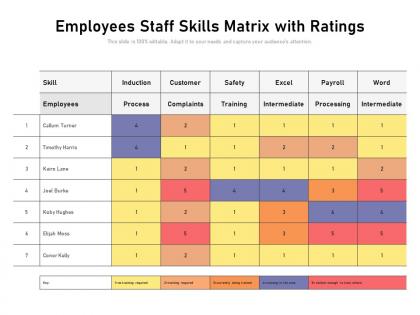
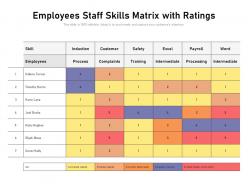
Employees staff skills matrix with ratings




Try Before you Buy Download Free Sample Product
 Impress Your
 Audience
 100%
100% Editable
 Save Hours
 of Time


Fight injustice with our Employees Staff Skills Matrix With Ratings. Elaborate on biased decisions.
People who downloaded this PowerPoint presentation also viewed the following :
Employees staff skills matrix with ratings with all 2 slides:
Elaborate on biased decisions with our Employees Staff Skills Matrix With Ratings. It helps fight injustice.
FAQs for Employees staff skills
So a skills matrix is just a grid where you list your team members across the top and skills down the side. Then you rate everyone as beginner/intermediate/expert for each skill. Pretty straightforward stuff. We use ours all the time for figuring out who should work on what projects, or spotting where we need training. Also helps during performance reviews and planning who might replace someone if they leave. Way better than trying to remember everyone's strengths off the top of your head - I'm terrible at that honestly. Just start with your most important skills first, don't overcomplicate it.
So you basically create this chart showing what skills everyone has vs what you actually need for your projects. Rate each person's abilities - like a report card but way less awkward. Honestly, the gaps jump out at you immediately once it's all mapped out. You'll spot who needs training, where the team's weak spots are, or if you need to bring someone new in. I'd say the trick is being real about people's current levels (no sugar-coating) and keeping it updated. Otherwise you're just planning with old info, which is pretty useless.
Start by figuring out what skills your team actually needs - don't go crazy here, just focus on what matters now and maybe next year. Define clear proficiency levels like beginner to expert so everyone knows what you're talking about. Have people rate themselves first (honestly this part's kinda awkward but whatever), then managers can review and discuss gaps. The real magic happens when you use it for planning training and assigning projects. Oh, and update it regularly or it becomes useless fast!
I'd say quarterly works for most teams, but it really depends on your situation. Monthly makes way more sense if you're growing fast or people keep switching roles. The trick is updating it before the info gets stale - whenever someone finishes training, joins/leaves, or picks up new stuff. Honestly, I've watched teams ignore theirs for like a year and then wonder why it's completely useless. Just throw a recurring reminder on your calendar and make sure whoever owns it actually gives a damn about keeping it fresh.
So there's usually three main types: technical stuff (software, coding languages, equipment), soft skills like communication and leadership, and then job-specific things for your industry. Some companies get way too obsessed with tracking every little detail - it's kind of annoying tbh. But the good ones just focus on skills that actually matter for doing your job well. You might also see certifications or language skills thrown in there depending on what your company does. The whole point is tracking what helps people succeed in their current role or move up.
Honestly, skills matrices are game-changers for figuring out who needs what training. Map out what skills your team has versus what you actually need - the gaps will jump right out at you. Then you can ditch those awful one-size-fits-all workshops (seriously, who learns anything from those?) and build targeted development plans instead. Your people will love seeing exactly what they need to level up, plus you'll spot who can mentor others. I've seen teams waste so much budget on random training when they could've just focused on their actual weak spots first.
Honestly, a skills matrix is a game-changer for succession planning. Map out what each role actually needs, then see who's got those skills already. You'll spot gaps fast - like realizing nobody else knows how to run that quarterly report your manager does. When someone leaves or gets promoted, you're not panicking about replacements. The data shows you who's ready to move up and who needs training first. I'd start with your most critical positions because that's where you really can't afford to wing it. Trust me, once you see everything laid out visually, you'll wonder how you managed without it.
Honestly, skills matrices are game-changers for project planning. Instead of just looking at job titles, you actually see who can do what. I learned this the hard way after assigning someone to lead a technical project they weren't ready for - awkward! Anyway, you can spot gaps before they bite you and avoid burning out your best people. During planning, it helps you build teams that actually make sense and set deadlines you won't hate yourself for later. Training needs become super obvious too. Just start by mapping what skills you've got versus what's coming up. You'll instantly see where you need to hire or train people up.
Don't overcomplicate it from the start - that's the biggest mistake I see. Get your team involved in defining what skills actually mean, because "intermediate" could be anything honestly. Skip the vague beginner/intermediate/advanced labels unless you spell out exactly what those look like with real examples. I'd start with maybe 5-10 key skills tops. You can always add more later once people get used to the process. Oh, and don't let it become one of those documents that just lives in a folder somewhere collecting digital dust. Build in some kind of regular check-ins or it'll be useless within six months.
Oh man, you should totally make a skills matrix! Basically just list out who's good at what on your team. No more awkward "um does anyone actually know JavaScript?" moments mid-project. I learned this the hard way when we got stuck for like two days because nobody admitted they'd never touched the database stuff before. You can spot gaps early and people can actually volunteer for things they want to learn instead of getting stuck with random assignments. Just start with maybe 8-10 skills and update it every few months. Trust me, it'll save you so many headaches.
Start with Excel or Google Sheets if you're just testing the waters. Fair warning though - they turn into a hot mess once you've got more than like 10 people. BambooHR's pretty solid for HR stuff, or try Skills Base if you want something built specifically for tracking skills. Project management tools work too if you set up custom fields right. The cool thing about the fancier systems? They'll auto-update when someone finishes a course on LinkedIn Learning or wherever. My advice: don't overthink it initially. Just pick something that exports data easily so you're not stuck later.
So basically, technical skills matrices are packed with hard skills - programming languages, certifications, specific tools like AWS or Python. Non-technical ones? They're all about soft skills instead. Communication, leadership, that kind of stuff. Technical matrices are honestly so much easier to measure objectively (either you know React or you don't, right?). But here's the thing - both types should mix hard and soft skills together. Figure out which way your role leans first. Then go like 70% of whatever's dominant for that role, 30% the other stuff. Makes the whole thing way more balanced.
So basically, you map out everyone's skills first - then look for weird gaps between different groups. Like, are all your senior devs white dudes? That's a red flag. The matrix shows you who's getting development opportunities and who isn't. Then you can actually do something about it - targeted mentorship, better training access, stuff like that. It won't fix systemic bias overnight (obviously), but it does help remove some guesswork from promotions. I'd start small though - pick one team and see what patterns emerge. You'll probably be surprised by what you find.
Here's what I'd focus on - skill gap closure rates are pretty telling. How fast are people actually filling those gaps you identified? Employee engagement around career growth usually jumps when they can see clear paths forward. Internal promotions and cross-team moves matter too. Honestly, that's where you really see if the matrix is working or just sitting in a spreadsheet somewhere. Training ROI gets way better when you know exactly what skills need work. Time-to-competency for new hires is another good one. Don't try tracking everything at once though - pick 2-3 metrics that actually matter to your company first.
First thing - look at your strategic plan and figure out what 5-10 skills actually matter for hitting those goals. If you're doing digital transformation, tech skills beat generic leadership stuff every time. Don't build one of those useless matrices that tracks everything under the sun (I've seen way too many). Focus on what you'll need going forward, not just what people can do today. Honestly, most companies mess this up by making it too broad. Map those skills directly to your business direction. Update it when strategies change - these things get stale fast. Start with proficiency levels that actually mean something for your specific situation.
No Reviews