


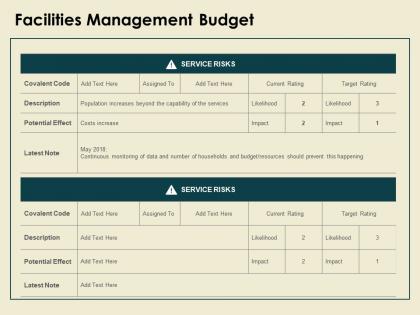
Facilities management budget slide potential ppt powerpoint presentation outline aids




Try Before you Buy Download Free Sample Product
 Impress Your
 Audience
 100%
100% Editable
 Save Hours
 of Time


Function efficiently with our Facilities Management Budget Slide Potential Ppt Powerpoint Presentation Outline Aids. Experience the advantage of economy of effort.
People who downloaded this PowerPoint presentation also viewed the following :
Facilities management budget slide potential ppt powerpoint presentation outline aids with all 5 slides:
Our Facilities Management Budget Slide Potential Ppt Powerpoint Presentation Outline Aids are designed for economy of effort. They allow you to function efficiently.


FAQs for Facilities management budget slide potential ppt powerpoint
Key facilities management budget components include maintenance and repairs, utilities and energy costs, cleaning and janitorial services, security systems, space planning, and compliance management. These elements work together to ensure operational efficiency, regulatory adherence, and optimal workspace functionality, with many organizations finding that strategic budget allocation across these areas ultimately delivers cost predictability and enhanced employee productivity.
Technology streamlines facilities management budgeting through automated expense tracking, predictive analytics for maintenance costs, and integrated financial reporting systems. These digital solutions enhance budget accuracy by analyzing historical data patterns, enabling proactive resource allocation, and delivering real-time cost visibility, with many organizations finding significantly improved financial control and reduced operational expenses.
Forecasting facilities management costs requires evaluating maintenance schedules, utility rate projections, staffing requirements, compliance updates, and capital improvement plans. These factors enable organizations to anticipate expenses across office buildings, manufacturing facilities, and healthcare institutions, while accounting for inflation trends and regulatory changes, ultimately delivering accurate budget allocations and operational efficiency.
Maintenance costs significantly impact facilities management budgets by representing 60-80% of total expenditures through preventive maintenance, emergency repairs, equipment replacements, and labor expenses. Strategic maintenance planning enables organizations to reduce unexpected breakdowns, extend asset lifecycles, and optimize resource allocation, with many facilities finding that proactive approaches ultimately deliver 15-20% cost savings and improved operational efficiency.
Strategies to reduce unexpected facilities management expenses include preventive maintenance scheduling, predictive analytics for equipment monitoring, comprehensive vendor contract management, emergency fund allocation, and regular facility audits. These approaches streamline operations by identifying potential issues early, negotiating better service terms, and maintaining equipment reliability, with many organizations finding that proactive planning delivers significant cost savings and operational efficiency.
Sustainability initiatives influence facilities management budgets by reducing long-term operational costs through energy-efficient systems, waste reduction programs, and resource optimization strategies. While initial investments in green technologies and sustainable infrastructure can increase upfront expenses, organizations increasingly find that these initiatives deliver significant cost savings, improved operational efficiency, and enhanced corporate reputation over time.
Compliance and regulatory costs represent significant budget components in facilities management, encompassing safety inspections, environmental regulations, accessibility standards, fire codes, and health department requirements. These mandatory expenses vary by industry, with healthcare facilities, manufacturing plants, and educational institutions often facing higher regulatory burdens, ultimately requiring strategic budget allocation to avoid penalties while maintaining operational excellence.
Facilities managers can effectively prioritize projects by conducting comprehensive risk assessments, evaluating regulatory compliance requirements, analyzing cost-benefit ratios, and assessing impact on operational continuity. Strategic prioritization involves focusing on safety-critical repairs, energy efficiency upgrades, and preventive maintenance initiatives, with many organizations finding that this approach ultimately reduces long-term costs while maintaining optimal workplace functionality.
Key facilities management budget metrics include cost per square foot, energy consumption rates, maintenance response times, space utilization percentages, and vendor performance scores. These indicators enable organizations to optimize resource allocation, identify cost-saving opportunities, and enhance operational efficiency, with many companies finding that tracking these metrics delivers improved workplace experiences while reducing overall facility expenses.
A facilities management budget aligns with strategic goals by prioritizing investments that support core business objectives, enhance operational efficiency, and enable scalability across departments. Through strategic space optimization, technology integration, and sustainability initiatives, organizations streamline costs while improving employee productivity and customer experiences, ultimately delivering competitive advantage and measurable ROI that supports long-term growth.
Common facilities management budget pitfalls include underestimating maintenance costs, neglecting emergency reserves, overlooking technology upgrades, failing to account for regulatory compliance, and inadequate vendor contract reviews. These oversights often result in budget overruns and operational disruptions, with many organizations finding that proactive planning and regular budget assessments ultimately deliver better cost control and facility performance.
Stakeholder engagement enhances facilities budgeting by incorporating diverse perspectives, identifying critical priorities, ensuring realistic resource allocation, and building consensus around strategic investments. Through collaborative workshops and feedback sessions, facilities managers gather insights from department heads, employees, and executives, ultimately creating more accurate budgets that reflect actual operational needs and secure stronger organizational buy-in.
Best practices for reallocating budget funds during crises include prioritizing essential operations, conducting rapid expense audits, implementing tiered cost-cutting measures, maintaining emergency reserves, and establishing flexible vendor agreements. These strategies enable facilities managers to redirect resources from non-critical areas like routine maintenance to urgent needs such as safety protocols and infrastructure repairs, ultimately ensuring operational continuity while minimizing financial impact.
Outsourcing facilities management typically reduces overall budget costs by 15-30% through operational efficiencies, specialized expertise, and economies of scale, while converting fixed costs to variable expenses. However, organizations should carefully evaluate service quality standards, contract flexibility, hidden fees, and vendor reliability, with many finding that strategic outsourcing partnerships ultimately deliver enhanced services and predictable cost structures.
Employee feedback contributes to more effective facilities management budgeting by identifying underutilized spaces, highlighting maintenance priorities, revealing technology gaps, and pinpointing comfort issues that impact productivity. This direct insight enables facilities managers to allocate resources strategically, with many organizations finding that employee-driven data reduces unnecessary spending while enhancing workplace satisfaction and operational efficiency.
No Reviews