


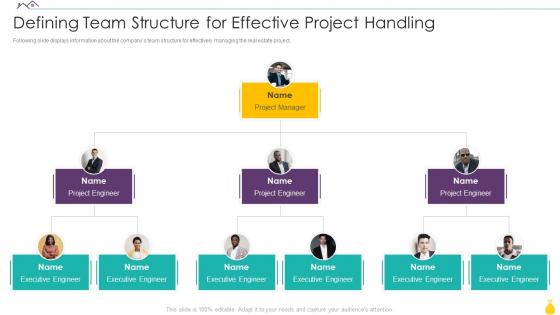
Finance For Real Estate Development Defining Team Structure For Effective Project Handling




Try Before you Buy Download Free Sample Product
 Impress Your
 Audience
 100%
100% Editable
 Save Hours
 of Time


Following slide displays information about the companys team structure for effectively managing the real estate project.
People who downloaded this PowerPoint presentation also viewed the following :
Finance For Real Estate Development Defining Team Structure For Effective Project Handling with all 6 slides:
Use our Finance For Real Estate Development Defining Team Structure For Effective Project Handling to effectively help you save your valuable time. They are readymade to fit into any presentation structure.





FAQs for Finance For Real Estate Development Defining Team Structure For
You definitely need a clear leader making final calls, plus someone handling the day-to-day execution stuff. Then obviously your subject matter experts doing the actual work. But seriously, don't let everyone think they're in charge - I've watched teams completely implode over that! Get someone who's naturally good at keeping people in the loop too. Maybe throw in a creative type who sees things differently? The trick is mapping out what skills you actually need first, then matching people to roles based on what they're good at, not just who's free. Everyone needs to own their piece without stepping on toes.
Honestly, your team structure totally controls how info moves around and whether people actually work well together. Flat teams? Way faster communication - no bureaucratic nonsense to wade through. Hierarchical setups can bog things down, though at least someone's clearly in charge when decisions need making. Cross-functional groups collaborate better since they're all chasing the same goal. Oh, and remote teams - they're tricky. You've gotta be way more deliberate about when and how people connect. Don't just copy what worked at Google or whatever. Match your structure to how your specific team actually operates.
So flat structures are great for speed - decisions happen fast and people actually talk to each other instead of playing telephone through five managers. Your team feels way more empowered too. But hierarchical? That's where you get clear accountability and someone who can actually make the hard calls when everything's on fire. Plus better career paths, which honestly matters more than people admit. Really depends on your team size though. Under 15 people? Go flat for sure. Once you hit that point you'll probably need some structure or things get messy fast.
Honestly, your team's gonna change a lot as the project evolves. Start with strategists and planners doing their thing. Then you'll need way more developers when you're actually building stuff. QA becomes super important near launch - learned that the hard way on my last project. Team size bounces around too, which feels chaotic but it's normal. You'll probably grow during heavy development, then shrink back down. Don't stress about sticking to your original plan. Just focus on what you actually need right now and adjust roles accordingly.
So basically, diverse teams shake things up by bringing totally different ways of thinking and solving problems. Yeah, it gets chaotic compared to when everyone thinks the same way - I won't lie about that. But here's the thing: that chaos is actually good because people start questioning stuff and hitting problems from weird angles you'd never think of. Teams end up being way less top-down since you need everyone's input to make it work. The trick is setting up your meetings so you're actually using all those different perspectives instead of just... I don't know, pretending they don't exist.
Dude, tech is honestly a lifesaver for this stuff. Get some org chart tools and project management apps so everyone can actually see who's doing what. The visual part is huge - no more awkward "um, whose job is this?" conversations in meetings lol. I'd start with whatever's bugging you most. Like if communication sucks, try Slack with different channels. If task ownership is messy, Asana works great. Even basic shared docs help. Don't try to fix everything at once though. Pick one thing, get it working, then add more tools as you go.
Honestly, most org structure fails come down to unclear roles - people constantly stepping on each other because nobody knows who owns what. Micromanaging is another huge killer. Teams that are either massive or have weird skill gaps never work well either. Decision-making gets messy when too many people think they're running the show (learned that one the hard way). Don't restructure every time something breaks - that just creates more chaos. Map out who does what first, keep reporting lines simple. Clear ownership solves like 90% of these headaches.
Honestly, you NEED to get this sorted out. Nothing's worse than that whole "wait, I thought Sarah was doing this" mess when deadlines hit. I've seen entire projects tank because three people worked on the same thing while the actual important stuff got ignored. Map out who decides what and who delivers what - seriously, write it down even if it seems obvious. Your team will thank you later. When people know exactly what they own, decisions happen faster and there's way less of that weird finger-pointing drama. Also means everyone actually knows if they're crushing it or not in their role.
Honestly, start with a RACI matrix - sounds boring but it's clutch for figuring out who does what. Maps out responsibility, accountability, who gets consulted, all that. Spotify's squad model is everywhere right now, works great for tech teams. There's this thing called Conway's Law too - basically your team structure ends up mirroring how people actually talk to each other, so might as well plan for it. Holocracy exists if you're into really radical stuff, though personally I think it's overkill for most companies. RACI first, then maybe try the squad approach if your team's into it.
So remote work totally changes how your team talks to each other. No more random hallway chats, which honestly sucks at first because you miss out on all that casual info sharing. Everything becomes way more planned out - lots of scheduled check-ins and Slack threads. But here's the thing: it's actually pretty great for introverts and anyone not in the main office timezone since everyone's on equal footing now. You just gotta be super intentional about connecting with people, both for work stuff and just shooting the breeze. Oh, and definitely over-communicate in the beginning while everyone figures it out.
Honestly, start with trust and communication - everything else falls apart without those. I'd do structured team check-ins (not the useless "how's everyone feeling" kind). Define who does what upfront because role confusion is the worst. Oh, and don't underestimate casual stuff - virtual coffee breaks actually help people connect. Here's the thing though: pick maybe 2-3 things and stick with them for months. I see people trying to implement like 10 strategies at once and it's chaos. Weekly syncs are probably your best starting point if you're not already doing them.
Honestly, your team setup totally changes how decisions get made. Flat structures? Super fast to agree on stuff, but good luck figuring out who's actually responsible when things go sideways. Hierarchical teams are the opposite - clear chain of command but everything takes forever with all those approvals. Matrix structures bring in experts from everywhere, which is great, except now three people think they're in charge. I've seen that mess before lol. Really though, you gotta match the structure to what kinds of decisions you're making most. Day-to-day operational stuff needs different handling than big strategic moves.
First, map out what's actually broken vs what's working fine. Check how tasks get distributed and where the skill gaps are hitting you hardest. Communication flow is massive - like if Sarah's holding up every decision, that's your red flag right there. Think about upcoming projects too and whether your current setup can handle them. Some people work better with freedom, others need more teamwork (honestly depends on personality). Budget and reporting lines obviously matter. But don't overhaul everything at once - just fix the specific stuff that's causing real friction first.
Honestly, cultural stuff can totally change how you set up your team. Some cultures are super hierarchical - they want clear bosses and formal processes. Others are way more chill with flat structures where everyone shares decisions. Communication's weird too... certain cultures need everything written down while others just want to talk face-to-face. Time zones suck obviously, but what's worse is when some cultures are super strict about deadlines and others are more flexible. My advice? Figure out your team's cultural mix first, then build around that instead of trying to shove everyone into the same box.
Honestly, just focus on a few basics that actually matter. Delivery speed is obvious - are deadlines getting hit without everyone burning out? Then check if decisions happen quickly or if they're stuck in committee hell forever. Meeting efficiency tells you SO much (seriously, if people are complaining about pointless meetings, your structure sucks). Employee satisfaction and retention rates don't lie either. Can teams adapt when priorities shift? The whole thing comes down to whether work flows naturally or people constantly hit walls. Pick maybe 2-3 metrics that fit your team's biggest pain points and track them monthly. Don't overthink it.
-
The content is very helpful from business point of view.
-
“One of the best experiences with SlideTeam for my presentation.Everything on time, communication is efficient and price is reasonable. All good in one place.”