

Five elements with different icons




Try Before you Buy Download Free Sample Product
 Impress Your
 Audience
 100%
100% Editable
 Save Hours
 of Time


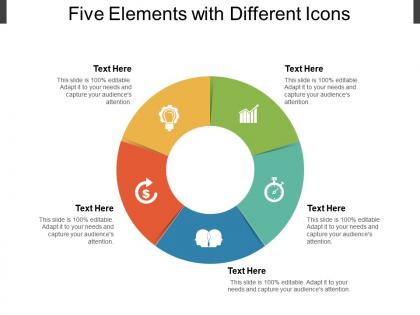
Get this readily available Five Elements With Different Icons PPT slide that will help you present the company’s goals and objectives in a seamless manner. Showcase the vision and mission of your organization. You can also set the targets for your employees that will motivate them to work hard. Present the star performers and the hardworking employees of your organization using this 5 stage elements PPT slide. You can add different icons in the template as per your suitability. Depict the policies, rules and regulations of your organization. The procedure of carrying any activity can also be depicted with the assistance of this professionally designed PowerPoint slide design. Workflows or interconnected series of any activity can be elucidated without any hassle. Showcase the steps or levels that one has to go through for completing any event by downloading this five element PPT diagram template.
People who downloaded this PowerPoint presentation also viewed the following :
Five elements with different icons with all 5 slides:
Be a global citizen with our Five Elements With Different Icons. Your thoughts will be broadcast extensively.
FAQs for Five elements
So the Five Elements thing is actually pretty cool - it popped up independently in different places. China had wu xing (wood, fire, earth, metal, water) around 3000 BCE. Greece developed their version way later, like 450 BCE, with earth, water, air, fire. Crazy how people on opposite sides of the world figured out similar stuff, though honestly the Chinese approach was more about balance and how things interact. Greeks were more focused on what everything's made of. If you're trying to understand them, look at how each culture used theirs - Chinese medicine still uses wu xing for diagnosis today, while Western alchemy built off the Greek ideas.
So the Five Elements thing is basically wood, fire, earth, metal, and water working in two cycles. One cycle shows how they feed each other - wood fuels fire, fire makes ash (earth), etc. Pretty cool system actually. The other cycle keeps them in check so nothing goes overboard. Each element connects to different organs, emotions, and seasons in your body. When practitioners see health issues, they figure out which element relationships are off balance. You could try matching your symptoms to the elements - might give you some clues about what needs fixing. It's way more logical than I expected!
So basically, Five Elements is like an ancient personality test that maps your traits to different elements. Wood's about creativity, Metal's organization and letting go - that kind of thing. You figure out which elements are strong or weak in your life, then balance them out. Maybe you're low on Fire element? Time to focus on joy and connecting with people. I'd honestly just start with one of those online assessments to see where you're at. Then you can work on the imbalances through specific foods, practices, or just shifting how you think about stuff. Pretty cool framework actually.
Dude, diagrams are a total game-changer for explaining the Five Elements! I always use circles for the creative cycle - wood feeds fire, fire makes earth, whatever. Star patterns work great for the destructive relationships too. Color coding everything helps so much (green=wood, red=fire). People just zone out when you're throwing theory at them, but put up a visual and they actually get it. Oh and keep your diagrams super consistent - I learned that the hard way when I confused the hell out of everyone switching formats mid-presentation. Simple is always better than fancy here.
So the Five Elements thing is actually pretty cool when you think about ecosystems! Wood = growth/forests, Fire = energy from the sun, Earth = soil stuff, Metal = mineral cycles, Water = flow and hydration. They're all connected in these endless loops, kinda like nature does it. When one element gets messed up, everything else goes to hell - sound familiar with climate change? I always thought that was interesting. You could totally use this for sustainability projects by checking if you're considering all five elements and how they work together, instead of just tunnel-visioning on one aspect.
So basically you can match your business stuff to the Five Elements thing - Wood is growth/innovation, Fire handles marketing and relationships, Earth does operations, Metal is structure/quality, and Water covers resources. Honestly feels like business feng shui or whatever. The trick is figuring out what you're overdoing versus ignoring completely. Like if you're crushing the growth side (Wood) but your operations are a mess (Earth), you're gonna hit problems when scaling up. I'd just go through your current projects and see where the gaps are - usually pretty obvious once you look at it this way.
So I actually do this! Keep little element cards on my desk for when I'm totally stuck. Wood = growth and new beginnings, Fire = passion and energy, Earth = stability and grounding. Then Metal's all about precision, Water flows with adaptability. Try assigning different elements to your creative phases - like Wood for brainstorming sessions, Fire when you're actually executing, Metal for that brutal editing stage. Their color palettes work great too. Honestly, even just thinking "what would the water approach be here?" can totally shift your perspective when you hit a wall.
So basically, Eastern philosophy treats the five elements like they're alive and constantly changing into each other - wood feeds fire, fire creates earth, etc. It's all about cycles and flow. Western thinking? More like "here are your building blocks" - earth, air, fire, water as separate, fixed things. Chinese medicine uses this for acupuncture and understanding how seasons affect your body. Pretty cool stuff actually. Western alchemy was more about these elements being fundamental pieces of reality that don't really transform. Quick tip: if you're studying either system, just ask yourself whether the elements are supposed to interact fluidly or stay in their own lanes. That'll tell you everything about the philosophy behind it.
Oh yeah, tons of therapists are getting into Five Elements stuff now! Somatic therapists love mapping emotions to elements - anger goes with Wood, anxiety with Metal, that kind of thing. Some CBT folks use it for personality frameworks too. Honestly, it's pretty cool how clients can visualize their emotional stuff better this way. Like they'll figure out which element feels "off" and it clicks for them. If you want to try it, just learn which emotions connect to each element first - gives you a whole different way to see what's going on with people. My friend's therapist does this and swears by it.
Honestly, this Five Elements thing sounds woo-woo but it actually works pretty well! Wood is perfect for creative stuff - art projects, writing assignments. Fire works great for presentations since it's all about communication and energy. Earth? That's your solid foundation subjects like basic math concepts. Metal is where you get into editing and critical thinking - basically the refinement stuff. Water flows nicely into reflection time and problem-solving. My students seem way more engaged when I cycle through these different modes instead of just lecturing constantly. Try mapping out your next unit and see which element fits each activity. It creates this natural rhythm that just... works better somehow.
Okay so the biggest thing people get wrong? Thinking Wood, Fire, Earth, Metal, and Water are actual physical stuff. They're not - more like energy patterns or phases. Way more dynamic than that. Also everyone assumes those generating and controlling cycles work like clockwork, but honestly they're pretty fluid depending on context. I used to make this mistake too lol. Don't think of them as rigid categories - they're more like describing HOW energy moves and changes. Focus on understanding what each element's qualities actually represent in whatever you're studying instead.
So the Five Elements basically give artists this whole symbolic toolkit to work with. Wood shows up as growth and flexible movements in dance. Fire? That's all the passionate rhythms you hear in music. Earth grounds everything with stability, while Metal adds structure and precision. Water flows through those spontaneous, improvisational moments. Artists deliberately use specific colors, sounds, and movements tied to each element - it's wild how this ancient stuff still influences modern art! Next time you're watching a performance, try catching these patterns. Once you start noticing them, they're literally everywhere.
Dude, the Five Elements thing actually works because it taps into how our brains are wired for stories. People expect that setup-conflict-resolution flow - kinda like every movie you've ever watched. Instead of boring your audience with random facts, you're building tension and then boom, hit them with your solution. Way more memorable than bullet points too. I used to think it was just marketing fluff, but honestly? Stories just stick better. Complex ideas suddenly make sense when you arrange them this way. Your audience won't zone out because they're waiting to see how it all resolves. Next time you're prepping a presentation, try mapping it out like this - you'll be surprised how much more engaged people get.
Honestly, the Five Elements thing is pretty smart for figuring out team dynamics. Your Wood people are natural leaders but they'll bulldoze everyone if you're not careful. Water types? Amazing strategists, though they overthink literally everything. Fire personalities bring crazy energy but burn out super quick, Earth folks keep the peace, and Metal people are all about systems and quality. When shit hits the fan, check which elements are butting heads - like Fire racing ahead while Earth teammates are still processing. I'd try mixing complementary types on projects. Give each person what actually works for them instead of forcing everyone into the same box.
So depends what you're after! "Between Heaven and Earth" by Beinfield and Korngold is solid for TCM stuff. Lillian Too has good feng shui materials if that's your thing. Classical Taoist texts are amazing but honestly can be a slog to get through - just heads up. You could also check out the American College of Traditional Chinese Medicine for courses. Oh, and there's apps now that help figure out your element type which is pretty cool. I'd say pick whatever angle grabs you first, then explore from there. Way easier than trying to tackle everything at once.
-
Innovative and attractive designs.
-
Amazing product with appealing content and design.