


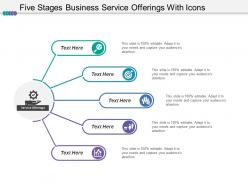
Five stages business service offerings with icons





Try Before you Buy Download Free Sample Product
 Impress Your
Audience
 100%
Editable
 Save Hours
of Time


Our Five Stages Business Service Offerings With Icons give inventors a chance to exhibit their ingenuity. Ingenuity will begin to flourish.
People who downloaded this PowerPoint presentation also viewed the following :
Five stages business service offerings with icons with all 5 slides:
Elaborate on the importance of etiquette with our Five Stages Business Service Offerings With Icons. Clearly explain how everyone benefits.


FAQs for Five stages business service
Business service offerings typically evolve through five stages: ad-hoc services, standardized offerings, integrated solutions, platform-based services, and ecosystem orchestration. These stages progress from reactive, customized approaches to strategic, scalable models, with organizations like consulting firms and technology providers finding that each evolution delivers greater operational efficiency, enhanced client value, and competitive differentiation in increasingly complex markets.
Organizations effectively identify and assess target market needs through comprehensive market research, customer feedback analysis, competitive benchmarking, and data-driven insights at each service stage. These methodologies enable businesses to understand evolving customer preferences, pain points, and expectations, with many companies in sectors like healthcare, financial services, and retail finding that continuous assessment delivers enhanced customer satisfaction, improved service alignment, and ultimately stronger competitive positioning in increasingly dynamic markets.
Market research provides critical foundation for business service offerings by identifying customer pain points, analyzing competitor gaps, assessing market demand, and validating service concepts before development begins. Through comprehensive market analysis, organizations can strategically position their services, minimize development risks, and ensure alignment with actual customer needs, ultimately delivering more targeted solutions and competitive advantage in increasingly crowded service markets.
Customer feedback and iteration drive continuous refinement by enabling data-driven adjustments to service design, delivery processes, and customer touchpoints throughout all five stages. This iterative approach allows businesses to identify pain points, optimize operational efficiency, and enhance customer experiences, with many organizations finding that systematic feedback collection ultimately delivers improved service quality, higher customer satisfaction, and stronger competitive advantage in increasingly demanding markets.
At each stage, businesses should track distinct KPIs: ideation focuses on market research metrics and customer feedback scores, development monitors prototype testing results and resource allocation efficiency, launch tracks customer acquisition costs and initial satisfaction rates, growth measures revenue scaling and market penetration, and maturity evaluates profitability margins and competitive positioning. These comprehensive metrics enable organizations to make data-driven decisions throughout their service evolution, with many finding that stage-specific KPI tracking ultimately delivers enhanced operational efficiency and sustainable competitive advantage.
Companies ensure service alignment through strategic mapping, where offerings directly support core objectives, target markets, and competitive positioning. Through regular portfolio reviews, cross-functional collaboration, and performance metrics tracking, organizations streamline their services to maximize resource efficiency, enhance customer value delivery, and ultimately strengthen market position while eliminating offerings that don't contribute to strategic goals.
Organizations typically face resource allocation challenges, skill gaps, cultural resistance, operational complexity, and customer expectation management when transitioning between service offering stages. These transitions require strategic planning, employee training, and technology investments, with many companies finding that phased implementation approaches help minimize disruption while enabling sustainable growth and competitive advantage.
Technology enhances business service offerings through automation, AI-driven analytics, cloud platforms, CRM systems, and digital communication tools across all five stages. These technologies streamline operations by reducing manual processes, enabling real-time data insights, and facilitating seamless client interactions, with many organizations finding that strategic technology integration ultimately delivers faster service delivery, improved accuracy, and enhanced competitive advantage.
Businesses can implement targeted content marketing, strategic partnerships, customer testimonials, digital advertising, and referral programs tailored to each development stage. Early-stage companies focus on awareness-building through thought leadership and demos, while mature services leverage case studies and optimization data, with financial services and healthcare organizations finding that stage-specific messaging ultimately delivers higher conversion rates and stronger market positioning.
Competition drives business service offerings to evolve by forcing continuous innovation, differentiation strategies, and market positioning refinements across all five stages. In mature markets like financial services and telecommunications, companies increasingly bundle complementary services, enhance customer experiences, and leverage technology integration to maintain competitive advantage, with many organizations finding that strategic service evolution ultimately delivers both market resilience and sustainable growth opportunities.
Methods for evaluating service offering success include customer satisfaction surveys, key performance indicators tracking, revenue analysis, market share assessment, and competitive benchmarking studies. These evaluation approaches enable organizations by measuring customer retention rates, analyzing profitability margins, and monitoring service delivery efficiency, with many businesses finding that combining quantitative metrics with qualitative feedback ultimately delivers comprehensive insights for continuous improvement and strategic optimization.
Businesses can pivot their service offerings through strategic repositioning, diversification into complementary sectors, technology integration, customer segment expansion, and delivery model transformation. Through digital adoption and agile methodologies, companies across industries like retail, healthcare, and financial services streamline operations, enhance customer experiences, and capture new revenue streams, ultimately delivering competitive advantage in increasingly dynamic markets.
Customer experience fundamentally drives service offering development across all five stages, from initial conception through maturity, by informing feature priorities, delivery methods, and refinement strategies. Organizations increasingly integrate customer feedback loops, usage analytics, and satisfaction metrics into each developmental phase, with companies in retail, healthcare, and financial services finding that experience-driven iterations deliver higher adoption rates, reduced churn, and sustained competitive advantage.
Training and development enables teams to master stage-specific competencies, from foundational service delivery skills to advanced relationship management and innovation capabilities. Through continuous learning programs, organizations enhance employee expertise, adapt to evolving client needs, and maintain service quality standards, with many companies finding that structured development pathways ultimately deliver improved customer satisfaction and competitive advantage.
Businesses cultivate innovation throughout the five stages by embracing experimentation during development, gathering continuous customer feedback, investing in emerging technologies, and fostering cross-functional collaboration. Through strategic partnerships, iterative improvements, and employee empowerment programs, organizations enhance service capabilities, accelerate market responsiveness, and deliver competitive advantages, with many companies finding that sustained innovation drives long-term growth and customer loyalty.
-
Innovative and Colorful designs.
-
Qualitative and comprehensive slides.