


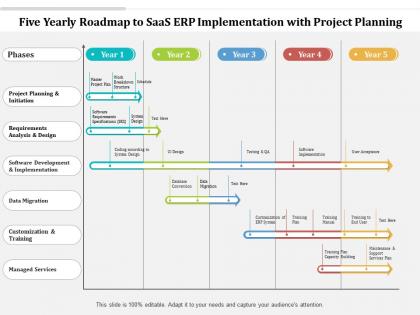
Five yearly roadmap to saas erp implementation with project planning




Try Before you Buy Download Free Sample Product
 Impress Your
 Audience
 100%
100% Editable
 Save Hours
 of Time


A well thought out action plan makes execution easier and increases the possibility of success significantly. Ensure hitting all the milestones within the deadlines by introducing our fully customizable Five Yearly Roadmap To SaaS ERP Implementation With Project Planning. Streamline the work related information, budget, timeframe, key deliverable, landmarks, and major steps involved, all in one place to give an organized overview of the project by utilizing our PowerPoint theme. Minimize time lag and increase work efficiency by providing insight into the process with our comprehensively researched roadmap PowerPoint layout. Color coding helps in highlighting the process and grabs the attention of the audience. Download our handy Five Yearly Roadmap To SaaS ERP Implementation With Project Planning to identify the possible problem areas in a much shorter time and propose solutions. Have a productive brainstorming session with your workforce by utilizing our action plan visualization tool.
People who downloaded this PowerPoint presentation also viewed the following :
Five yearly roadmap to saas erp implementation with project planning with all 2 slides:
Give your audience a fulfilling experience. They will find our Five Yearly Roadmap To SaaS ERP Implementation With Project Planning elevating.

FAQs for Five yearly roadmap to saas erp implementation
Oh man, SaaS ERP implementations are a journey! You'll start with planning and requirements - takes way longer than anyone expects. Then vendor selection and contracts (ugh). Configuration comes next, followed by data migration which is honestly a nightmare most of the time. Don't even get me started on how messy legacy data can be. Finally user training and launch. Budget 6-12 months minimum but seriously add buffer time everywhere, especially around data stuff. Something always goes sideways that nobody saw coming.
Look at three main things first: your current tech setup, whether your team can actually handle the change, and how messy your data is. I'd start with an audit of existing systems - legacy stuff will be a nightmare to integrate, trust me. Your team needs to be ready for totally different workflows too, since people either embrace these changes or sabotage them completely. Oh, and definitely clean up your data before you even think about migrating. Make a quick scorecard rating each area 1-10. Anything consistently below 6? Fix those issues first or you'll regret it later.
Oh man, stakeholder engagement is huge - probably the biggest factor in whether your ERP project succeeds or crashes and burns. You absolutely need leadership, end users, and IT all bought in from the start. Without them on board, you'll get pushback during rollout and terrible adoption rates. Plus you'll miss requirements that could've been spotted early if people actually felt included. I've watched projects completely implode because key people felt ignored. Communication is everything - keep everyone in the loop, ask for feedback constantly, and actually address their concerns. Don't just check the box at kickoff then disappear.
Honestly, the worst parts are gonna be data migration (total pain), getting people to actually use the new system, and making everything play nice with what you already have. Start by getting your executives on board - without that you're screwed. Clean up your messy data first, then test your migration like 3 times minimum. Map out every single system you're currently using before you even think about connections. Oh and involve your key users early or they'll revolt later. I learned that one the hard way! Training is huge too - people resist change but decent training helps.
First thing - do a data audit to see what you actually need. You'll be shocked how much old junk you can just delete. Clean up your formats beforehand, not while you're migrating. Break it into chunks instead of moving everything at once. Test each batch like crazy. Run both systems side by side for a bit - honestly this saved my butt last time I did one. Map out how your old fields connect to the new system early on. Get your users to help validate stuff. Oh, and give yourself double the time you think it'll take. Seriously.
Start with whether it actually does what you need - can it handle your main processes without tons of tweaking? Implementation time and total costs matter too, plus their history with similar-sized companies. Security's obviously huge if you're in a regulated space. Skip the fancy demos honestly - call their references instead. I learned this the hard way but their support team and financial health are way more important than the sales pitch makes it seem. Oh and definitely have your actual team test the interface first. Nothing kills adoption faster than a system that's a pain to use daily.
Honestly, get users involved from the very start - I can't stress this enough. Find your power users and make them champions, not enemies. Don't save training for the end when everyone's panicking. Been there, seen that disaster. Throughout the whole process, do hands-on sessions. Quick reference guides help too, but make them actually useful for how people really work. Oh and celebrate the small stuff! Users need to feel heard, so set up ways they can give feedback and actually see changes happen. Trust me on this one.
Honestly? Don't even touch custom code until you've tried everything else first. Use their built-in stuff - workflows, custom fields, user permissions. I've watched so many teams go straight to customizations and then get totally screwed when updates roll out. Trust me on this one. If you really can't avoid custom work, keep it super simple and stick to their APIs. Document the hell out of it too, because when that developer inevitably leaves, you don't want to be stuck. Oh, and definitely figure out your must-haves vs nice-to-haves upfront - saves major headaches later.
Honestly, you gotta nail down your metrics before launch if you want real ROI numbers. Track the obvious stuff - how much faster processes run, what you're saving on ops costs, fewer screw-ups from manual work. Finance will eat up anything about quicker month-end closes or cutting headcount (they're predictable that way). Don't ignore the squishy metrics either though. Better decision speed and happier customers count, even if they're annoying to measure. Set up some monthly dashboards after you go live. Track everything for at least a year - trust me on this one.
Okay, so first thing - encryption is huge. Your SaaS provider better encrypt data both moving around and sitting still. Check what certs they have too, like SOC 2 or ISO 27001. Set up multi-factor auth and role permissions right away. I know it's annoying during setup but trust me, don't skip it. Also figure out where they're storing your data geographically - GDPR gets weird about that stuff. Before you sign anything, ask about their incident response plan. What happens if they get breached? Get those SLA guarantees in writing.
Honestly, start by figuring out what compliance stuff you actually need - don't skip this part. Get your compliance people involved early to map out which regulations hit your industry. Configure those workflows first in the new ERP before doing anything fancy. I learned this the hard way watching other companies mess it up! Test with real-looking data, not just dummy stuff. You'll need proper audit trails and user permissions that actually meet regulatory standards. Oh, and the reporting has to pass muster too. This whole mapping thing takes way longer than you'd expect, so don't leave it for last.
For your SaaS ERP integration, I'd definitely go with API-based connections first - most have solid REST APIs that play nice with other systems. Zapier or MuleSoft are great if you don't want to code everything from scratch (honestly saved my butt on a project last year). File transfers work too, but they're kinda clunky and not real-time. Before jumping in though, sketch out what data actually needs to move between systems. Trust me, this step will save you headaches later and help you figure out if you need the fancy real-time stuff or if simple ETL batches will do the job.
So this totally depends on your company size and how messy your current setup is. Small businesses can usually knock it out in 3-6 months if their processes aren't too crazy. Bigger companies? You're looking at 6-12 months minimum. SaaS is way faster than the old on-premise stuff since you don't need all that hardware nonsense, but honestly scope creep will still bite you in the ass. Your biggest factors are data quality and integrations - plus whether your team actually shows up for testing (they won't). I'd plan for whatever timeline seems realistic, then add like 30% on top because something always goes wrong.
Dude, you absolutely need good ongoing support with SaaS ERP. I can't stress this enough - I've watched companies get totally screwed because they went cheap on support packages. Your vendor handles all the updates and troubleshooting now, which is great until something breaks at 2am. Business processes change constantly, integrations get wonky, and those regular platform updates? They'll mess with your workflows sometimes. Users always have questions too. It's just reality. Budget for comprehensive support from day one and negotiate it upfront. Trust me on this - it's not where you want to cut corners.
Set up pulse surveys weekly at first, then dial back to monthly once things settle. Honestly, dedicated Slack channels work great for this - users are gonna complain anyway, so you might as well funnel it somewhere useful. Schedule interviews with your power users AND the biggest skeptics within 30 days. Those feedback widgets embedded right in the interface are clutch too. Nobody wants to switch apps just to report a bug. The whole point is making it brain-dead simple for people to tell you what sucks.
No Reviews