


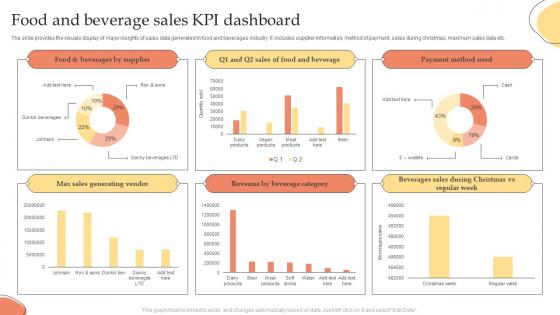
Food And Beverage Sales Kpi Dashboard




Try Before you Buy Download Free Sample Product
 Impress Your
 Audience
 100%
100% Editable
 Save Hours
 of Time


The slide provides the visuals display of major insights of sales data generated in food and beverages industry. It includes supplier information, method of payment, sales during christmas, maximum sales data etc.
People who downloaded this PowerPoint presentation also viewed the following :
Food And Beverage Sales Kpi Dashboard with all 7 slides:
Use our Food And Beverage Sales Kpi Dashboard to effectively help you save your valuable time. They are readymade to fit into any presentation structure.






FAQs for Food And Beverage
Dude, start with food costs (aim for 28-35%) and labor costs - those two will literally kill your business if you're not careful. Gross profit margin is critical too, like check it daily or you're basically guessing. Revenue per square foot shows if your space is actually paying for itself. Table turnover matters a ton for restaurants, plus inventory turnover ratio. Oh and customer lifetime value is getting super important now since everyone's scrambling for repeat customers. Honestly though? Focus on food and labor first, then add the other stuff once you've got those dialed in.
So basically, faster inventory turnover = better profit margins. You're not stuck with spoiled stuff or expired products killing your bottom line. Fresh ingredients might cost more upfront, but they sell at way better prices when they're actually fresh - makes total sense, right? Moving products quickly also frees up your cash instead of having it sit in slow stock. I'd start by checking which items move the slowest, then either order less of those or get creative about pushing them out faster. Track your turnover rates by category too - that'll show you exactly where to adjust your ordering.
So food cost percentage is basically how much you're spending on ingredients vs what you're charging. Most restaurants aim for 28-35% - like if your ingredients cost $3, you'd price the dish around $10 to hit that 30% mark. Honestly, it sounds simple but it's super easy to screw up if you're not keeping track. Supplier prices change all the time and can totally wreck your margins before you even notice. I'd start with your bestsellers first since that's where you'll actually see results. Also, you gotta update these calculations whenever costs shift or you're basically flying blind.
Honestly, you need to hit customers from a few different angles to get the real picture. QR codes on receipts work well for post-meal surveys, or just stick a tablet by the checkout. Online reviews are solid data but they're usually skewed toward the pissed off customers - happy people don't always bother writing reviews, you know? Mystery shoppers are worth it for consistent feedback, plus train your servers to actually listen and report back when guests mention stuff. I'd do NPS surveys monthly and break down specifics like food quality and service speed. Most important thing though - actually fix what they're complaining about or they'll stop bothering to tell you.
Honestly, start with inventory turnover - that tells you how fast you're actually moving product. Food waste percentage is huge too, like that's where you'll see your money disappearing. Track your order fulfillment times and perfect order rates for the customer side of things. Also keep an eye on cost per delivery and how reliable your suppliers are with their delivery schedules. Those five should give you a solid picture. Set up baselines first, then maybe do weekly check-ins? I learned the hard way that catching this stuff early saves you from way bigger headaches later.
So basically, faster table turnover = more money. If you're flipping tables every 45 minutes instead of 90, you've doubled your capacity without paying for more space. More covers per shift, higher sales - makes sense, right? But here's the thing - you can't just rush people out the door or they'll never come back. I learned that the hard way at my last place. You've got to find that sweet spot between efficiency and letting people actually enjoy their meal. Track your numbers by lunch/dinner periods and work on kitchen timing and smoother service flow. Speed matters, but so does keeping customers happy.
Track your food waste percentage by category and cost per pound - that's where you start. Daily weigh-ins for prep waste, plate waste, and spoilage work best. Most restaurants are honestly blown away when they first see their real numbers (it's usually way worse than they think). Calculate your waste-to-sales ratios weekly and don't forget disposal costs. The trick is staying consistent - pick specific staff to log everything and review it together each week. I'd focus on your top 3 waste sources first, then build action plans around those. Way less overwhelming that way.
So basically you take total beverage revenue and divide by guest count - super simple math. This tells you if your servers are actually pushing wine pairings, cocktails, that sort of thing. I track mine daily because trends pop up fast. Maybe Tuesday nights always suck for drink sales, or maybe Jake's shift consistently outperforms morning staff. If the number starts dropping, your team probably needs a pep talk about suggestive selling. Or honestly? Sometimes it just means your cocktail menu's gotten stale and needs a refresh.
Your labor cost percentage is like a warning sign for how profitable you're gonna be. Keep it around 25-35% - though honestly, it depends on what type of place you're running. When it starts creeping up, your profits get squeezed hard. That's when slow days really hurt you. I'd check it every week if I were you. Don't be like those owners who ignore it until they're bleeding money! You can usually fix it by tweaking schedules before it becomes a real problem. Way easier than trying to dig yourself out later.
Look, tracking your seasonal sales basically tells you what people actually crave throughout the year instead of just winging it. Winter means soup sales go crazy, summer brings salad lovers - obvious but the data shows you exactly when and how much. You won't get stuck with ingredients that sit around going bad, and you'll be ready when demand shifts. Honestly, it's kind of satisfying seeing those patterns emerge. Pull your sales data from the past 2-3 years and hunt for those recurring trends. Then you can plan specials that people actually want instead of hoping for the best.
Dude, keeping customers costs like 5-25x less than finding new ones - the math is crazy. Your regulars spend 67% more over time and actually forgive you when you screw up their order (which happens to everyone). They visit more often, try new stuff, and don't bail when prices go up. Honestly, word-of-mouth from happy customers beats any marketing campaign. The repeat visit rate thing compounds too - loyal customers aren't as picky about spending during rough economic patches. Track who's coming back monthly. Figure out what hooks them and do more of that.
Just get a good POS system that talks to your inventory software - it'll track everything automatically. Sales, food costs, waste patterns, all that stuff flows in real-time without you doing anything. Some platforms even predict your rush times which is honestly pretty neat. The trick is connecting everything so you're not pulling reports manually every week (ugh, who has time for that?). Start with a POS that plays nice with what you already have. Then maybe add restaurant analytics software later. Way better to spend your time actually using the data instead of collecting it.
Oh man, this stuff is actually pretty eye-opening once you dig into it. Like, you'll probably find that millennials are crushing your weekend brunch numbers - maybe 60% of sales - but then completely ghost you during weekday lunch. Different age groups go for totally different price points too. Some splurge on premium stuff, others are all about value deals. I swear this kind of analysis seems so obvious after the fact, but it completely changes how you think about staffing and marketing. Start with your top 3 customer segments and just see what their spending looks like - it's honestly kind of addictive once you get going.
Yeah, there's definitely a connection between social media buzz and actual sales, but it's kinda delayed. Like, you'll post something that gets tons of engagement, then see people actually show up 1-3 days later. Food pics and limited-time deals work best - honestly makes sense since people get hungry looking at your stuff. Posts about your "brand story" or whatever are more for building long-term loyalty than driving immediate sales. I'd track your engagement next to daily sales for at least a month. You'll start seeing your own patterns pretty quickly, then you can time your posts better.
Your systems don't talk to each other - that's the nightmare right there. POS, inventory, labor tracking... they're all siloed. Fresh food makes it worse since you're constantly dealing with spoilage and shifting values. And don't get me started on staff turnover - every time someone new starts, your data consistency goes out the window. Food costs are all over the place too depending on what's in season. Honestly? Just focus on 3-4 key metrics first. Get those rock solid before you try tracking everything under the sun.
-
I faced no difficulty while searching for the slide I wanted. Honestly, the website’s interface is easy to use and can be navigated easily!
-
I am a big fan of their newsletters because that is how I found my perfect requirement at the time of urgency. Thank God, I kept opening those.