


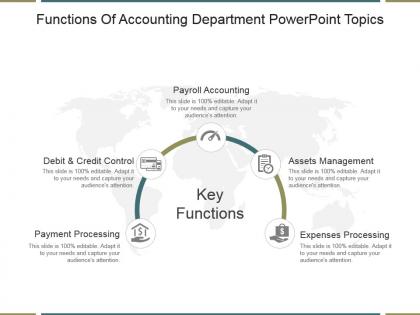
Functions of accounting department powerpoint topics




Try Before you Buy Download Free Sample Product
 Impress Your
 Audience
 100%
100% Editable
 Save Hours
 of Time


Add another exciting angle with our Functions Of Accounting Department Powerpoint Topics. They will give it a fresh dimension.
People who downloaded this PowerPoint presentation also viewed the following :
Functions of accounting department powerpoint topics with all 5 slides:
Devise a good approach with our Functions Of Accounting Department Powerpoint Topics. Figure out how to get over any difficulty.




FAQs for Functions of accounting
The primary responsibilities of an accounting department include financial record-keeping, budgeting and forecasting, tax compliance, payroll management, and financial reporting to stakeholders. These functions streamline business operations by ensuring regulatory compliance, enabling data-driven decision making, and maintaining fiscal transparency, with many organizations finding that efficient accounting processes ultimately deliver competitive advantage through better resource allocation and strategic planning.
**INPUT**: How does an accounting department contribute to financial decision-making within an organization? **OUTPUT**: Accounting departments enhance financial decision-making by providing accurate financial reporting, budget analysis, cost management insights, and performance metrics that guide strategic planning. Through detailed financial data and trend analysis, organizations streamline resource allocation, assess investment opportunities, and minimize financial risks, ultimately delivering improved profitability and competitive advantage in increasingly complex business environments. *Word count: 54 words*
The accounting department ensures tax compliance by maintaining accurate financial records, calculating tax liabilities, preparing required filings, and staying current with regulatory changes. Through systematic documentation and strategic tax planning, organizations streamline audit processes, minimize penalties, and optimize tax positions, with many companies finding that proactive compliance management ultimately delivers cost savings and reduces regulatory risks.
The accounting department manages budgeting by developing financial forecasts, monitoring expenditures against approved budgets, and providing variance analysis to identify deviations. Through systematic tracking and reporting mechanisms, accounting teams enable organizations to optimize resource allocation, control costs, and make strategic adjustments, with many companies finding that robust budgeting oversight ultimately delivers enhanced operational efficiency and improved financial performance.
The accounting department aids cash flow management through forecasting future cash needs, monitoring receivables and payables, implementing payment scheduling systems, and providing real-time financial reporting. These functions enable organizations to optimize working capital, prevent liquidity shortages, and make strategic investment decisions, with many businesses finding that proactive cash flow oversight ultimately delivers improved operational efficiency and competitive financial positioning.
The accounting department manages payroll by calculating wages, processing deductions, ensuring tax compliance, maintaining compensation records, and coordinating benefit payments. Through automated payroll systems and structured processes, organizations streamline salary disbursements, minimize errors, and ensure regulatory adherence, while many companies find that integrated payroll management enhances employee satisfaction and operational efficiency.
Accounting departments commonly use ERP systems like SAP and Oracle, cloud-based platforms such as QuickBooks and Xero, specialized software like Sage and NetSuite, and automated tools for invoicing and expense management. These technologies streamline operations by reducing manual data entry, enhancing financial reporting accuracy, and enabling real-time collaboration, with many organizations finding that integrated systems ultimately deliver faster month-end closes and improved regulatory compliance.
The accounting department identifies cost reduction opportunities through detailed expense analysis, budget variance reviews, process audits, and profitability assessments by department or product line. By leveraging financial data analytics and performance metrics, accounting teams can pinpoint inefficiencies, recommend resource reallocation strategies, and implement automated processes, ultimately delivering significant operational savings and enhanced competitive positioning.
Internal controls within accounting departments are significant because they prevent fraud, ensure accurate financial reporting, maintain regulatory compliance, and safeguard company assets through systematic checks and balances. These controls enable organizations to streamline audit processes, reduce operational risks, and build stakeholder confidence, with many financial institutions finding that robust internal controls ultimately deliver competitive advantage and enhanced investor trust.
The accounting department facilitates stakeholder financial reporting by compiling transaction data, preparing standardized statements, ensuring regulatory compliance, and maintaining transparent documentation systems. Through automated reporting tools and systematic processes, organizations streamline quarterly disclosures, annual reports, and investor communications, ultimately delivering accurate financial insights that enable informed decision-making and regulatory adherence.
Financial accounting focuses on external reporting through standardized statements, regulatory compliance, and historical transaction recording, while management accounting emphasizes internal decision-making through budgeting, performance analysis, and strategic planning. These complementary functions enable organizations to maintain regulatory transparency while delivering actionable insights for operational efficiency, with many companies finding that integrating both approaches enhances competitive advantage and stakeholder confidence.
The accounting department collaborates closely with finance through budget preparation, financial reporting, and cash flow management, while coordinating with operations on cost tracking, inventory valuation, and performance metrics. These strategic partnerships enable seamless data flow between departments, ensuring accurate financial insights, streamlined decision-making processes, and enhanced operational efficiency across the organization.
Essential skills for accounting professionals include strong analytical abilities, attention to detail, proficiency in accounting software, knowledge of financial regulations, and effective communication skills. These competencies enable accountants to streamline financial processes, ensure compliance accuracy, and deliver strategic insights, with many organizations finding that well-qualified accounting teams significantly enhance operational efficiency and decision-making capabilities.
Technology revolutionizes accounting department functions by automating data entry, streamlining financial reporting, and enhancing real-time analytics capabilities. Through cloud-based systems and AI-powered tools, organizations minimize manual errors, accelerate month-end processes, and deliver more strategic financial insights, with many companies finding that automated workflows ultimately free accounting teams to focus on analysis and decision-making support.
The accounting department can enhance data accuracy through automated reconciliation systems, real-time data validation protocols, segregation of duties, regular audit trails, and standardized chart of accounts. These measures streamline financial processes by minimizing manual errors, detecting discrepancies instantly, and ensuring consistent reporting standards, with many organizations finding that such controls ultimately deliver greater operational efficiency and regulatory compliance.
-
Excellent design and quick turnaround.
-
Great product with effective design. Helped a lot in our corporate presentations. Easy to edit and stunning visuals.