


Good governance the right governance pillars





Try Before you Buy Download Free Sample Product
 Impress Your
 Audience
 100%
100% Editable
 Save Hours
 of Time


Get folks to avoid being extra cautious with our Good Governance The Right Governance Pillars. Discredit any exaggerated fears.
People who downloaded this PowerPoint presentation also viewed the following :
Content of this Powerpoint Presentation
Description:
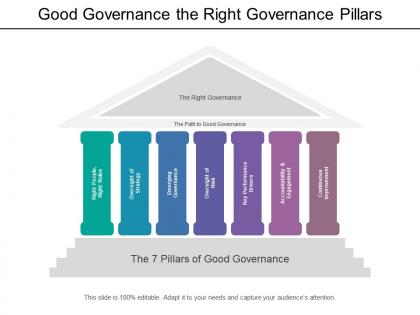
The image presents a slide titled "Good Governance the Right Governance Pillars," which highlights the seven foundational elements essential for achieving effective governance. The seven pillars are visually represented as columns, graduated in height to suggest a pathway leading upwards, symbolizing progress or aspirational goals. Each of the pillars is labeled with a principle of good governance:
1. Right People, Right Roles:
Signifies the importance of having competent and motivated individuals in the appropriate positions.
2. Oversight of Strategy:
Refers to the systematic review and guidance of the organization's strategic direction.
3. Effective Governance:
Implies the implementation of structures and practices that support good decision-making.
4. Oversight of Risk:
Involves the careful management of potential risks that could affect the organization.
5. Key Performance Drivers:
Points to the critical factors that drive the organization's performance.
6. Engagement & Alignment:
Highlights the need for active involvement and the alignment of stakeholders' interests.
7. Continuous Improvement:
Suggests an ongoing commitment to refining and enhancing processes and outcomes.
Use Cases:
The seven pillars can be universally applied across various industries to enhance governance practices. Here are seven industries and specific use cases:
1. Healthcare:
Use: Training on governance standards in healthcare institutions.
Presenter: Healthcare consultant.
Audience: Hospital administrators.
2. Finance:
Use: Discussing risk management and governance in financial planning.
Presenter: Compliance officer.
Audience: Banking and financial services professionals.
3. Education:
Use: Implementing effective governance in educational administration.
Presenter: University dean.
Audience: School board members.
4. Non-Profit:
Use: Workshop on governance and performance monitoring for non-profit organizations.
Presenter: Non-profit advisor.
Audience: Non-profit board of directors.
5. Technology:
Use: Advising on strategy oversight and continuous improvement in tech companies.
Presenter: IT governance expert.
Audience: Technology startup founders.
6. Government:
Use: Governing local and federal government agencies' strategic planning sessions.
Presenter: Public sector consultant.
Audience: Government agency leaders.
7. Manufacturing:
Use: Seminar on engagement, alignment, and governance in supply chain management.
Presenter: Operations manager.
Audience: Supply chain and logistics managers.
Good governance the right governance pillars with all 5 slides:
Choreograph the event with our Good Governance The Right Governance Pillars. Bring about an artistic feel.


FAQs for Good governance the
So there's six main things that make good governance work: transparency, accountability, participation, rule of law, effectiveness, and equity. You want decisions made openly where everyone can see what's happening. People need to answer for their actions too - no passing the buck. Getting stakeholders involved is key, and honestly, the rule of law thing might be the most important part since it means nobody gets special treatment. Then you've got effectiveness (actually getting stuff done) and making sure it's fair for everyone. Quick way to judge any organization? Just see how they stack up on these six points and you'll find the weak spots pretty fast.
Honestly, good governance is like having a solid foundation for your house - without it, everything crumbles. Investors actually trust countries where there's rule of law and transparency because they know their money won't just vanish overnight. Corrupt officials can't steal resources when there's real accountability. Look at South Korea or Botswana - they're perfect examples. Oh, and if you're ever thinking about emerging market investments (which you probably aren't but still), always check their governance scores first. It'll save you headaches later.
Honestly, there's tons of cool stuff happening with tech and government transparency. Open data portals let citizens actually see what's in those government datasets. Real-time budget dashboards are huge - you can literally watch where tax money goes. Blockchain's creating records nobody can mess with later, which is pretty wild if you think about it. Live-streaming city council meetings helps too, though half the time they're boring as hell. AI analysis of policy impacts is getting better. Don't try everything at once though - maybe start with budget transparency and see how it goes from there.
Honestly, citizen engagement is what keeps politicians from getting lazy and corrupt. Active citizens create this whole feedback loop - people show up to town halls, ask tough questions, and suddenly officials actually have to be transparent. Without that pressure, you get terrible policies made by people who've never lived in the real world. Voting matters obviously, but local meetings are where you can really shake things up. Short story: the more involved citizens are, the less likely politicians are to screw us over. Plus local government affects your daily life way more than federal stuff anyway.
Honestly, you need multiple watchdogs - independent audits, ethics boards, citizen panels that can actually bite back. Public reporting is clutch. Force them to show where every dollar goes and how they're performing (wild idea, I know). Real consequences for screwups matter too, plus protect whistleblowers so people aren't scared to talk. These systems need actual power though - can't let politicians just ignore them when it's convenient. Oh, and start local with disclosure rules. Way easier to win there first.
So basically, developing countries get hit with this perfect storm of governance issues. Corruption runs deep in the system. Infrastructure's usually trash - like, good luck running fair elections when half the country doesn't have reliable internet. Weak institutions can't handle basic services properly because they're underfunded and understaffed. Political instability makes everything worse, especially when you throw ethnic tensions into the mix. Then their smartest people just leave for better jobs abroad (honestly, can't blame them). The really tricky part? All these problems make each other worse, so you can't just fix one thing and call it a day.
Honestly, governance is all over the map depending where you are. Western democracies are big on individual rights and transparency. Meanwhile East Asian countries? They're more about collective harmony and long-term thinking than quick accountability. Africa has ubuntu philosophy - very community-focused. The Nordics somehow nailed it with strong institutions plus high social trust (seriously jealous). Islamic countries blend sharia with democratic stuff. Point is, there's no universal playbook. Before working anywhere internationally, dig into their local expectations first. What seems obvious to you might completely blow up somewhere else.
You know how good governance and human rights kinda go hand in hand? Like, when governments are transparent and actually include people in decisions, they're protecting basic rights to participation and fair treatment. Rule of law creates space for rights to grow. Then those rights make the whole system more legitimate - it's this whole cycle that feeds itself. I was just reading about this actually. Short version: if you're working on any governance stuff, ask yourself how it empowers regular citizens and protects their dignity. That's usually your north star.
First thing - map out your local political scene and figure out how things actually work there. Don't just copy some framework from another place because it'll probably crash and burn (trust me on this one). The core stuff like transparency matters, but you've got to make it fit your context. What are the power dynamics? How do people prefer to communicate and make decisions? Honestly, local traditions can make or break your whole approach. Test everything small first - like pilot programs or whatever - before going big. Oh and stakeholder relationships are huge, so spend time understanding those early on.
Ugh, it's like this endless downward spiral. Bad governments lose people's trust because they're incompetent or shady, right? Then citizens stop cooperating - they won't follow rules or pay taxes to leaders they think are useless. Makes sense honestly. But here's the thing: without that cooperation, the government can't function properly, which makes them look even worse. Total mess. The only real fix? Start small and prove you can actually get stuff done. Build trust with quick wins before trying to solve the big problems. Otherwise you're just spinning your wheels.
So basically, the World Bank, IMF, and UN track good governance using metrics like corruption levels and rule of law - pretty standard stuff. They dangle money as leverage though, telling countries "reform your institutions and we'll fund you." The World Bank's Worldwide Governance Indicators get cited everywhere (honestly kind of annoying how much people reference them). But they do show which countries are actually improving vs. falling apart. Some orgs also do capacity building programs on the side. If you're dealing with this at work, their annual reports are solid for tracking trends.
Honestly, check out Denmark, Singapore, and New Zealand - they're crushing it with transparency and digital services. Singapore's data-driven approach is pretty impressive, though maybe a bit too controlling for most places. Nordic countries are great at getting citizens actually involved, and Estonia's whole e-residency thing is wild (I still think about applying sometimes). New Zealand's anti-corruption game is solid too. But here's the thing - you can't just copy-paste their systems. Figure out what's actually broken in your situation first, then see how these countries handled similar problems. Start small and build from there.
Look, ethical leadership is basically what makes everything else work in governance. Trust me on this one. Without it, you don't have trust or accountability - and those are kinda non-negotiable. Fair decisions, transparency, being responsible to people... all that flows from leading ethically. I mean, think about it - would you trust an institution run by someone sketchy? Probably not. The practical stuff? Model what you want to see. Be open about how you make decisions. Actually consider who gets affected by your choices. It's honestly pretty straightforward once you get the mindset right.
Mix hard data with what people actually think - that's where the magic happens. Track your compliance rates, how fast decisions get made, budget stuff. But honestly? The soft metrics hit different. Survey people about trust and transparency regularly. Participation rates are huge too - if nobody's showing up to governance meetings, something's broken. Risk stuff matters - like how fast you catch problems before they blow up. Oh and don't go crazy tracking everything at once. Pick 3-4 solid metrics first, then build from there when you've got your rhythm down.
Media's wild - it can totally expose corruption and keep politicians honest, but then it also spreads so much BS that people stop trusting anything. Good journalists basically do our homework for us, digging up stuff we'd never find out otherwise. The problem is biased reporting just makes everyone more polarized. Can't find middle ground when everything's sensationalized, you know? And don't get me started on social media - now every random person thinks they're a reporter. If you're in government, just be straight with legit news outlets and fact-check before posting anything. Transparency actually works.
-
Excellent work done on template design and graphics.
-
Content of slide is easy to understand and edit.