


Governance model elements presentation slide




Try Before you Buy Download Free Sample Product
 Impress Your
 Audience
 100%
100% Editable
 Save Hours
 of Time


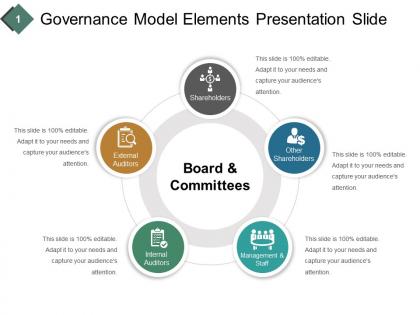
Use our technically developed PPT image on governance model elements PPT slide to improve your company’s operating model. This corporate governance PPT slide image will help in prioritizing your business efforts. Use this governance operating model PowerPoint template to translate the elements related with the business governance framework into the organizational practice. Other this this, you can also use this corporate governance model Presentation layout image to define the essential components related with your business governance framework. Such as structure, oversight responsibilities, Talent, culture, and infrastructure. It will help in describing the board roles and responsibilities which further helps in enhancing your business productivity and also helps in resolving any kind of business challenges. Hence, just start instating with this professional governance model Presentation image to build a business Presentation on improving your company’s capability levels. It also allows the management to take competent and result oriented organizational decisions. Thus, tap on the download link below. Figure out the factors causing doubt with our Governance Model Elements Presentation Slide. It helps address the dilemma.
People who downloaded this PowerPoint presentation also viewed the following :
Governance model elements presentation slide with all 5 slides:
Depict your feelings on our Governance Model Elements Presentation Slide. Experience contentment on a day to day basis.




FAQs for Governance model
Key components of an effective governance model include clear organizational structure, defined roles and responsibilities, decision-making frameworks, risk management protocols, and performance monitoring systems. These elements work together by establishing accountability, streamlining operations, and ensuring regulatory compliance, with many organizations finding that well-structured governance ultimately delivers enhanced transparency, operational efficiency, and strategic alignment across all business functions.
Stakeholder engagement significantly enhances governance effectiveness by improving decision-making transparency, increasing accountability mechanisms, and ensuring diverse perspectives inform strategic choices. Through regular consultations and feedback loops, organizations streamline resource allocation, minimize operational risks, and deliver better stakeholder outcomes, with many institutions finding that engaged stakeholders ultimately provide stronger oversight and strategic guidance.
Governance models adapt to emerging technologies through flexible frameworks, continuous risk assessment, regular policy updates, stakeholder engagement protocols, and technology-specific oversight committees. These adaptive mechanisms enable organizations across sectors like healthcare, financial services, and manufacturing to integrate AI, blockchain, and automation while maintaining compliance, ultimately delivering enhanced operational efficiency and competitive advantage in an increasingly digital landscape.
Transparency strengthens governance frameworks by enabling stakeholder accountability, improving decision-making processes, and building organizational trust through clear communication channels. It facilitates better risk management, regulatory compliance, and strategic oversight, with many institutions finding that transparent reporting mechanisms ultimately deliver enhanced credibility, stronger investor confidence, and competitive advantage in increasingly regulated markets.
Governance models ensure compliance through comprehensive risk assessment frameworks, automated monitoring systems, clear accountability structures, regular audit protocols, and standardized reporting mechanisms. These frameworks enable organizations across sectors like banking, healthcare, and manufacturing to proactively identify regulatory gaps, streamline compliance processes, and maintain transparent documentation, ultimately delivering reduced regulatory risk and enhanced operational efficiency.
Organizations can measure governance model success through key performance indicators tracking decision-making speed, compliance rates, risk mitigation effectiveness, stakeholder satisfaction scores, and operational efficiency metrics. These measurement strategies enable companies across sectors like financial services and healthcare to identify governance gaps, optimize resource allocation, and demonstrate regulatory compliance, ultimately delivering enhanced transparency and competitive advantage in increasingly complex business environments.
Public organizations typically operate under regulatory frameworks with board oversight, stakeholder accountability, and transparent reporting requirements, while private organizations maintain more flexible governance with shareholder-focused boards and streamlined decision-making processes. These structural differences enable private entities to pivot quickly in competitive markets, whereas public organizations prioritize transparency and regulatory compliance, with many finding that hybrid approaches increasingly deliver both accountability and operational efficiency.
Robust risk management frameworks incorporate comprehensive risk assessment protocols, clear governance structures, continuous monitoring systems, stakeholder engagement processes, and integrated reporting mechanisms. These practices enable organizations across sectors like banking, healthcare, and manufacturing to proactively identify threats, streamline compliance efforts, and enhance operational resilience, ultimately delivering competitive advantage through strategic risk mitigation.
Cultural differences significantly impact governance model design through varying communication styles, decision-making preferences, regulatory requirements, and stakeholder expectations across regions. Multinational corporations increasingly adopt hybrid approaches that blend standardized global frameworks with localized adaptations, enabling consistent oversight while respecting cultural nuances, ultimately delivering enhanced compliance and stronger stakeholder relationships worldwide.
Accountability systems within governance models include performance measurement frameworks, regular reporting mechanisms, independent audit functions, stakeholder feedback channels, and transparent decision-making processes. These systems enhance organizational oversight by establishing clear metrics, enabling continuous monitoring, and creating multiple touchpoints for evaluation, with many institutions finding that structured accountability frameworks ultimately deliver improved operational efficiency and stronger stakeholder trust.
Governance models facilitate better decision-making by establishing clear accountability structures, standardized evaluation criteria, and streamlined approval processes that eliminate bottlenecks and confusion. Through defined roles and systematic frameworks, organizations enhance transparency, reduce decision delays, and ensure consistent strategic alignment, with many financial institutions and healthcare systems finding that structured governance ultimately delivers faster responses and improved operational efficiency.
Aligning governance with organizational strategy ensures decision-making frameworks support business objectives, resource allocation matches strategic priorities, and risk management protects value creation initiatives. This strategic combination enables companies to execute plans more effectively, respond to market changes with agility, and maintain competitive advantage, with many organizations finding that aligned governance accelerates growth while minimizing operational inefficiencies.
Ethics and compliance integrate into governance models through clear codes of conduct, regular training programs, robust monitoring systems, and transparent reporting mechanisms. These frameworks enable organizations to mitigate risks, ensure regulatory adherence, and maintain stakeholder trust, with many financial services and healthcare institutions finding that strong ethical foundations ultimately deliver competitive advantage and operational resilience.
Diversity and inclusion enhance governance effectiveness by bringing varied perspectives, reducing groupthink, and improving decision-making quality through broader stakeholder representation. Organizations with diverse boards and leadership teams demonstrate stronger risk management, better strategic oversight, and enhanced stakeholder trust, with many companies finding that inclusive governance structures deliver superior long-term performance and competitive advantage.
Technology supports governance models in tracking performance metrics through automated data collection, real-time dashboards, predictive analytics, and integrated reporting systems. These digital tools streamline monitoring by eliminating manual processes, providing instant visibility into KPIs, and enabling proactive decision-making, with many organizations finding that automated governance platforms ultimately deliver enhanced transparency and strategic oversight.
-
Design layout is very impressive.
-
Out of the box and creative design.