


Guide Of Digital Transformation In Healthcare Industry To Accelerate Innovation And Improve Services DT CD




Try Before you Buy Download Free Sample Product
 Impress Your
 Audience
 100%
100% Editable
 Save Hours
 of Time


Check out our professionally designed Guide of Digital Transformation in Healthcare Industry to Accelerate Innovation and Improve Services PowerPoint Presentation. This presentation explores the progression of digital transformation within the healthcare sector, aiming to improve medical services and internal healthcare information systems. The focus is on current trends like telemedicine, Alexa, and virtual care, contributing to the digital transformation of healthcare services. Additionally, the Smart Pills and Ingestors templates encompass assimilating technological advancements, including intelligent tablets and ingestors, patient remote monitoring systems, and innovations in drug discovery and molecular simulations. This integration leverages the capabilities of IoT, artificial intelligence, blockchain, and electronic health record systems. Furthermore, the E-Prescribing Software slides incorporate a comparative analysis of healthcare information software and outline the budget required for integrating these solutions. Lastly, it introduces a dashboard for evaluating their impact on key performance indicators such as medication error rates and patient outcomes. Download our 100 percent editable and customizable PowerPoint, compatible with Google Slides, to streamline your presentation process.
People who downloaded this PowerPoint presentation also viewed the following :
Content of this Powerpoint Presentation
Slide 1: This slide introduces Guide of Digital Transformation in Healthcare Industry to Accelerate Innovation and Improve Services. State your company name and begin.
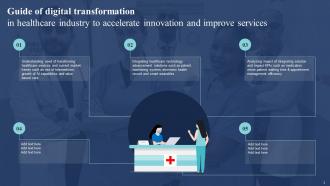
Slide 2: This slide displays Guide of digital transformation in healthcare industry to accelerate innovation and improve services with additional textboxes and related imagery.
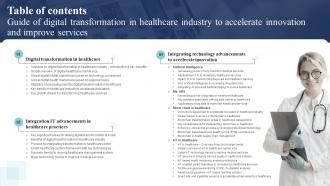
Slide 3: This slide shows Table of Content for the presentation.
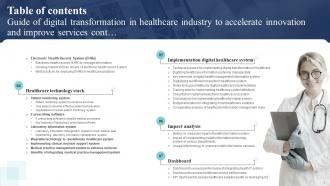
Slide 4: This slide continues showing Table of Content for the presentation.
Slide 5: This slide shows title for topics that are to be covered next in the template.
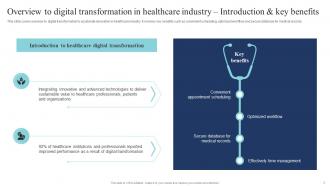
Slide 6: This slide covers overview to digital transformation to accelerate innovation in healthcare industry.
Slide 7: This slide displays global overview of digital healthcare market size and expected growth projections.
Slide 8: This slide covers global digital health market size based on components. It involves market revenue shares on basis of software, hardware etc.
Slide 9: This slide describes global digital healthcare market size based on regions. It involves regions with accounted revenue share and growth forcing factors.
Slide 10: This slide covers statistics showcasing need for transforming healthcare industry digitally.
Slide 11: This slide displays key trends in healthcare industry to accelerate innovation and digital transformation.
Slide 12: This slide covers forcing factors for integrating digital solutions to healthcare services.
Slide 13: This slide shows title for topics that are to be covered next in the template.
Slide 14: This slide covers four areas for enabling healthcare digital transformation at scale. It involves people & experiences, data & technology etc.
Slide 15: This slide displays advantage of emerging digital healthcare industry for patients and service providers.
Slide 16: This slide covers five steps process for integrating innovation in healthcare industry to evolve digitally.
Slide 17: This slide presents smart healthcare system framework with emerging technologies and advancements. It involves virtual assistants, smart furniture etc.
Slide 18: This slide covers futuristic trends to revolutionize healthcare system. It involves major emerging technological trends such as symptom checker chatbots etc.
Slide 19: This slide displays major technology trends to reshape healthcare industry and enhance efficiency of medical services.
Slide 20: This slide shows title for topics that are to be covered next in the template.
Slide 21: This slide covers latest technology trends to enhance healthcare innovation. It involves integration of IoT, big data, AI capabilities etc.
Slide 22: This slide shows title for topics that are to be covered next in the template.
Slide 23: This slide covers how artificial intelligence play vital role in transforming medical services.
Slide 24: This slide displays strategic use case of artificial intelligence to enhance medical services.
Slide 25: This slide covers role of artificial intelligence in effective treatment. It involves impact on areas such as faster diagnostics etc.
Slide 26: This slide presents key reasons how AI is revolutionizing drug discovery process to transform clinical processes digitally.
Slide 27: This slide covers utilizing AI powered medical imaging to evolve healthcare services. It involves use cases of AI models in healthcare.
Slide 28: This slide shows title for topics that are to be covered next in the template.
Slide 29: This slide covers utilizing big data models to transform healthcare services. It involves sources of extracting healthcare information.
Slide 30: This slide displays stats associated with big data in healthcare market. It involves details such as YoY growth, major regions etc.
Slide 31: This slide presents application of big data to enhance medical services. It involves patient prediction, supply chain management etc.
Slide 32: This slide shows title for topics that are to be covered next in the template.
Slide 33: This slide displays integration of blockchain in healthcare industry to improve security and enhance operational efficiency.
Slide 34: This slide covers global market overview of blockchain in healthcare industry. It involves projected growth rate and key growth drivers.
Slide 35: This slide presents key areas for implementing blockchain to enhance healthcare services. It involves electronic health records, clinical trials etc.
Slide 36: This slide covers major requirements before integrating blockchain technology in healthcare sector. It involves key considerations such as identify opportunities etc.
Slide 37: This slide describes how blockchain enhance clinical trial process. It involves key elements such as interactive voice response system etc.
Slide 38: This slide covers architecture of blockchain-based Electronic Health Record (EHR) management system.
Slide 39: This slide describes blockchain in health supply chain management to enhance operational efficiency. It involves key components such as customized track & trace software etc.
Slide 40: This slide shows title for topics that are to be covered next in the template.
Slide 41: This slide covers integrating internet of things (IoT) healthcare system to enhance patient outcomes.
Slide 42: This slide displays global IoT in healthcare market size. It involves details such as projected market growth rate and key driving forces.
Slide 43: This slide covers top IoT technology trends to enhance healthcare services. It involves key innovations such as 5G networks, edge computing etc.
Slide 44: This slide displays applications of IoT technology in healthcare and medical industry. It involves devices such as hearables, remote patient monitoring etc.
Slide 45: This slide covers IoT embedded smart health monitoring system architecture. It involves devices, communication gateways, cloud and data centers and applications & services.
Slide 46: This slide displays IoT enabled smart hearables to revamp healthcare services. It involves applications of hearable devices.
Slide 47: This slide covers IoT enables continuous glucose monitoring devices to improve diabetes patient outcomes.
Slide 48: This slide displays IoT based asset tracking system to monitor hospital equipments and enhance operational efficiency.
Slide 49: This slide covers evolvement of smart pills and ingestible sensors to accelerate innovation in healthcare system.
Slide 50: This slide shows title for topics that are to be covered next in the template.
Slide 51: This slide covers integrating electronic health record system to manage healthcare information. It involves medical data such as test results, allergies etc.
Slide 52: This slide displays global market overview of electronic health record system. It highlights financial projections and key forcing factors.
Slide 53: This slide covers best practices for integrating electronic health record system to improve healthcare information services.
Slide 54: This slide shows title for topics that are to be covered next in the template.
Slide 55: This slide covers remote patient monitoring system architecture to improve workflow efficiency.
Slide 56: This slide describes the process to optimize patient portal system to improve medical efficiency. It involves key steps such as determine portal’s features etc.
Slide 57: This slide covers applications of remote patient monitoring system in different departments of healthcare services.
Slide 58: This slide displays prescribing software to enhance healthcare services. It involves flow of information and benefits.
Slide 59: This slide shows title for topics that are to be covered next in the template.
Slide 60: This slide covers type of health information system that deals with effective prescription and simplify medical processes.
Slide 61: This slide shows title for topics that are to be covered next in the template.
Slide 62: This slide covers integration of laboratory information management system (LIMS) to track medical data. It involves electronic data management system etc.
Slide 63: This slide displays laboratory information management system. It involves need of LMS in healthcare as it supports regulatory compliance etc.
Slide 64: This slide shows title for topics that are to be covered next in the template.
Slide 65: This slide covers integrating wearables in healthcare to improve medical processes. It involves devices such as blood pressure monitors etc.
Slide 66: This slide presents deployment of clinical decision support system (CDSS) to enhance medical services.
Slide 67: This slide covers medical practice management system to improve operational efficiency.
Slide 68: This slide displays medical practice management system to enhance healthcare services.
Slide 69: This slide shows title for topics that are to be covered next in the template.
Slide 70: This slide covers data maturity model for integrating digital healthcare system. It involves three major approaches.
Slide 71: This slide displays digitizing healthcare information to reduce manual error and enhance medical services.
Slide 72: This slide covers key elements of health information management system. It involves components such as resources, indicators, data sources etc.
Slide 73: This slide presents automating healthcare workflows by leveraging technology solutions such as remote patient monitoring system, e prescribing software etc.
Slide 74: This slide covers roles and responsibilities for integrating effective digital healthcare solutions. It involves key members such as executive leadership etc.
Slide 75: This slide displays training program to improve efficiency of healthcare provider and enhance information management system.
Slide 76: This slide covers pre requisites for implementing EHRs system in healthcare effectively.
Slide 77: This slide presents cost associated for implementing health information system. It involves solutions such as HMS implementation etc.
Slide 78: This slide covers budget allocation for deploying smart healthcare solution in organization. It involves electronic health record system etc.
Slide 79: This slide displays comparative assessment of health management information tool to select suitable one. It involves features such as clinical database etc.
Slide 80: This slide shows title for topics that are to be covered next in the template.
Slide 81: This slide covers KPIs to measure impact of implementing health information system to improves effectiveness of healthcare services.
Slide 82: This slide presents impact of health information technology system in different departments.
Slide 83: This slide covers impact of health information technology on healthcare services. It involves key technologies such as block chain, robotics etc.
Slide 84: This slide shows title for topics that are to be covered next in the template.
Slide 85: This slide covers KPI dashboard to analyze improved performance after implementing health information technology system in organization.
Slide 86: This slide displays KPI dashboard to assess performance of medical services. It involves details such as patient stay length, admission rate etc.
Slide 87: This slide covers KPI dashboard to assess healthcare supplier quality by leveraging IoT. It involves details such as suppliers with most and least complaints etc.
Slide 88: This slide shows all the icons included in the presentation.
Slide 89: This is a Thank You slide with address, contact numbers and email address.
Guide Of Digital Transformation In Healthcare Industry To Accelerate Innovation And Improve Services DT CD with all 97 slides:
Use our Guide Of Digital Transformation In Healthcare Industry To Accelerate Innovation And Improve Services DT CD to effectively help you save your valuable time. They are readymade to fit into any presentation structure.












FAQs for Guide Of Digital Transformation In Healthcare Industry To Accelerate Innovation And Improve
Honestly, AI and machine learning are huge right now for diagnostics and predicting stuff before it happens. Cloud computing's everywhere for storing data and making systems talk to each other. IoT devices too - all those fitness trackers and smart medical gear. Telehealth blew up during COVID and never really went away, which makes sense. Robotic surgery's getting more mainstream, though that stuff's still pretty pricey. Blockchain for patient data is interesting but feels like it's still figuring itself out. Oh, and EHR systems keep getting better at actually working together. My advice? Figure out what's actually broken in your setup first, then find tech that fixes those specific problems.
Honestly, telemedicine is a game-changer for getting patients more involved. No more driving across town or dealing with packed waiting rooms - they can just hop on a call from their couch. I've noticed people actually open up more about awkward health stuff when they're at home, which is kinda surprising. You'll see better show-up rates too since scheduling becomes way less of a headache. The best part? More frequent check-ins mean you catch problems before they blow up. Oh, and definitely pick a platform with decent messaging - patients love being able to shoot you quick questions between appointments.
Dude, AI is totally changing medicine right now. It's catching patterns doctors miss - like spotting early cancers in X-rays better than radiologists sometimes. Wild, right? Your genetic data, medical history, lifestyle stuff? AI crunches all that to find treatments that'll actually work for you specifically. The coolest part is smaller clinics can now do precision medicine, not just those fancy research hospitals. Honestly thought this was still sci-fi a few years ago. You should check what AI tools are already FDA-approved in your field - there's probably more than you'd expect.
Look, don't make security an afterthought - weave it into everything from the start. Zero-trust architecture is your friend here, plus end-to-end encryption for all patient stuff. Your team needs regular cybersecurity training because honestly? Most breaches happen when someone clicks the wrong thing. Set up solid access controls so random people can't peek at sensitive data. Oh, and get third-party security audits done regularly - they'll catch things you miss. The compliance folks should be in these tech conversations early, trust me on that one.
Honestly, the money thing hits hardest - licenses, new computers, training costs, plus everyone's super slow at first so productivity tanks. Your staff will probably hate it because they're used to the old way of doing things. Workflow gets completely messed up initially, like everything that took 2 minutes now takes 10. Oh and good luck if you need it to actually talk to other hospital systems - that's always a nightmare. I'd seriously double whatever timeline and budget you're thinking. Maybe get people involved in picking the system so they don't feel like it's just being forced on them?
Honestly, these devices are huge for chronic care. Instead of seeing patients every few months for a quick snapshot, you're getting continuous data streams - blood glucose, BP, heart rate, all of it. Patients can't forget to check their numbers when it happens automatically, which is honestly a relief. The real win is catching problems early before they land in your ER. Just make sure whatever devices you pick actually talk to your EMR system properly. Oh, and definitely train your staff on reading all that data - otherwise you'll drown in numbers that don't help anyone.
Yeah, so there's definitely big upfront costs, but long-term it saves money through automation and cutting down on stupid duplicate tests. Electronic records help doctors not order the same bloodwork three times (seriously happens more than you'd think). AI catches stuff early when it's way cheaper to fix. Remote monitoring keeps people out of the ER for minor things. The ROI thing usually hits around year 2-3 once everything's actually working together. My advice? Figure out where you're bleeding money first, then find digital fixes for those specific problems.
So patient portals are basically like having a direct text line with your patients, but way more organized. They can message you non-urgent stuff, refill prescriptions, book appointments, check lab results - all without calling your office. Honestly saves you from so much phone tag it's ridiculous. Patients love seeing their results right away too, makes them feel more involved in their care. Just make sure you're super clear upfront about response times and what needs a phone call versus portal message. Otherwise you'll get people messaging about chest pain at midnight.
Look, don't let them just do some quick demo and call it training. Your team needs actual hands-on practice with the software, plus someone they can call when stuff breaks (which it will, probably at the worst possible time). The hardest part honestly? Managing everyone's stress about learning new systems while they're trying to do their jobs. Train a few tech-savvy people first so they can help others later. Oh, and make sure everyone knows the privacy rules - that's huge in healthcare. Budget for serious support for like 6 months minimum after you launch.
So the main thing is getting everyone on the same page with shared systems - like EHRs where all the patient info updates instantly. No more hunting down records or waiting for callbacks. Secure messaging is huge too, way better than phone tag with specialists. Video calls are honestly perfect for bringing in experts remotely (saves so much time for rural places especially). You'll want some kind of care coordination system to track tasks and deadlines. Just don't go crazy picking something super complicated - I've seen places choose fancy platforms that nobody ends up using consistently.
So basically blockchain makes patient records tamper-proof - once something's recorded, you can't change it without everyone knowing. The data gets spread across tons of computers instead of sitting in one hackable database. Honestly, it's like having a bunch of people watching every move, which sounds paranoid but actually works really well. Patients can control who sees their stuff through smart contracts too. Oh, and definitely start with something small like consent management - don't jump straight into overhauling your entire record system because that'll be a nightmare.
Honestly, you've gotta measure both the clinical stuff and operational side to know if it's actually making a difference. Patient satisfaction, time-to-diagnosis, readmission rates - all that matters. Staff productivity and cost savings too, since the C-suite eats that up. But here's what most people mess up: set your baselines BEFORE rolling anything out, or you'll have no clue what changed. I'd track monthly instead of waiting around for annual reviews. Pick maybe 3-5 metrics that actually align with what you're trying to fix and build some basic dashboards. Revenue per patient is another big one if you can swing it.
So the big things you gotta watch out for are patient privacy, data security, and algorithmic bias. Even anonymized data can sometimes be traced back to specific people, which is sketchy. Hackers love going after health records too. But honestly? Bias is what keeps me up at night - if your AI trains on datasets that aren't diverse, it'll just make healthcare inequities worse for marginalized groups. You need solid consent processes so patients actually know what's happening with their info. I'd start by auditing your current data practices and maybe get some diverse review committees to spot bias issues before they become problems.
So digital transformation can actually help bridge healthcare gaps in underserved areas - think telemedicine for remote places, mobile apps for managing chronic conditions, that sort of thing. The trick is not just slapping tech onto broken systems but actually redesigning how care works. I'd focus on stuff that runs on basic phones with crappy data connections honestly. Partner with local community groups since people trust them way more than some random app. Oh and make sure whatever you build actually makes sense culturally for the people using it. Start by figuring out what barriers your community faces first, then build backwards from those problems.
Dude, AI diagnostics are gonna be huge for catching stuff early. Telehealth isn't going anywhere obviously, but the cool part is how it'll blend with regular office visits. Wearables are getting insane too - like, constant health data instead of just those awkward checkups once a year. Blockchain for medical records is picking up steam, which honestly I didn't see coming. My advice? Just try one new digital thing this year. Nothing crazy, just something to dip your toes in. The whole industry's shifting whether we like it or not, so might as well get comfortable with it now.
-
Unique research projects to present in meeting.
-
The best and engaging collection of PPTs I’ve seen so far. Great work!