Data Driven Digital Transformation Journey
Try Before you Buy Download Free Sample Product
Audience
Editable
of Time
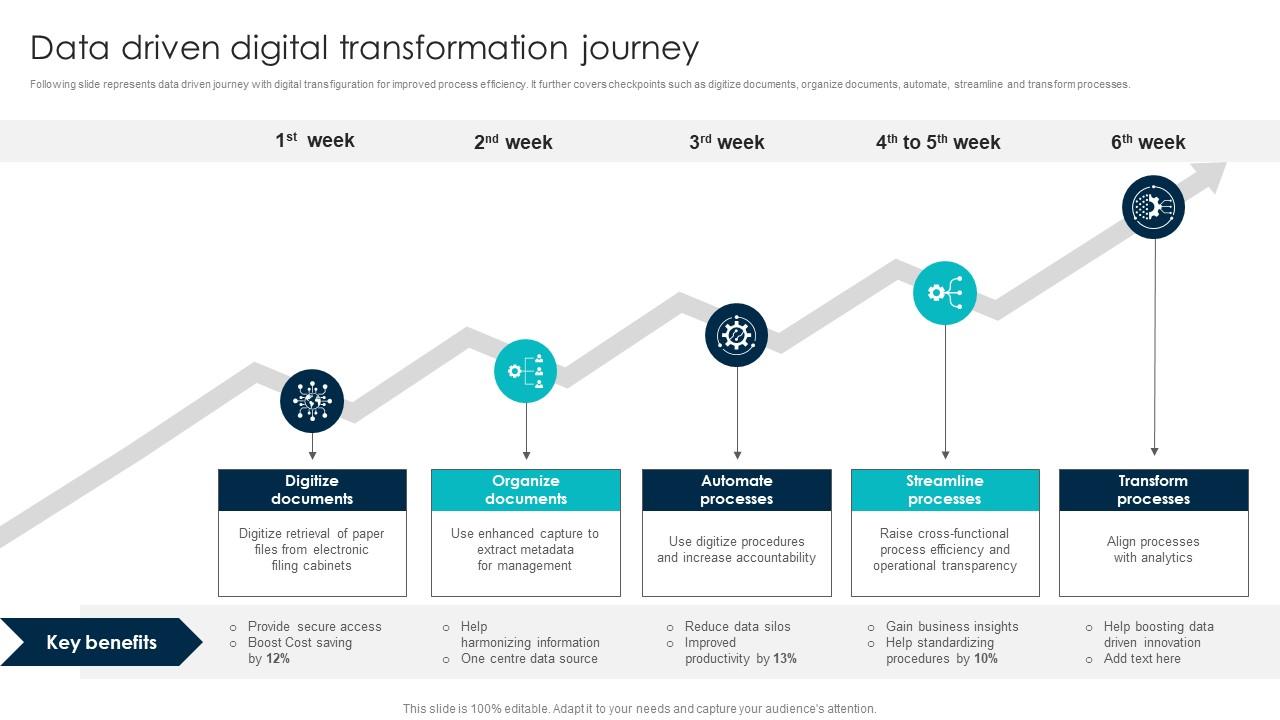
Following slide represents data driven journey with digital transfiguration for improved process efficiency. It further covers checkpoints such as digitize documents, organize documents, automate, streamline and transform processes.
People who downloaded this PowerPoint presentation also viewed the following :
Data Driven Digital Transformation Journey with all 9 slides:
Use our Data Driven Digital Transformation Journey to effectively help you save your valuable time. They are readymade to fit into any presentation structure.
FAQs for Data Driven
Honestly, you need four main things to make this work. First - boring but critical - your data infrastructure has to be solid. Garbage data = garbage results, period. Analytics tools that don't make people want to cry are next, plus training so your team actually knows what they're doing. Leadership has to buy in too, which is sometimes the hardest part. Oh, and you'll need a culture shift where people trust numbers over hunches. My advice? Start small - audit whatever data you've got now and pick one business problem you can actually solve with it.
Look, I know it sounds boring but you gotta set up data governance right from the start. Figure out who owns what data and create validation rules for everything coming in. Documentation is huge too - when stuff breaks (and it will), you'll want to trace where it went wrong. Oh and don't dump this all on your IT team, make it everyone's job. I'd set up some dashboards to track data health and actually review them weekly. Automated quality checks at every entry point will save you so much headache later, trust me on this.
Honestly, leadership makes or breaks this stuff. If your executives are still making gut calls while preaching "data-driven decisions," people see right through that BS. What really works is when leaders actually use data themselves and show it's okay to challenge old assumptions - like creating that psychological safety thing where people won't get fired for uncomfortable insights. I've watched so many companies blow money on fancy dashboards and training, but then nobody changes how they actually make decisions. You need leaders who prove data skills matter for getting promoted, not just something HR talks about. Short version: leaders have to walk the walk first.
Map your data stuff directly to what actually matters for business - revenue, costs, happy customers, whatever. Too many teams just hoard data because it seems important (guilty of this myself honestly). Work backwards instead. What are your goals? Then figure out what data helps you hit those targets. Get stakeholders involved early or you'll be fighting uphill later. Quick wins are everything - start with small pilot projects that show results fast. Once people see the ROI, scaling becomes way easier. Don't try to boil the ocean right away.
Honestly, just start with what you've got and build from there. You'll want cloud storage (AWS or Azure work great), then grab something like Tableau or Power BI for visualizing everything. Don't sleep on Excel either - I know it sounds basic but it's clutch for quick analysis. SQL is pretty much mandatory for database stuff, no way around that one. Python or R are solid if you want to get fancy with analytics later. Oh, and Google Analytics handles most web tracking automatically which is nice. The trick is not overwhelming your team right away - they'll actually use it if you keep things simple at first.
Get your people involved in *making* the change happen, don't just dump it on them. Be upfront about why this matters - and I mean how it'll actually help their day-to-day work, not some corporate BS about synergy. Most pushback comes from being scared of what's coming. Show some quick wins early so they see real benefits. Find those natural influencers on each team who can get others excited about it. Actually listen when people raise concerns (this part's huge). Don't just steamroll over objections. Give them proper training so they feel ready, not thrown to the wolves. Oh, and be transparent about what's changing versus what's staying the same.
Forget the fancy data quality scores - nobody upstairs cares about those. Focus on stuff that actually moves the needle: how fast can people make decisions now? Are you cutting costs through automation? Track if anyone's even using your dashboards (shocking how often they're not). Revenue impact is where it's at though. Show how your data work affects sales or keeps customers from leaving. I've seen so many teams waste time on technical metrics that make zero sense to executives. Connect everything back to KPIs leadership already watches obsessively. That's your golden ticket to more budget.
Look, data visualization is just making your crazy spreadsheets tell a story people can actually get. Your team will spot trends and weird outliers way faster than staring at endless rows of numbers. I've literally watched meetings go from two-hour disasters to twenty-minute wins because someone threw together a decent chart. Plus dashboards give everyone the same language - suddenly marketing and engineering aren't talking past each other anymore when they're both looking at the same graph. My advice? Start small with one metric your team always fights about and just visualize that first.
Think of regulations like guardrails for your whole transformation project. They dictate what data you can grab, where it lives, and who sees it. GDPR, HIPAA, SOX - whatever applies to your industry. Here's the thing though: build compliance right into your data setup from the start. Seriously, don't try to add it later because that's a nightmare. Get your legal folks involved early so they can actually guide your tech decisions instead of just saying "no" to everything afterward. First step? Map out which rules hit your specific data and use cases.
Honestly, most analytics projects crash because of two things - crappy data and nobody actually wanting to use the results. Companies get excited about shiny new tools but skip the boring stuff like cleaning their data first. Classic mistake. Teams also waste months trying to build the perfect system instead of just starting somewhere small. Oh, and here's what drives me nuts - building gorgeous dashboards that solve zero real business problems. Nobody told them what they actually needed! Start with one specific issue your friend's company faces, fix the data mess first, and talk to the people who'll actually use it.
Honestly, start by tracking what your customers actually *do* - not just what they tell you in surveys. Look at their buying patterns, where they bail out of your funnel, how they navigate your site. That behavioral stuff is way more valuable than people realize. Once you've got some data, segment users into groups and customize your messaging for each one. I'd pick just one metric to focus on first though - maybe conversion rates? Test some changes based on what you're seeing, then double down on whatever moves the needle. The whole point is turning insights into action, not just hoarding spreadsheets.
Dude, you absolutely need other departments involved or your project will crash and burn. Marketing knows the customers, finance controls the purse strings, IT handles the tech stuff - they all have pieces you need. I've seen so many "perfect" data solutions that nobody actually wanted to use because the team didn't talk to anyone else first. Operations especially - they know what actually works day-to-day versus what looks good on paper. Map out who touches your data and loop them in early. Trust me, those conversations save you from building something technically amazing but completely useless.
Honestly, just start with the free stuff - Google Analytics and whatever social media insights you've got access to. They'll give you more data than you know what to do with. Excel might sound boring, but it's actually solid for tracking sales patterns and customer feedback. Pick one specific question first, like "why do people actually buy from us?" Don't try analyzing everything at once or you'll go crazy. Once you get into the habit of checking your numbers regularly - and I mean actually using what you find - then you can think about paid tools.
Honestly, just stick to the basics and you'll be fine. Get clear consent before grabbing anyone's data - like actually ask, don't bury it in some 20-page terms thing. Tell people straight up what you're doing with their info. Only grab what you actually need too, not every random detail you can get. Oh and obviously keep it secure and let people bail out or delete stuff easily. I mean, it's really just about treating people's data how you'd want yours treated - with some actual respect instead of like you own it or whatever.
So predictive analytics is like having a crystal ball for your business data - you feed it historical info and it tells you what's coming next. Healthcare uses it to catch which patients might get readmitted. Retail figures out when demand will spike. Banks spot fraud before it happens. The cool part? You stop playing defense all the time. Instead of your team running around putting out fires, you're actually preventing problems or jumping on opportunities first. I'd honestly start small though - pick one annoying recurring issue you deal with and see if you can build a model to flag it early.
-
What an exhaustive collection of templates you guys have there in slideteam. Impressive!!!
-
Easy to use and customize templates. Helped me give a last minute presentation.