

Hacking it powerpoint presentation slides




Try Before you Buy Download Free Sample Product
 Impress Your
 Audience
 100%
100% Editable
 Save Hours
 of Time


Hacking is an effort to gain unauthorized access to a computer system or a private network within a computer. Here is a professionally designed Hacking IT template that provides an overview of the business current situation by describing the hacking attacks faced by the company and the impact of these attacks on the organization. This PowerPoint presentation covers the new strategies to prevent hacking, including ethical hacking, cyber security awareness among employees, backup of sensitive data, disaster recovery plan, usage of security programs, and others. Additionally, this Security Hacker PPT talks about the budget for implementing new security policies and new prevention measures. Furthermore, this template includes an implementation plan that caters to a 30-60-90 days plan, a roadmap, and a dashboard. Also, this PPT provides the impact of new security policies and preventing measures on business such as the impact of ethical hackers, benefits of ethical hackers to the company, and regaining the companys reputation. Lastly, this Hacking deck introduces hacking and ethical hacking and its purpose and legality. Download this 100 percent editable template now.
People who downloaded this PowerPoint presentation also viewed the following :
Content of this Powerpoint Presentation
Slide 1: This slide introduces Hacking (IT). State Your Company Name and begin.
Slide 2: This is an Agenda slide. State your agendas here.
Slide 3: This slide presents Table of Content for the presentation.
Slide 4: This slide shows title for topics that are to be covered next in the template.
Slide 5: This slide displays Reasons and Impact of Website Hacking on Business.
Slide 6: This slide represents the distributed denial of service attacks faced by the company.
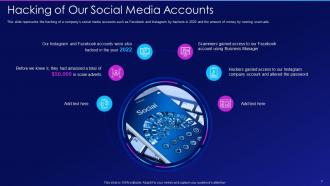
Slide 7: This slide showcases Hacking of Our Social Media Accounts.
Slide 8: This slide presents hacking of the company email domain by hackers by sending spam email.
Slide 9: This slide shows title for topics that are to be covered next in the template.
Slide 10: This slide represents the different types of cyber-attacks throughout the year.
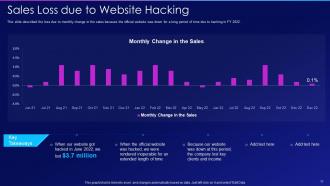
Slide 11: This slide displays Sales Loss due to Website Hacking.
Slide 12: This slide depicts the increased additional costs caused by cyber-attacks.
Slide 13: This slide represents Reputational Damage due to Cyberattacks.
Slide 14: This slide showcases Loss of Customers and Client Information.
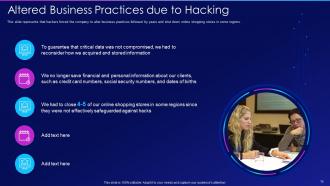
Slide 15: This slide represents that hackers forced the company to alter business practices.
Slide 16: This slide shows title for topics that are to be covered next in the template.
Slide 17: This slide displays Ethical Hacker and Why We Need Ethical Hacker.
Slide 18: This slide represents Roles and Responsibilities of Ethical Hackers.
Slide 19: This slide depicts why organizations recruit ethical hackers, including effective security measures.
Slide 20: This slide shows title for topics that are to be covered next in the template.
Slide 21: This slide represents the cybersecurity awareness training program for staff.
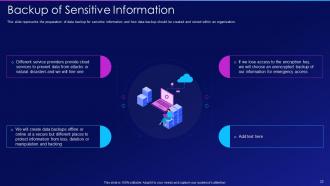
Slide 22: This slide showcases the preparation of data backup for sensitive information.
Slide 23: This slide depicts what factors will be considered while preparing a disaster recovery planning.
Slide 24: This slide represents the usage of security programs such as secure socket layer, web application firewall, etc.
Slide 25: This slide shows title for topics that are to be covered next in the template.
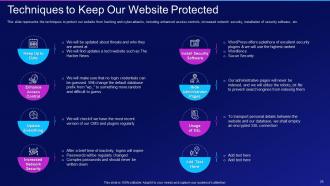
Slide 26: This slide displays Techniques to Keep Our Website Protected.
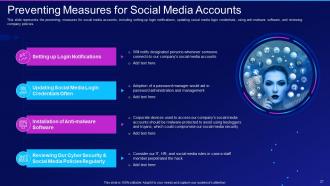
Slide 27: This slide represents Preventing Measures for Social Media Accounts.
Slide 28: This slide depicts the email prevention guidelines for employees, including spam filters.
Slide 29: This slide shows title for topics that are to be covered next in the template.
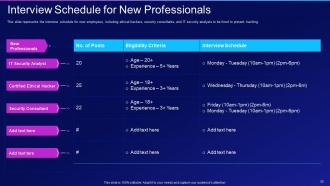
Slide 30: This slide represents the interview schedule for new employees, including ethical hackers.
Slide 31: This slide displays budget for newly recruited professionals, including new professionals.
Slide 32: This slide showcases Budget for IT Spending by the Company.
Slide 33: This slide shows title for topics that are to be covered next in the template.
Slide 34: This slide presents the impact of ethical hackers on business by describing the decreased number of malicious attacks.
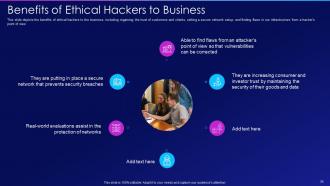
Slide 35: This slide depicts the benefits of ethical hackers to the business, including regaining the trust of customers and clients.
Slide 36: This slide describes the regaining company’s reputation through regaining customers’ trust.
Slide 37: This slide shows title for topics that are to be covered next in the template.
Slide 38: This slide presents 30-60-90 Days Plan for New Strategies Implementation.
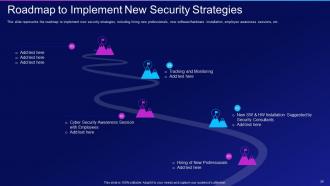
Slide 39: This slide displays Roadmap to Implement New Security Strategies.
Slide 40: This slide depicts the dashboard for threat tracking through cyber security measures.
Slide 41: This slide is titled as Additional Slides for moving forward.
Slide 42: This slide illustrates the overview of hacking and how businesses are getting affected by it every year.
Slide 43: This slide represents the phases of hacking, including reconnaissance, scanning, gaining access, etc.
Slide 44: This slide describes the common types of cybercrime such as identity theft, computer fraud, etc.
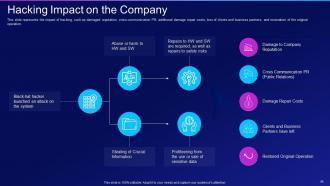
Slide 45: This slide showcases the impact of hacking, such as damaged reputation, crisis communication PR, etc.
Slide 46: This slide depicts ethical hacking and how ethical hackers could be an asset to a company.
Slide 47: This slide presents the purpose of ethical hacking, including the tools and tactics.
Slide 48: This slide displays the legality of ethical hacking, how ethical hackers work official permission.
Slide 49: This slide represents Icons for Hacking (IT).
Slide 50: This slide describes Line chart with two products comparison.
Slide 51: This is Our Mission slide with related imagery and text.
Slide 52: This slide shows Post It Notes. Post your important notes here.
Slide 53: This slide contains Puzzle with related icons and text.
Slide 54: This is a Comparison slide to state comparison between commodities, entities etc.
Slide 55: This is an Idea Generation slide to state a new idea or highlight information, specifications etc.
Slide 56: This slide depicts Venn diagram with text boxes.
Slide 57: This is a Timeline slide. Show data related to time intervals here.
Slide 58: This is a Thank You slide with address, contact numbers and email address.
Hacking it powerpoint presentation slides with all 63 slides:
Use our Hacking IT Powerpoint Presentation Slides to effectively help you save your valuable time. They are readymade to fit into any presentation structure.

























FAQs for Hacking it
Honestly, it's all about intent and getting permission first. White hat hackers who ask before they test? Totally fine - they're actually helping companies find problems. But stealing data or messing with systems without consent? That's obviously not cool. There's also weird middle ground stuff like hacktivism that gets complicated real quick. My take is you need three things: proper authorization, don't cause unnecessary damage, and make sure you're actually trying to help people rather than hurt them. If you're even thinking about testing security stuff, definitely get written permission beforehand.
Honestly, you've gotta think of it like protecting your house - multiple locks are better than one. Train your team regularly because people mess up more than tech does (learned that the hard way). Keep everything updated and patched, throw multi-factor auth on literally everything you can. Network monitoring catches sketchy stuff early, which is clutch. Run pen tests to find holes before hackers do. Oh, and test your backups constantly - I can't stress this enough. Have an incident plan ready too because you're definitely getting hit eventually, just a matter of when.
Hey! So hackers love phishing emails - they're probably the most common trick to grab your passwords. SQL injection hits websites hard, and honestly, social engineering is terrifying because people just... trust too easily. Tools like John the Ripper crack passwords, while Nmap scans for weak spots in networks. They'll drop malware for long-term access or intercept your data with man-in-the-middle attacks on sketchy wifi. Here's the weird part - they often use the same security tools that IT teams do, like Metasploit. Your best bets? Update everything, train people to spot fake emails, and use two-factor authentication religiously.
So hacking started back in the 60s with MIT students who were just curious about how systems worked. Pretty wholesome actually. These programmers would mess around and push boundaries just to learn stuff. The whole thing got twisted in the 80s-90s when media made "hacker" sound like cybercriminal. Now there's white hat (good guys), black hat (actual criminals), and gray hat hackers somewhere in the middle. Bug bounties and cybersecurity jobs have made ethical hacking respectable again though. If you're thinking about getting into this, check out penetration testing - it's where that original curiosity meets real career potential.
So social engineering is basically when hackers mess with your head instead of trying to crack codes. They'll send fake emails, call pretending to be IT, or even follow you into buildings. Way sneakier than technical stuff honestly. These people are good at acting - they'll pretend they're your coworker or some vendor to get passwords or trick you into clicking sketchy links. The whole thing works because people trust too easily. Always double-check through a different method before you hand over anything sensitive. Trust me, that extra step saves headaches later.
Honestly, you've gotta make everyone feel like cybersecurity affects their actual job, not just dump it on IT. Use real phishing emails that hit your company - way more effective than generic training slides. Keep policies simple so people don't ignore them because they're too complicated. When someone spots something sketchy and reports it, celebrate that instead of making them feel weird about it. Monthly reminders work better than once-a-year training marathons (trust me on this one). Interactive stuff beats boring presentations every time. Build it into your culture gradually - can't just flip a switch and expect everyone to care overnight.
Oof, yeah there's been some big ones that really changed everything. Target got hit in 2013 - 40 million credit cards stolen because their checkout systems were basically unprotected. Equifax was probably the worst though, like 147 million people's info leaked in 2017 just because they didn't update their software. That one still makes me mad honestly. Then SolarWinds in 2020 totally flipped how we think about supply chains - hackers basically poisoned software updates to break into thousands of companies. Now everyone's doing zero-trust security and actually has breach response plans that don't suck.
So hackers basically cash in by selling your stolen info on the dark web, hitting you with ransomware, or straight-up identity theft. They'll also rent out botnets - which is kinda wild if you think about it. For victims though? You're screwed financially. Direct theft, ransom money, recovery costs, legal bills. Businesses get slapped with regulatory fines too. The average breach costs companies like $4.45 million now. Honestly, just invest in decent cybersecurity before you become another statistic. Way cheaper than dealing with the aftermath.
Yeah, so ethical hackers can do some pretty cool stuff for good causes. Anonymous has taken down oppressive government sites, and researchers constantly expose data breaches companies want to hide. It's basically digital whistleblowing with code instead of documents. White hat hackers help nonprofits beef up their security too - super needed since most are running on shoestring budgets and outdated systems. They also build tools for journalists in sketchy countries where they need protection. Organizations like Electronic Frontier Foundation showcase this stuff well if you want examples of how tech skills serve justice.
Oh man, SQL injection is still the big nasty one - attackers can totally wreck your database with that. XSS is another pain where malicious scripts run in people's browsers. Broken authentication is huge too, like when login systems are garbage. There's also this thing called insecure direct object references (sounds fancy but it's just poor access controls). CSRF attacks are pretty sneaky since they trick users into doing stuff without knowing. Honestly the OWASP top 10 list covers most of this. Just audit your code regularly and you'll catch the obvious stuff.
Dude, IoT devices are basically a hacker's dream come true. Your smart doorbell, thermostat, even that fancy fridge you got last year - they're all potential entry points. Most ship with garbage security like "admin/admin" passwords (I wish I was kidding). Companies care more about adding cool features than fixing vulnerabilities. Hackers love using these things for massive botnet attacks or sneaking into your main network through the back door. Change those default passwords ASAP and put your smart stuff on a separate network if you can.
Yeah, there are laws against hacking - the US has the Computer Fraud and Abuse Act plus wire fraud stuff. EU's got similar rules. Problem is, enforcement sucks because hackers love operating across borders where nobody can touch them. Countries don't always play nice with each other either. You'll see domestic hackers get busted sometimes, or really big international cases that make headlines. But honestly? Don't count on the law to save your company's ass. Get good security first, then maybe you won't need to test how well those laws actually work.
Okay so first things first - get a password manager like Bitwarden. Trust me, it's a game changer for creating strong passwords without losing your mind. Turn on two-factor authentication everywhere you can. Keep your apps updated because those patches actually matter. Don't click sketchy email links even if they look real. Public WiFi is sketchy for banking stuff, obviously. Oh and check your credit report like twice a year - I always forget to do this but it's clutch. Set up account alerts so you'll catch weird activity right away.
So AI is basically like giving both hackers and security teams steroids. Hackers can now automate finding weak spots, create super convincing phishing emails, and build malware that changes itself to dodge detection systems. Pretty wild stuff. But the good guys get the same advantages - their systems can process millions of security events instantly and spot attack patterns before they happen. Your defenses can actually learn and adapt now, which is honestly pretty cool. Bottom line? Just make sure your AI security tools aren't falling behind the AI attacks coming at you.
Dude, the threat landscape is getting crazy right now. AI-powered phishing is everywhere - these emails look legit because machine learning helps craft them. Supply chain attacks are blowing up too. Cloud configs are still a mess (seriously, basic stuff that companies somehow screw up constantly). Ransomware-as-a-service makes it easier for wannabe hackers to cause real damage. Oh, and deepfakes for social engineering - that's terrifying. IoT devices remain sitting ducks. My advice? Run security assessments regularly and train your people on this stuff before you're scrambling to fix a breach.
-
Very unique, user-friendly presentation interface.
-
Illustrative design with editable content. Exceptional value for money. Highly pleased with the product.
-
Excellent products for quick understanding.