


Hospital Performance Dashboard With KPI




Try Before you Buy Download Free Sample Product
 Impress Your
 Audience
 100%
100% Editable
 Save Hours
 of Time


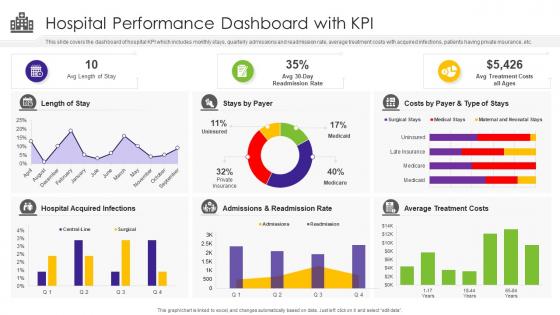
This slide covers the dashboard of hospital KPI which includes monthly stays, quarterly admissions and readmission rate, average treatment costs with acquired infections, patients having private insurance, etc.
People who downloaded this PowerPoint presentation also viewed the following :
Hospital Performance Dashboard With KPI with all 7 slides:
Use our Hospital Performance Dashboard With KPI to effectively help you save your valuable time. They are readymade to fit into any presentation structure.





FAQs for Hospital Performance
Honestly, start with bed occupancy rates and average length of stay - those are your bread and butter. ER wait times will make or break patient satisfaction, trust me on that one. Track your nurse-to-patient ratios too since staffing is always a nightmare. Readmission rates within 30 days? Super critical because it hits both your quality scores and your wallet. Cost per patient day gives you the financial picture. Oh, and patient throughput times - basically how fast people move through your system. Don't go crazy trying to monitor everything though. Pick like 5-6 to start.
Okay so patient satisfaction scores basically control everything at your hospital. Medicare literally uses your HCAHPS scores to decide how much they'll pay you - it's wild how much money is tied to whether patients liked their stay. Plus when people are unhappy, they don't follow their treatment plans as well, which means more readmissions and worse outcomes overall. The scores get published online too, so if you're tanking it affects your reputation and makes it harder to recruit good doctors and nurses. Honestly, most of it comes down to communication - train your staff to actually talk to patients better and you'll see those numbers jump pretty quickly.
So readmission rates are basically hospitals getting called out for sending people home too soon. High numbers within 30 days? That's a sign they messed up discharge planning or didn't teach patients what to do next. Medicare actually hits them with financial penalties now, which honestly seems fair. But don't just look at raw numbers - some patient groups are naturally higher risk. Compare hospitals in your area instead. Oh, and check other quality metrics too since readmissions alone don't tell the whole story.
Length of stay is huge - it's what drives your staffing needs and bed management. Longer stays? You'll need more nurses and resources for those units. Administrators hate it because it kills the budget, but honestly, rushing patients out isn't always smart. I'd track it with readmission rates too - no point in quick discharges if they just come back sicker. Look for departments with consistently weird stays first. Maybe surgery's backlogged or discharge planning sucks. The root cause stuff is where you'll actually fix things, not just moving numbers around.
Your staffing numbers are gonna show up everywhere - patient satisfaction, readmissions, mortality rates, you name it. Stretched nurses can't monitor patients like they should, and your quality scores tank pretty quick. Honestly, it's wild how many hospital execs act shocked when they see this correlation play out. Better staffing means less burnout too, so you're not constantly hemorrhaging staff and dealing with turnover costs. Oh, and length of stay usually improves when people actually get proper attention. I'd check your nurse-to-patient ratios first if metrics are sliding.
Honestly, I'd start with your ED since leadership always watches those numbers like hawks. Set up dashboards to track readmission rates, wait times, staff productivity - the usual suspects. But here's the thing that's actually game-changing: you're not just looking backwards anymore. You can predict which patients need extra attention and spot bottlenecks before they explode. Track patient flow patterns to optimize your staffing schedules. Benchmark against other hospitals in your network too. Don't try to boil the ocean though - pick one department first then expand once you've got it dialed in.
Focus on standardizing your care protocols first - get everyone doing evidence-based practices the same way. Real-time data monitoring is huge for catching problems early. Honestly, most places are terrible at this but the ones who nail it completely dominate. Don't forget staff training and quality improvement stuff. Track your infection rates, readmissions, and patient safety metrics as your main indicators. Here's the thing though - pick maybe 3-4 measures that actually matter and act on what the data tells you. Too many hospitals collect tons of data then just... sit on it.
Honestly, it's way more complicated than just "more money = better care." Sure, hospitals with solid finances usually invest in better staff and equipment. But some places are total jerks and cut corners just to pad their profits. Meanwhile, I've seen struggling safety-net hospitals deliver amazing care because their teams are incredibly dedicated. The trick is looking at both sides - don't treat profit and quality like they're enemies. Track your cost-per-case but also watch readmission rates and patient satisfaction. You need the whole picture to really know what's going on.
Infection rates are basically your report card on patient safety - they show exactly how well you're preventing harm that shouldn't happen in the first place. Track stuff like surgical site infections and catheter UTIs, and you'll see real quick where your protocols are failing. Hand hygiene, sterile technique, safety culture - it all shows up in these numbers. The financial piece is brutal too since reimbursement gets tied to your performance now. Honestly, I'd start with whatever unit has the worst numbers and dig deep into what they're actually doing wrong. Those gaps are usually pretty obvious once you look.
Look, throughput metrics are basically your secret weapon for bed management. Track your ED wait times and how fast beds turn over - you'll find crazy bottlenecks everywhere. Seriously, I've watched hospitals gain like 15-20% more bed capacity just by fixing their discharge timing. It's nuts how much that matters. The whole thing works backward though - measure your discharge-to-clean cycle first, then hunt down what's slowing everything else. Move patients through faster and boom, you're serving more people without building anything new. Way cheaper than adding wings to your building, right?
Start with patient safety stuff - infection rates, readmissions, mortality for key conditions. That's the big picture stuff that actually matters. Then look at operational things like length of stay and ER wait times. CMS and Joint Commission have decent benchmarks you can use. Financial metrics are important too, obviously - cost per case, revenue per patient day, the usual suspects. Honestly the hardest part is just picking what to focus on since there's so much data available. I'd grab maybe 5-10 metrics that match what your hospital cares about most. AHRQ's database is pretty solid for comparisons, or check your state hospital association.
Honestly, the right tech setup can completely change your hospital's numbers. Real-time data collection means no more drowning in manual reports (thank god). When your systems actually connect - EHRs, analytics dashboards, all that - you'll catch problems way earlier. Patient flow gets smoother, readmissions drop, staff works more efficiently. Predictive tools are pretty solid at flagging risky patients before things go sideways. Quality scores jump because you're not just winging decisions anymore. My advice? Figure out what metrics your leadership actually cares about first, then work backwards to find tech that automates tracking those specific things.
Oh man, the data quality issues are brutal - way messier than anyone tells you upfront. Each department tracks stuff completely differently, so you're constantly dealing with gaps and inconsistencies. Patient complexity makes comparisons tricky too, plus seasonal patterns mess with everything. Staff will push back hard if they think you're adding to their workload (and honestly, who can blame them?). My advice? Don't try to boil the ocean right away. Find your most solid data sources first and expand slowly from there.
So those community partnerships actually work pretty well for hospitals. Your patient satisfaction scores go up because people feel more supported - makes sense, right? You'll also see fewer readmissions and better chronic disease management when you team up with local health centers and community groups. Oh, and it helps with the whole preventive care thing too, which means less chaos in your emergency department. Honestly, I've seen this work way better than I expected it would. Start by figuring out which organizations already work with your patients, then just reach out and see what you can do together.
Honestly, just put everything out there where people can actually find it. Slap those dashboards right on your website - infection rates, readmission stats, patient satisfaction scores, all of it. Nobody's reading those monster 50-page reports anyway. Make the charts simple and explain stuff in normal words people understand. Hold public meetings every few months so folks can grill you with questions. Here's the thing though - don't try hiding your problems. People aren't stupid. Share what you're crushing AND what still sucks. That transparency thing? It actually works way better than pretending everything's perfect.
-
Designs have enough space to add content.
-
Excellent design and quick turnaround.