


How IoT Technology Is Transforming Mining Industry Powerpoint Presentation Slides IoT CD




Try Before you Buy Download Free Sample Product
 Impress Your
 Audience
 100%
100% Editable
 Save Hours
 of Time


Check out our professionally designed How IoT Technology is Transforming Mining Industry PowerPoint Presentation. In the ever evolving mining landscape, IoT Mining shines as a beacon of innovation and efficiency. This cutting edge mining approach harnesses the power of the Internet of Things IoT to transform business operations, offering real time insights, predictive analytics, and streamlined processes. Access our expertly crafted PowerPoint presentation, which begins with an introductory section covering the advantages, the latest technologies, and the process of intelligent mining. Additionally, the Smart Mining templates feature a segment dedicated to the industrys outlook, including market size, emerging trends, and growth opportunities. Furthermore, the Mining Automation slides address the security and privacy challenges confronting mining companies and offer practical solutions to overcome these hurdles. By adopting digital mining techniques, businesses can optimize resource utilization and make informed, data driven decisions. Lastly, the deck concludes with a series of slides showcasing a Key Performance Indicator KPI dashboard, providing companies with a means to measure the efficiency of their mining operations. Get access to this 100 percentage editable template now.
People who downloaded this PowerPoint presentation also viewed the following :
Content of this Powerpoint Presentation
Slide 1: This slide introduces How IoT Technology is Transforming Mining Industry. State your company name and begin.
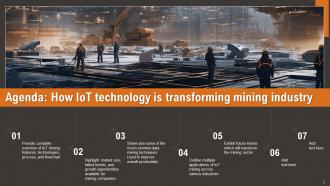
Slide 2: This is an Agenda slide. State your agendas here.
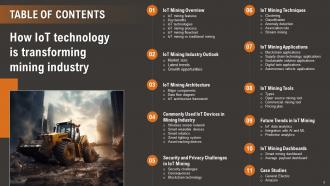
Slide 3: This slide shows Table of Content for the presentation.
Slide 4: This slide shows title for topics that are to be covered next in the template.
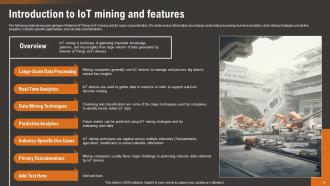
Slide 5: This slide showcases glimpse of Internet of Things (IoT) mining and its major characteristics.
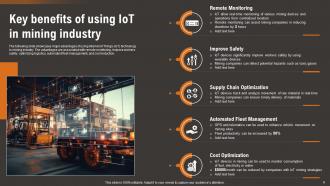
Slide 6: This slide displays major advantages of using Internet of Things (IoT) technology in mining industry.
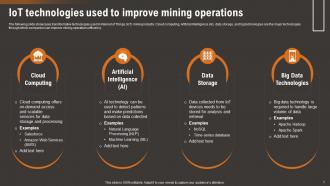
Slide 7: This slide showcases transformative technologies used in Internet of Things (IoT) mining industry.
Slide 8: This slide displays the eight step process of Internet of Things (IoT) mining to make data driven decisions in real time.
Slide 9: This slide presents diagrammatic representation of Internet of Things (IoT) mining flowchart through which companies can make informed decisions.
Slide 10: This slide showcases comparative analysis between Internet of Things (IoT) mining and traditional mining.
Slide 11: This slide shows title for topics that are to be covered next in the template.
Slide 12: This slide showcases statistical representation of Internet of Things (IoT) mining market size. Information covered in this slide is related to Compound Annual Growth Rate.
Slide 13: This slide displays global trends related to Internet of Things (IoT) mining. Information covered in this slide is related to continuous use of private networks etc.
Slide 14: This slide showcases potential growth opportunities available for smart mining companies.
Slide 15: This slide shows title for topics that are to be covered next in the template.
Slide 16: This slide showcases various elements of Internet of Things (IoT) mining. Information covered in this slide is related to IoT sensors etc.
Slide 17: This slide displays diagrammatic representation of Internet of Things (IoT) mining and covers information about multiple layers.
Slide 18: This slide showcases Internet of Things (IoT) model for data management and improved decision-making.
Slide 19: This slide shows title for topics that are to be covered next in the template.
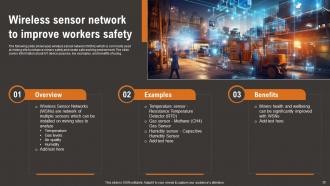
Slide 20: This slide presents ensor network (WSNs) which is commonly used at mining site to enhance miners safety and create safe working environment.
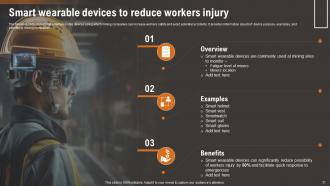
Slide 21: This slide showcases smart wearable devices using which mining companies can increase workers safety and avoid potential accidents.
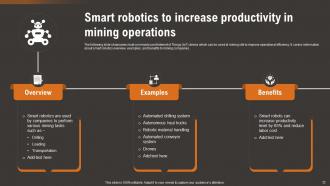
Slide 22: This slide presents most commonly used Internet of Things (IoT) device which can be used at mining site to improve operational efficiency.
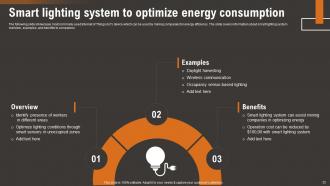
Slide 23: This slide showcases most commonly used Internet of Things (IoT) device which can be used by mining companies for energy efficiency.
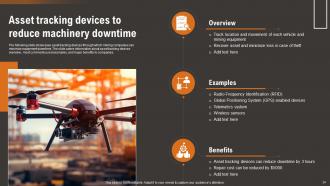
Slide 24: This slide displays asset tracking devices through which mining companies can minimize equipment downtime.
Slide 25: This slide shows title for topics that are to be covered next in the template.
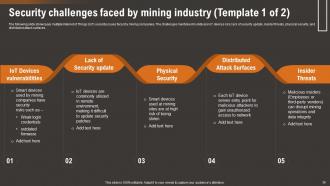
Slide 26: This slide showcases multiple Internet of Things (IoT) security issues faced by mining companies.
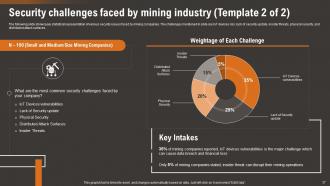
Slide 27: This slide displays statistical representation of various security issues faced by mining companies.
Slide 28: This slide showcases impact of Internet of Things (IoT) security challenges on mining companies.
Slide 29: This slide presents solutions to overcome Internet of Things (IoT) security challenges faced by mining companies.
Slide 30: This slide shows title for topics that are to be covered next in the template.
Slide 31: This slide showcases comprehensive data mining technique (Clustering) through which mining companies can streamline operations and improve resource utilization.
Slide 32: This slide also displays comprehensive data mining technique (Clustering) through which mining companies can streamline operations and improve resource utilization.
Slide 33: This slide showcases anomaly detection strategy through which mining companies can prevent potential hazards and enhance miners safety.
Slide 34: This slide displays association rule mining strategy through which companies can streamline robust mining operations and reduce operational cost.
Slide 35: This slide presents stream mining strategy in Internet of Things (IoT) which can assist companies to build predictive model and forecast future event.
Slide 36: This slide shows title for topics that are to be covered next in the template.
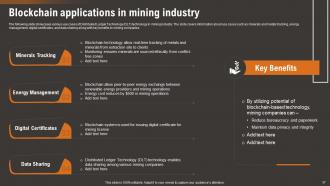
Slide 37: This slide showcases various use cases of Distributed Ledger Technology (DLT) technology in mining industry.
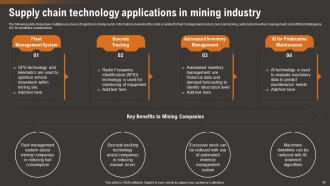
Slide 38: This slide displays multiple use cases of logistics in mining sector. Information covered in this slide is related to fleet management system etc.
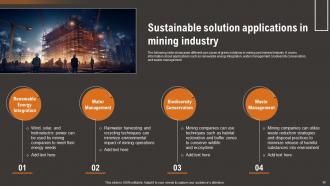
Slide 39: This slide showcases different use cases of green solutions in mining and mineral industry.
Slide 40: This slide presents use cases of digital replication in mineral resources industry. Asset management, process optimization etc.
Slide 41: This slide showcases various use cases of autonomous haulage systems (AHS) in natural resources sector.
Slide 42: This slide shows title for topics that are to be covered next in the template.
Slide 43: This slide showcases different types of Internet of Things (IoT) mining tools which can be used by companies to improve mining process.
Slide 44: This slide presents comparative evaluation of various open source Internet of Things (IoT) mining software.
Slide 45: This slide showcases comparative analysis of multiple commercial Internet of Things (IoT) mining tools.
Slide 46: This slide displays pricing plan of selected commercial Internet of Things (IoT) mining software. The pricing plans are classified on the basis of basic, standard, and premium.
Slide 47: This slide shows title for topics that are to be covered next in the template.
Slide 48: This slide showcases advancement in Internet of Things (IoT) in data analytics.
Slide 49: This slide presents integration with Artificial Intelligence (AI) and Machine Learning (ML) to streamline mining process and enhance overall efficiency.
Slide 50: This slide showcases the use of advanced data analytics techniques to forecast future event based on data collected by smart devices.
Slide 51: This slide shows title for topics that are to be covered next in the template.
Slide 52: This slide presents key performance indicator (KPI) dashboard of Internet of Things (IoT) mining.
Slide 53: This slide showcases smart mining key performance indicator (KPI) dashboard. The key metrics outlined in slide are fleet haulers, model code etc.
Slide 54: This slide shows title for topics that are to be covered next in the template.
Slide 55: This slide showcases case study of how General Electric (Multinational conglomerate) company enhanced aircraft engine performance.
Slide 56: This slide displays how Amazon company enhanced performance of warehouse and logistics using smart mining.
Slide 57: This slide shows all the icons included in the presentation.
Slide 58: This slide is titled as Additional Slides for moving forward.
Slide 59: This slide presents IoT applications in smart mining industry with additional textboxes.
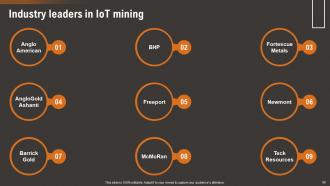
Slide 60: This slide showcases Industry leaders in IoT mining with additional textboxes.
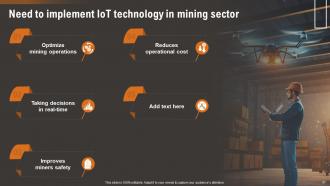
Slide 61: This slide presents Need to implement IoT technology in mining sector with additional textboxes.
Slide 62: This slide shows Post It Notes for reminders and deadlines. Post your important notes here.
Slide 63: This slide depicts Venn diagram with text boxes.
Slide 64: This is Our Goal slide. State your firm's goals here.
Slide 65: This slide provides 30 60 90 Days Plan with text boxes.
Slide 66: This is a Thank You slide with address, contact numbers and email address.
How IoT Technology Is Transforming Mining Industry Powerpoint Presentation Slides IoT CD with all 74 slides:
Use our How IoT Technology Is Transforming Mining Industry Powerpoint Presentation Slides IoT CD to effectively help you save your valuable time. They are readymade to fit into any presentation structure.
-
How IoT Technology is Transforming Mining Industry
-
How IoT technology is transforming mining industry
-
How IoT technology is transforming mining industry
-
How IoT technology is transforming mining industry
-
Introduction to IoT mining and features
-
Key benefits of using IoT in mining industry
-
IoT technologies used to improve mining operations
-
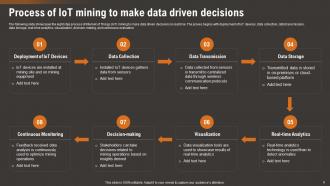
Process of IoT mining to make data driven decisions
-
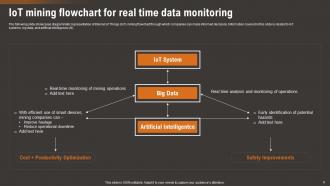
IoT mining flowchart for real time data monitoring
-
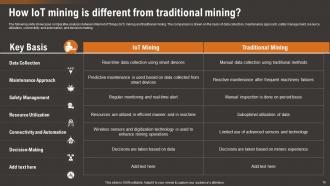
How IoT mining is different from traditional mining
-
How IoT technology is transforming mining industry
-
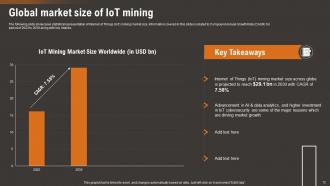
Global market size of IoT mining
-
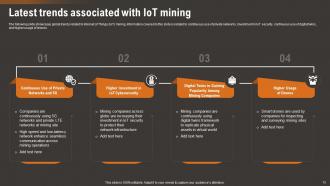
Latest trends associated with IoT mining
-
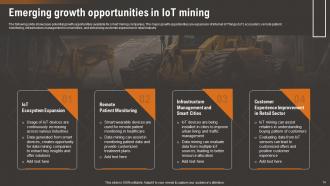
Emerging growth opportunities in IoT mining
-
How IoT technology is transforming mining industry
-
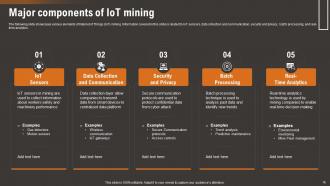
Major components of IoT mining
-
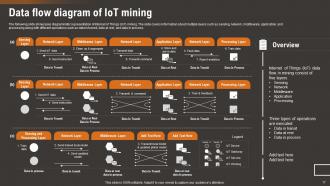
Data flow diagram of IoT mining
-
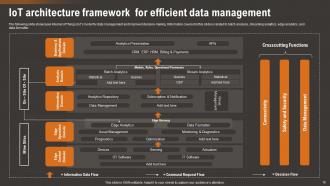
IoT architecture framework for efficient data management
-
How IoT technology is transforming mining industry
-
Wireless sensor network to improve workers safety
-
Smart wearable devices to reduce workers injury
-
Smart robotics to increase productivity in mining operations
-
Smart lighting system to optimize energy consumption
-
Asset tracking devices to reduce machinery downtime
-
How IoT technology is transforming mining industry
-
Security challenges faced by mining industry Template 1 of 2
-
Security challenges faced by mining industry Template 2 of 2
-
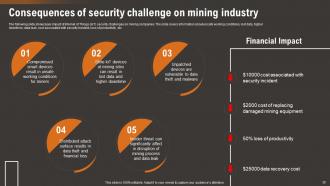
Consequences of security challenge on mining industry
-
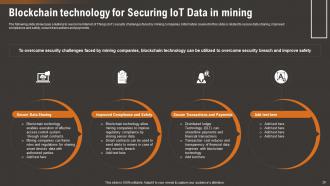
Blockchain technology for Securing IoT Data in mining
-
How IoT technology is transforming mining industry
-
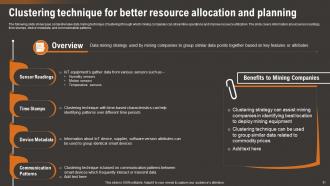
Clustering technique for better resource allocation and planning
-
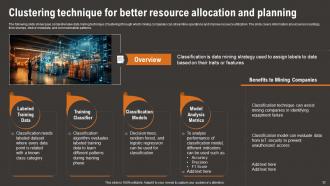
Clustering technique for better resource allocation and planning
-
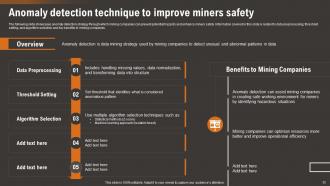
Anomaly detection technique to improve miners safety
-
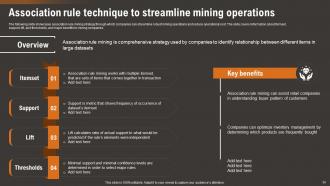
Association rule technique to streamline mining operations
-
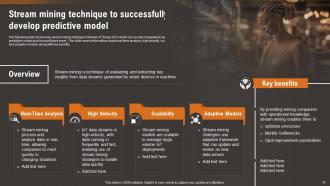
Stream mining technique to successfully develop predictive model
-
How IoT technology is transforming mining industry
-
Blockchain applications in mining industry
-
Supply chain technology applications in mining industry
-
Sustainable solution applications in mining industry
-
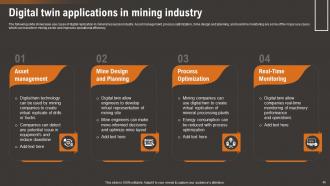
Digital twin applications in mining industry
-
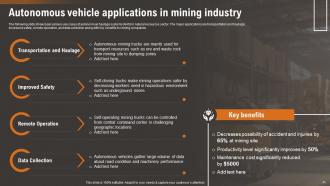
Autonomous vehicle applications in mining industry
-
How IoT technology is transforming mining industry
-
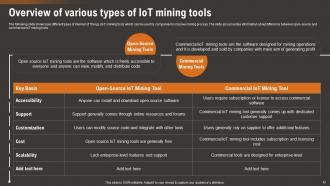
Overview of various types of IoT mining tools
-
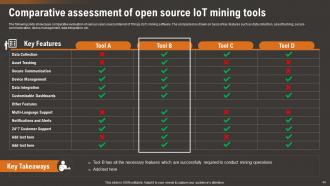
Comparative assessment of open source IoT mining tools
-
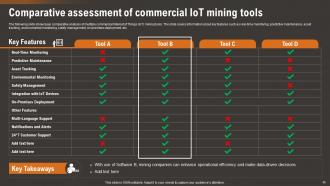
Comparative assessment of commercial IoT mining tools
-
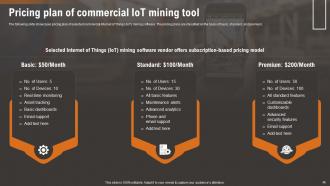
Pricing plan of commercial IoT mining tool
-
How IoT technology is transforming mining industry
-
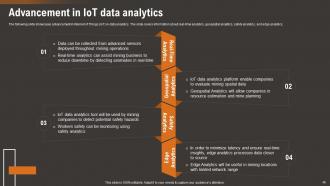
Advancement in IoT data analytics
-
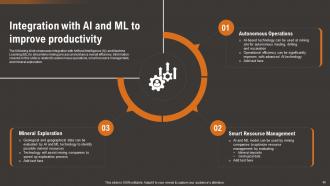
Integration with AI and ML to improve productivity
-
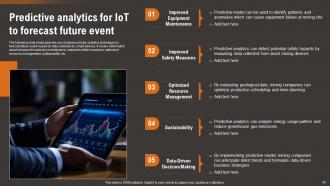
Predictive analytics for IoT to forecast future events
-
How IoT technology is transforming mining industry
-
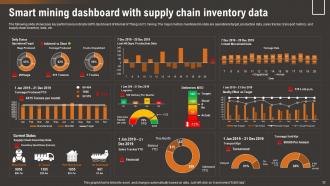
Smart mining dashboard with supply chain inventory data
-
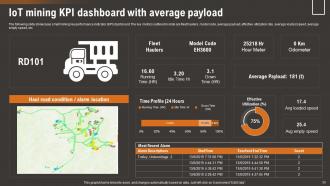
IoT mining KPI dashboard with average payload
-
How IoT technology is transforming mining industry
-
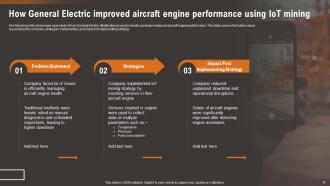
How General Electric improved aircraft engine performance using IoT mining
-
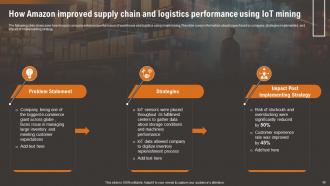
How Amazon improved supply chain and logistics performance using IoT mining
-
Icons slide How IoT technology is transforming mining industry
-
Additional slides
-
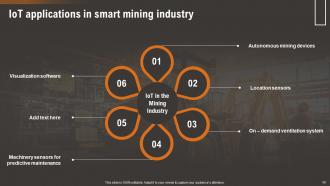
IoT applications in smart mining industry
-
Industry leaders in IoT mining
-
Need to implement IoT technology in mining sector
-
Post it notes
-
Venn
-
Our goal
-
How Iot Technology Is Transforming Mining Industry Iot Cd
-

Thanks for watching
-

-

-

-

-

-

-

-

FAQs for How IoT Technology Is Transforming Mining Industry Powerpoint Presentation
Dude, IoT in mining is seriously worth looking into. Real-time equipment monitoring prevents those expensive breakdowns nobody wants to deal with. You can track workers underground too, which is huge for safety. The predictive maintenance stuff is honestly mind-blowing - feels like you're seeing into the future with your machines. Environmental monitoring gets way better, and you'll catch problems before they drain your budget. Oh, and route optimization saves tons on fuel costs. I'd start with basic equipment sensors first, maybe some worker tracking devices. Scale up once you see how much money it's saving you.
So IoT basically creates this massive safety network across your whole mine - sensors everywhere monitoring air quality, gas levels, structural stuff. Workers wear devices that track their location and vitals too. If CO spikes or someone's heart rate goes crazy, everyone gets instant alerts. The predictive analytics are actually pretty impressive - catches equipment problems before they turn dangerous. It's like having eyes everywhere, honestly. Start with environmental sensors first, then add the wearables. That order gives you the most safety improvement for your money. Way more effective than doing it backwards.
Look, all those IoT sensors you've got are pretty much useless without solid data analytics behind them. They're collecting tons of info on ore quality, equipment stats, environmental stuff - but raw data doesn't mean much by itself. Analytics turns that mess into something you can actually use: predicting when machines will break down, finding better drilling spots, tweaking processing on the fly. Honestly, ore grade prediction is where I'd start if I were you - that's your quickest win. The whole point is transforming sensor noise into insights that boost your yield and cut waste.
Basically you stick IoT sensors on your mining gear to track vibration, temp, oil pressure - all that stuff. The sensors feed into analytics that learn your equipment's normal patterns. When something's off, you get alerts way before anything actually breaks. It's honestly pretty slick. Instead of dealing with those nightmare emergency shutdowns that cost you days, you can plan maintenance around your schedule. Order parts ahead of time, fix things during downtime you already planned for. Beats the hell out of scrambling around trying to find replacement parts at 2am.
Dude, connectivity is your biggest nightmare - especially underground where signals just die. Dust and crazy conditions will wreck your sensors constantly. Getting workers to actually use new tech? That's a whole other battle. The upfront costs are brutal, plus trying to make IoT play nice with ancient mine systems is honestly a pain. Oh, and now you've got internet-connected stuff in critical infrastructure, so security becomes this massive headache. My advice? Start with a small pilot somewhere less brutal first. Work out all the problems there, then you can show the higher-ups it actually pays off before going big.
So basically, IoT sensors let you monitor air quality, water contamination, dust, and emissions in real-time across all your sites. Way better than waiting around for those periodic manual tests - honestly such a pain. You'll get early warnings before small issues turn into huge environmental disasters. The data's pretty useful for optimizing equipment too, cuts down on fuel consumption and waste. Oh, and definitely set up automated alerts when things hit certain thresholds. That way your team can jump on problems immediately instead of finding out about them later.
So the big threats you're looking at? Hackers breaking into your systems, data breaches with all that sensitive mining info, plus ransomware that could literally shut everything down. Those IoT devices are honestly pretty sketchy - weak passwords, barely any updates. It's worse at remote sites since you can't babysit everything. Oh, and if sensors get compromised they'll feed you garbage data, which could mean equipment failures or worse. Update firmware regularly, use strong passwords, segment your networks. That way if one thing gets hit, it won't take everything else with it.
IoT sensors track your equipment's energy use in real-time, which lets you catch waste fast and fix it. You'll see data on conveyor belts, ventilation, all that stuff. Most mining operations are hemorrhaging energy once you actually start measuring - it's wild. The sensors can auto-adjust lighting when areas are empty, control HVAC better, and even flag equipment that's about to crap out so you're not running broken machinery. Focus on ventilation and material handling first since those are your biggest power hogs. Had a buddy save like 30% just from getting his air systems dialed in properly.
So there's a bunch of IoT stuff happening in mining right now. Sensor networks track air quality, RFID tags follow equipment around, and workers wear connected devices that monitor their safety. GPS systems show where all the heavy machinery is - the amount of data is honestly insane. Smart conveyor belts can predict when they'll break down, which is pretty cool. Automated drilling systems are getting popular too. Safety-wise, you've got connected gas detectors and emergency comms everywhere. Oh, and IoT ventilation controls. If you're thinking about trying this stuff out, I'd probably start with equipment monitoring first.
Honestly, those IoT wearables are pretty game-changing for mining. Workers wear devices that track their vitals, location, and air quality around them. Managers get alerts if someone's heart rate spikes or they wander into a sketchy area with bad gas levels. The real win? You can actually see when people are getting worn out instead of just guessing. Fewer accidents, less sick time, and everyone goes home safer. I'd probably start simple - basic fitness trackers and some air sensors to test the waters first.
Dude, real-time data is absolutely huge for mining decisions. Your sensors track everything - conveyor belts, air quality, production rates - so you're not sitting around waiting weeks for reports anymore. Catch equipment problems before they actually break down. Worker safety improves too since you're constantly monitoring conditions. Honestly, beats the old "cross your fingers and hope" method by miles. Production rates? You can tweak those instantly based on what's happening. My advice - start with just a few sensors on your most important equipment first. You'll see results pretty fast, then build from there.
Honestly, IoT sensors are a game changer for mining operations. Real-time tracking shows you exactly where your ore is during processing, plus truck locations and inventory across sites. When shipments get delayed or quality dips below standards, you'll get instant alerts instead of discovering issues way too late - which is honestly the worst. They help optimize routes too and predict when equipment's about to fail. Oh, and maintenance scheduling becomes way easier. I'd start with your most valuable materials first since that's where you'll see the biggest impact right away. The ROI is pretty immediate on those.
Look, cloud computing is basically where all your IoT mining data lives and gets crunched. We're talking tons of info from equipment sensors, safety monitors, environmental stuff - the works. Processing happens in the cloud because honestly, building data centers in the middle of nowhere would be insane and expensive. It handles pattern analysis, predicts when equipment's about to fail, sends real-time alerts across your whole operation. Way cheaper than going it alone. Get your cloud setup sorted early though - you'll need that room to grow as your IoT network expands. Trust me on this one.
So basically, IoT sensors can track all the stuff regulators actually want to see - air quality, water contamination, safety metrics, worker exposure times. They feed data straight into your compliance systems automatically, which beats scrambling around collecting everything manually when inspections happen. Real-time monitoring is clutch because you'll catch issues before they turn into actual violations. I'd definitely start with whatever your riskiest areas are first. My buddy at a manufacturing plant said it completely changed how they handle regulatory deadlines - way less stressful than constantly playing catch-up.
Honestly, edge computing is where things get interesting - your equipment starts making decisions right there instead of waiting for cloud processing. AI at the sensor level is getting insane at predicting when stuff's about to break. 5G finally gives you proper bandwidth for monitoring huge sites in real-time. Digital twins are pretty wild now too, simulating entire operations with scary accuracy. My advice? Start testing this stuff with small pilots. Companies jumping on it now will demolish their competition in a few years. The gap's gonna be massive.
-
They had the topic I was looking for in a readymade presentation…helped me meet my deadline.
-
No second thoughts when I’m looking for excellent templates. SlideTeam is definitely my go-to website for well-designed slides.