


Hrm challenges and solutions powerpoint slide images




Try Before you Buy Download Free Sample Product
 Impress Your
 Audience
 100%
100% Editable
 Save Hours
 of Time


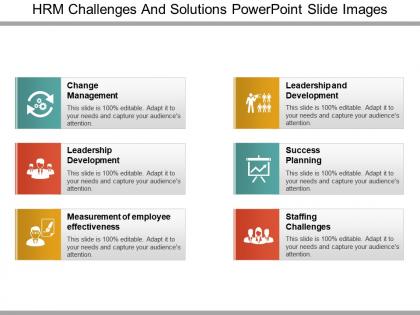
HRM challenges and solutions PowerPoint slide images is a visual tool that illustrates the strategic HR moves to take care of the problems. Make use of the competitive challenges in Human Resource management PPT presentation model to decipher the factors which enhance employee capabilities and potential abilities. Common HR challenges PPT presentation graphic supports the policies and plans that cater to the challenges and solutions of human resource. Simply designed Human Resource issues and solutions presentation template is a very useful way of expressing the concepts and ideas related to HR and so satisfying objectives of your organization or company. Human resource strategy presentation infographic is a professional proficient design for qualified presenters. This PowerPoint template is specially designed for professionals dealing in management concepts. Human resource strategy PPT can also be used to show the important elements of human resource management. Change management, leadership development, measurement of employee effectiveness, leadership and development, success planning and staffing challenges are the strategic moves of the human resource team to fight the problems. Without a professional presentation your ideas could be left out in the cold. Use our range of professional Hrm Challenges And Solutions Powerpoint Slide Images to make sure that your statement is really being made.
People who downloaded this PowerPoint presentation also viewed the following :
Hrm challenges and solutions powerpoint slide images with all 5 slides:
Your thoughts and our Hrm Challenges And Solutions Powerpoint Slide Images will make a great ensemble. They will win the prize hands down.




FAQs for Hrm challenges and solutions
Remote work presents HR managers with challenges including maintaining team engagement, monitoring productivity effectively, ensuring clear communication across distributed teams, managing work-life boundaries, and preserving company culture. These obstacles require strategic solutions like digital collaboration platforms, regular virtual check-ins, and flexible performance metrics, with many organizations finding that proactive communication and trust-based management ultimately deliver stronger employee satisfaction and retention.
Organizations can effectively measure employee engagement in hybrid workplaces through pulse surveys, virtual focus groups, one-on-one check-ins, collaboration analytics, and performance metrics tracking. These methods enable managers to assess remote and in-office experiences equally, while providing real-time insights into team dynamics, ultimately delivering improved retention rates and enhanced productivity across distributed teams.
HR can attract and retain top talent through competitive compensation packages, flexible work arrangements, comprehensive professional development programs, strong company culture initiatives, and robust employee recognition systems. These strategies work by addressing diverse employee needs, enhancing work-life balance, and creating growth opportunities, with many organizations finding that combining multiple approaches delivers significantly higher retention rates and competitive recruitment advantages.
Cultural differences significantly impact HR practices in multinational organizations through varying communication styles, performance evaluation methods, compensation expectations, leadership approaches, and employee engagement preferences. Companies like Unilever and McDonald's navigate these challenges by implementing localized recruitment strategies, culturally-adapted training programs, and flexible benefit structures, ultimately delivering more effective talent management and stronger employee retention across diverse markets.
Technology streamlines recruitment and onboarding by automating candidate screening, enabling virtual interviews, facilitating digital documentation, and providing analytics-driven insights for better hiring decisions. Through AI-powered platforms and integrated systems, organizations reduce time-to-hire, enhance candidate experiences, and ensure consistent onboarding processes, ultimately delivering faster talent acquisition and improved employee retention rates.
Best practices for managing employee relations include establishing clear communication channels, implementing fair grievance procedures, providing regular feedback mechanisms, fostering inclusive workplace cultures, and training managers in conflict mediation techniques. Through proactive relationship management, organizations streamline resolution processes, enhance employee satisfaction, and minimize workplace disruptions, with many companies finding that structured approaches ultimately deliver improved retention rates and stronger team dynamics.
HR practitioners support employee mental health through comprehensive wellness programs, flexible work arrangements, mental health days, access to counseling services, and stress management resources. These initiatives enhance productivity, reduce absenteeism, and improve retention rates, with many organizations finding that proactive mental health support ultimately delivers stronger employee engagement and competitive advantage in talent acquisition.
HR professionals should develop cultural competency, inclusive leadership skills, unconscious bias recognition, effective communication across diverse groups, and data analytics capabilities to measure inclusion metrics. These competencies enable organizations to create more equitable workplace policies, enhance employee engagement across different demographics, and leverage diverse perspectives for innovation, with many companies finding that skilled HR leaders drive both cultural transformation and improved business performance.
HR leverages data analytics to inform decision-making through predictive modeling, performance metrics analysis, employee engagement tracking, and workforce planning algorithms. These technologies streamline recruitment processes, identify retention risks, and optimize talent allocation, with many organizations finding that data-driven HR strategies ultimately deliver reduced turnover costs, enhanced productivity, and stronger competitive advantage.
Key legal compliance challenges include employment law updates, data privacy regulations, workplace discrimination prevention, wage and hour compliance, and remote work policies. These evolving requirements create complex oversight responsibilities, with many HR departments finding that automated compliance tracking, regular legal training, and integrated HR management systems streamline adherence while reducing costly violations and ensuring consistent workforce protection.
Performance management systems must evolve by embracing continuous feedback mechanisms, flexible goal-setting frameworks, skills-based assessments, remote work evaluations, and personalized development pathways to address today's dynamic workforce needs. These enhanced systems streamline employee engagement while accommodating hybrid work environments, with many organizations finding that real-time performance tracking and individualized career planning ultimately deliver improved retention rates and competitive advantage.
Innovative training methods include microlearning modules, virtual reality simulations, AI-powered personalized learning paths, gamified skill assessments, and peer-to-peer knowledge sharing platforms. These approaches enhance employee engagement by delivering bite-sized content, immersive experiences, and adaptive curricula, with many organizations finding that blended learning strategies significantly accelerate skill acquisition while reducing training costs.
HR can address employee turnover in high-stress industries through comprehensive wellness programs, flexible work arrangements, competitive compensation packages, robust mental health support, and clear career advancement pathways. These strategies work by reducing burnout, enhancing work-life balance, and improving job satisfaction, with many healthcare organizations, financial services firms, and manufacturing companies finding that proactive retention initiatives significantly reduce turnover costs while boosting employee engagement.
Remote working creates communication gaps, reduces spontaneous interactions, and can lead to isolation, while also offering flexibility and broader talent access. HR can address these challenges through regular virtual team-building activities, structured communication protocols, digital collaboration tools, and hybrid meeting formats, ultimately maintaining team cohesion and productivity in distributed work environments.
HR should approach succession planning through flexible frameworks that emphasize skill adaptability, cross-functional capabilities, and continuous leadership development rather than rigid position-based structures. This involves identifying high-potential employees across departments, creating mentorship networks, and building competency-based development paths that prepare candidates for evolving roles, ultimately ensuring organizational resilience and competitive advantage.
-
Great product with effective design. Helped a lot in our corporate presentations. Easy to edit and stunning visuals.
-
Excellent work done on template design and graphics.