

Human Resources Life Cycle Powerpoint Presentation Slides





Try Before you Buy Download Free Sample Product
 Impress Your
 Audience
 100%
100% Editable
 Save Hours
 of Time


Assure you better assimilation with our human resources life cycle PowerPoint presentation slides. Our human resources life cycle PPT templates have been designed to explain the key roles and responsibilities of the team members in a creative way. This PPT layout enables the primary functions of human resources management such as hiring people, training them, motivation and many more things. These slides showcase the scheme and strategies to hire perfect people for the job and retain the best talent. With a variety of visuals and images, you can create more engaging and tempting PPT for your audience. This helps you to boost the team spirit and morale of your employees which makes an improvement in their performance. Besides that, these ready-made and pre-formatted human resources life cycle PPT templates are completely customizable. This enables you to create the PPT slideshows as per your business needs. Download these human resources life cycle PPT examples to attract your audience. Customers burgeon with our Human Resources Life Cycle Powerpoint Presentation Slides. They will flock to you from all directions.
People who downloaded this PowerPoint presentation also viewed the following :
Content of this Powerpoint Presentation
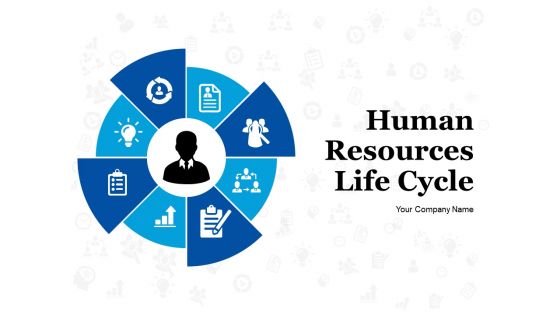
Slide 1: This slide presents Human Resources Life Cycle with imagery. State your company name and proceed.
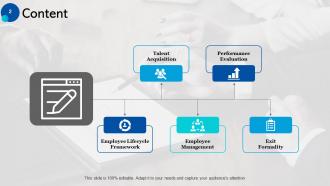
Slide 2: This slide states Content with the following constituents- Employee Lifecycle Framework, Talent Acquisition, Employee Management, Performance Evaluation, Exit Formality.
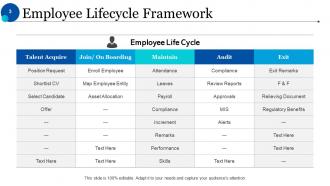
Slide 3: This slide presents Employee Lifecycle Framework table with the following sub headings- Talent Acquire, Join/ On Boarding, Maintain, Audit, Exit.
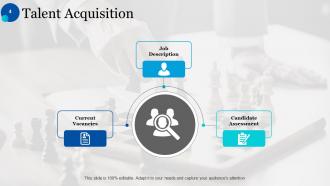
Slide 4: This is Talent Acquisition slide showing- Current Vacancies, Job Description, Candidate Assessment.
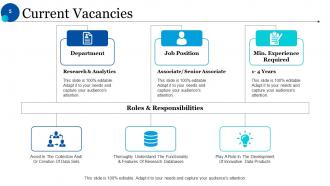
Slide 5: This slide showcases Current Vacancies with respect to- Department, Job Position, Min. Experience Required.
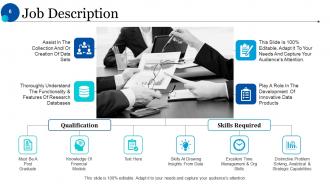
Slide 6: This slide presents Job Description with- Skills Required, Qualification.
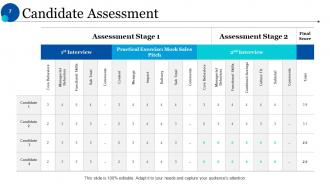
Slide 7: This is Candidate Assessment slide. Present candidate assessment stats in a tabular form here.
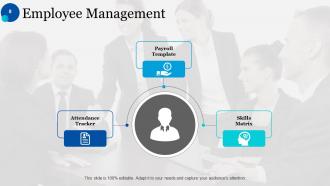
Slide 8: This slide showcases Employee Management with- Attendance Tracker, Skills Matrix, Payroll Template.
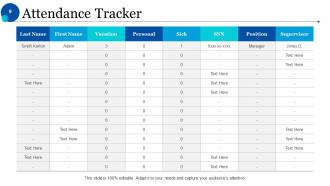
Slide 9: This slide presents Attendance Tracker in a tabular form.
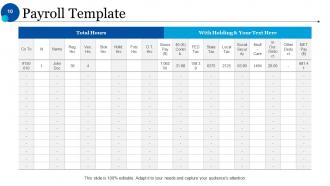
Slide 10: This slide showcases a Payroll Template.
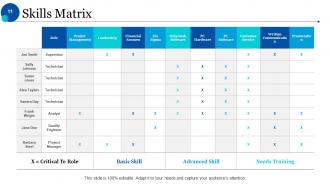
Slide 11: This is Skills Matrix slide. Showcase your skills in a matrix form here.
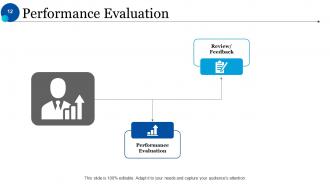
Slide 12: This slide shows Performance Evaluation consisting of the following 2 aspects to state- Review/ Feedback, Performance Evaluation.
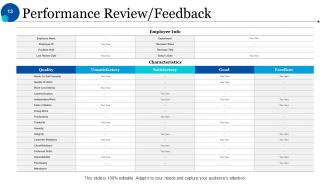
Slide 13: This slide presents Performance Review/ Feedback with- Employee Info, Characteristics.
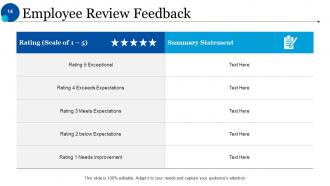
Slide 14: This slide presents Employee Review Feedback with- Rating (Scale of 1 – 5), Summary Statement.
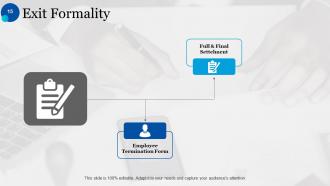
Slide 15: This slide showcases Exit Formality with- Full & Final Settelment, Employee Termination Form.
Slide 16: This slide presents Employee Termination Form. Mention the following information here- Employee Name, Employee Position, Employee Department, Employee Start Date, Employee Termination Date, Reason For Termination? Is Employee Eligible For Rehire?.
Slide 17: This slide presents Full & Final Settlement with Name and other details.
Slide 18: This is Human Resource Life Cycle Icons Slide. Use icons as per requirement.
Slide 19: This slide is titled Additional Slides to move forward. You may change the content as per need.
Slide 20: This is Our Mission slide stating Mision and vision.
Slide 21: This is an Our Team slide with name, image and text boxes to put the required information.
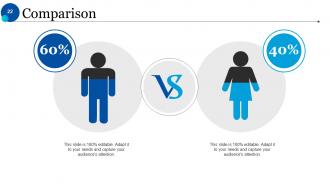
Slide 22: This is a Comparison slide to show comparison of two entities/ products etc.
Slide 23: This is an About Us slide showing Preferred By Many, Valued Clients, and Target Audiences as examples.
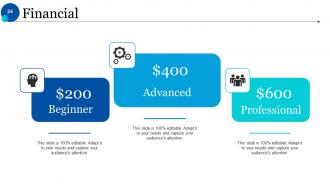
Slide 24: This is a Financial score slide. State financial aspects etc. here.
Slide 25: This is a Quotes slide to convey messages, beliefs etc. You can change the slide content as per need.
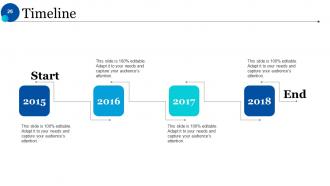
Slide 26: This is a Timeline slide to show growth, evolution, milestones etc.
Slide 27: This is Our Target slide. State your targets, goals etc. here.
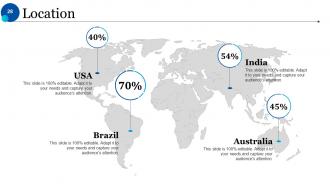
Slide 28: This is a Location slide to show global growth, presence etc. on a world map image.
Slide 29: This is a Puzzle pieces image slide to show information, specifications etc.
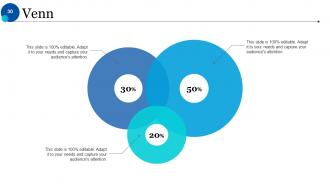
Slide 30: This is a Venn diagram image slide to show information, specifications etc.
Slide 31: This is a LEGO slide with text boxes to show information.
Slide 32: This is a People Silhouettes slide. Use it the way you want to show solutions etc.
Slide 33: This is a Mind map image slide to show information, specifications etc.
Slide 34: This is a Bulb With Idea image slide to show ideas, innovative information etc.
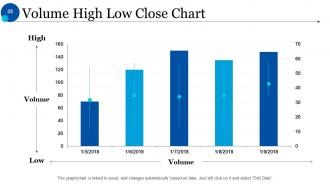
Slide 35: This is Volume High Low Close Chart to show product/ entity growth, comparison, specifications etc.
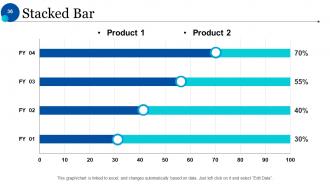
Slide 36: This is a Stacked Bar Chart slide to show product/ entity growth, comparison, specifications etc.
Slide 37: This is a THANK YOU acknowledgement slide with Address# street number, city, state, Contact Numbers, Email Address.
Human Resources Life Cycle Powerpoint Presentation Slides with all 37 slides:
Our Human Resources Life Cycle Powerpoint Presentation Slides assure better assimilation. Air your views with compete clarity.
-
Human Resources Life Cycle
-
Content
-
Employee Lifecycle Framework
-
Talent Acquisition
-
Current Vacancies
-
Job Description
-
Candidate Assessment
-
Employee Management
-
Attendance Tracker
-
Payroll Template
-
Skills Matrix
-
Performance Evaluation
-
Performance Review Feedback
-
Employee Review Feedback
-
Exit Formality
-
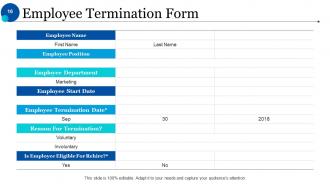
Employee Termination Form
-
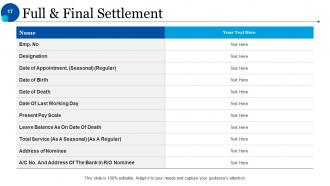
Full Final Settlement
-
Human Resource Life Cycle Icons Slide
-
Additional Slides
-
Our Mission
-
Our Team
-
Comparison
-
About Us
-
Financial
-

Quotes
-
Timeline
-
Our Target
-
Location
-
Puzzle
-
Venn
-
Lego
-
Silhouettes
-
Mind Map
-
Bulb With Idea
-
Volume High Low Close Chart
-
Stacked Bar
-

Thanks For Watching
FAQs for Human Resources Life Cycle
So basically there are six stages in the HR lifecycle. First you've got recruitment and onboarding - finding people and getting them settled. Development comes next, which is where you train and grow employees (this is honestly where most places mess up). Retention strategies keep your good people around. Then there's the transition phase for promotions and internal moves. Offboarding wraps things up when someone leaves. The thing is, it's not really linear - you'll be juggling all these stages at once since different employees are at different points. Makes sense?
Look, getting recruitment right is huge - it basically makes everything else way easier. When you actually find people who fit the job AND your culture, onboarding becomes smoother, performance issues drop, and people stick around longer. Bad hires are such a nightmare to deal with later (trust me on this one). The secret is really figuring out what success looks like for each specific role before you even start looking. I know it sounds obvious, but most places skip this step. Good hires perform better, cost less to manage, and you're not constantly replacing people. Way better than trying to fix hiring mistakes after the fact.
Honestly, start planning like two weeks before they even show up. Send their laptop and paperwork early so day one isn't a mess. Map out their first week - introductions, training, team lunch (seriously, don't skip the social stuff, it makes a huge difference). Give them a buddy who's NOT their boss - someone they can ask dumb questions to without feeling weird about it. Oh, and schedule check-ins at 30, 60, 90 days. Sounds obvious but most people forget. The structured approach really pays off later.
So employee development is basically the ongoing stuff that happens after you hire someone - keeps them from getting bored and jumping ship. You're constantly investing in their skills and career growth throughout their whole journey with the company. During performance reviews, you'll spot skill gaps and figure out growth opportunities. Honestly, I think most companies mess this up by treating it like a one-time thing instead of weaving it into every stage. Oh, and it connects directly to performance management too. Start by mapping what development looks like for your team at different points.
Honestly, good performance management is a game-changer for keeping people engaged. Your team wants to know where they stand and how to get better - nobody likes working in the dark. Skip those awful annual reviews though, they're basically useless. Do regular check-ins instead so you can spot problems early and actually celebrate the good stuff. Make it feel like a real conversation, not some corporate ritual. Set clear goals, give feedback that actually helps, and show them how their work matters to the bigger picture. Oh, and start with monthly one-on-ones if you're not already - trust me on this one.
Honestly, start simple - pick like 2-3 metrics per stage or you'll drown in data. For hiring, track time-to-fill and quality of hire. New employee satisfaction scores are huge during onboarding, plus check your 90-day retention. I'm obsessed with internal promotion rates for development tracking - shows if people actually grow there. Employee engagement surveys are pure gold for retention stuff. They literally tell you everything about why people stay or bounce. Exit interviews matter too, but people don't always tell the truth when they're leaving. Build your baselines first, then measure consistently. Way easier than trying to fix everything at once.
Honestly, communication is everything here - just be upfront and consistent from day one. When people start, tell them how you handle feedback and conflicts so there's no surprises later. Don't wait for formal reviews to check in either, that's a mistake I see everywhere. Regular quick conversations catch problems while they're still small. Exit interviews are gold if you actually listen and change things based on what people tell you. Most drama starts tiny and snowballs because managers ignore the early signs. Start tracking patterns now - you'll thank yourself later when you can fix stuff before it blows up.
Honestly, tech has changed everything in HR. AI now screens resumes before humans even see them. Onboarding? Totally automated workflows. Performance reviews happen through digital systems that track development constantly - which is kinda crazy if you think about it. Training platforms customize everything for each person, and analytics can actually predict who's about to quit. Even when people leave, access gets revoked automatically and exit surveys are digital. The trick is making sure your tools actually talk to each other, otherwise you're just creating more headaches.
Dude, HR is getting completely flipped upside down right now. Chatbots are doing first-round interviews, which honestly feels weird but works. Companies are using predictive analytics to figure out who's about to quit before they even know it themselves. Remote work changed everything too - now digital onboarding isn't just trendy, it's mandatory. AI tools are personalizing training for each employee, and HR finally has real data to show executives that their programs actually work. The analytics piece is huge. My take? Don't try to automate everything at once. Pick one process, nail it, then expand. You'll save yourself a headache.
Most exit interviews are total garbage because companies ask the wrong questions. Skip the "how was your experience" fluff and dig into specifics about processes, management issues, growth problems. Have someone neutral do the interview - not their boss obviously. Create a safe space where they'll actually be honest with you. Then here's the part most places screw up - you need to analyze all that feedback for patterns and actually share what you find with leadership. Otherwise you're just wasting everyone's time. The whole point is using those insights to fix whatever's driving people away in the first place.
HR compliance is honestly such a pain, but I break it down by stage so I don't lose my mind. Recruitment means sticking to EEOC stuff and fair hiring - pretty straightforward. Onboarding gets messier with I-9s, tax forms, all that paperwork. Daily operations? That's wage laws, ADA accommodations, documenting everything (ugh). When people leave, you've got final pay rules, COBRA notices, unemployment claims. I swear by checklists for each phase though - compliance violations cost way too much money and they're totally preventable if you stay organized.
Ugh, going global with HR is wild - everything changes. Japan expects totally different interview vibes than Silicon Valley does. Performance reviews get messy fast because some cultures want brutal honesty while others think that's incredibly rude. You'll need different compensation packages, benefits, even firing processes for each region. Honestly, the feedback thing trips up so many companies. Don't try forcing one policy everywhere - it won't work. Get local HR people in each country who actually understand the culture. Build flexibility into your systems from day one.
Track time-to-fill and offer acceptance rates first - those show if your hiring process is broken. Then watch 90-day retention like a hawk because honestly, if new hires are bailing that fast, something's seriously wrong. Don't forget voluntary turnover, satisfaction scores, and how many people actually move up internally. Exit interviews suck but the data's pure gold. Oh, and slice everything by department and manager - you'll spot problem areas way faster. The trick is connecting the dots between all these numbers instead of just staring at them individually.
Look, succession planning basically weaves through your entire HR process. When you're doing workforce planning, you're already thinking about future leadership gaps. Then recruitment becomes more strategic - you're hiring with those bigger roles in mind. Development is huge here (and where most places totally mess up, tbh). You're prepping your high-potential people for the next level. Once someone leaves or moves up, boom - your succession plan handles the transition smoothly. Don't wait until someone drops their resignation on your desk. Map out critical roles now. Figure out who could step up. It's way less stressful than scrambling later.
Honestly, your leaders are basically running the whole show when it comes to employee experience. They're making decisions about hiring, training, promotions - all of it. You know that saying about people quitting their managers, not their jobs? It's so true. Good leaders create environments where people actually want to stick around and grow. Bad ones... well, you've probably seen how that goes. Your company culture, how engaged people feel, whether they get decent career opportunities - that all comes down to leadership style. Want better HR results? Focus on teaching your managers how to actually manage people well. It's not rocket science, but so many get it wrong.
-
Nice