


Industrial Maintenance Powerpoint Ppt Template Bundles




Try Before you Buy Download Free Sample Product
 Impress Your
 Audience
 100%
100% Editable
 Save Hours
 of Time


Introducing our comprehensive Industrial Maintenance PowerPoint PPT presentation, designed to equip your team with essential knowledge in preventive maintenance, equipment reliability, asset management, and downtime reduction strategies. This informative resource offers a deep dive into the world of industrial maintenance, emphasizing the critical importance of condition monitoring to ensure peak operational efficiency. Our PPT covers preventive maintenance techniques that help you avoid costly breakdowns and unplanned downtime, fostering equipment reliability and prolonged asset lifespan. Learn how effective asset management strategies can optimize resource allocation and enhance your bottom line. Discover the secrets to minimizing downtime through proactive maintenance and real-time condition monitoring, ensuring that your operations run smoothly and without disruptions. Equip your team with the knowledge and insights needed to elevate your industrial maintenance practices to new heights.
People who downloaded this PowerPoint presentation also viewed the following :
Industrial Maintenance Powerpoint Ppt Template Bundles with all 25 slides:
Use our Industrial Maintenance Powerpoint Ppt Template Bundles to effectively help you save your valuable time. They are readymade to fit into any presentation structure.
-
Industrial Maintenance
-

Various Types of Industrial Maintenance Methods
-

Benefits of Timely Industrial Equipment Maintenance
-

Best Practices for Effective Industrial Maintenance
-

Impact of Industrial Maintenance on Multiple Businesses
-

Strategies for Preventative Maintenance of Industrial Equipment
-

Levels of Industrial Maintenance for Business Equipment
-

Checklist for Industrial Equipment Preventative Maintenance
-

KPIs to Measure Effectiveness of Industrial Maintenance Strategy
-
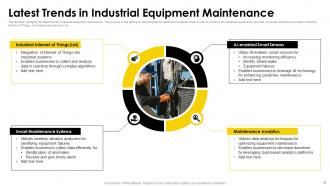
Latest Trends in Industrial Equipment Maintenance
-

Challenges Faced During Industrial Maintenance of Manufacturing Equipment
-

Components of Efficient Industrial Maintenance Budget
-

Dashboard to Monitor Industrial Maintenance Status
-

Icon for Tracking Maintenance of Industrial Equipment
-

Industrial Maintenance Icon for Increasing Business Production
-

Icon for Regular Maintenance Of Industrial Equipment
-

Thank You Slide
-

-

-

-

-

-

-

-

FAQs for Industrial Maintenance Powerpoint
So basically, preventive is just doing stuff on schedule no matter what - like changing oil every 3 months even if it's fine. Predictive is way smarter though. It uses sensors to actually tell you when something needs attention, like "yo, that bearing's getting sketchy." Yeah, predictive costs more upfront but you're not wasting time on unnecessary maintenance. Plus you catch problems before they explode into expensive disasters. Honestly I'd start with preventive on your most critical stuff first, then gradually add the predictive tech when you've got budget for it.
So basically, these IoT sensors monitor your equipment 24/7 - vibration, temp, pressure, all that stuff. Way better than just guessing when something might break. They'll ping you when things start looking sketchy, so you can actually plan maintenance instead of scrambling when everything goes to hell. Honestly, the predictive maintenance angle is a game-changer. You're not stuck doing repairs on some random schedule anymore. Just pick one important machine to start with though - don't try to sensor everything at once or you'll go crazy with all the data.
Dude, training is everything in maintenance - seriously can't stress this enough. Your techs will spot issues way earlier when they actually know the equipment, which saves you from those nightmare repair bills later. Safety's huge too, obviously nobody wants someone getting hurt on dangerous machinery. I've seen shops where untrained guys are constantly flipping through manuals and wasting time. Meanwhile trained techs just fix stuff quickly without calling outside contractors every five minutes. Regular hands-on sessions are worth it - your downtime drops and everything runs smoother. Trust me on this one.
Dude, aging equipment is killing everyone right now. Plus all the experienced techs are retiring and good luck finding replacements - honestly the talent pool is pretty thin. You're constantly juggling whether to fix stuff when it breaks or try to stay ahead of problems, which is tough when budgets are tight. Downtime pressure is insane too, especially with how complicated everything's gotten. Some places are doing better with digital tools but man, integrating that stuff is its own nightmare. I'd start by figuring out what's bleeding the most money first, then work backwards from there.
So basically you'll want to track stuff like uptime, how much you're spending per piece of equipment, and OEE if you're into that. I'd compare your maintenance budget against what you save from less downtime and fewer oh-shit emergency calls. Honestly, the calculations can be annoying but whatever. Don't forget about the bonus stuff - safety improvements, energy savings, equipment lasting longer. Set up your baseline numbers for maybe 4-6 months first. Then see how things improve after you change your approach. Just pick like 4 solid metrics and actually stick with them - that's the hardest part.
Dude, so much happening right now with maintenance tech. IoT sensors are everywhere - they're tracking vibration, temperature, all that stuff to predict when equipment's gonna fail. Machine learning does the heavy lifting on the predictions. Digital twins are actually pretty sick - you can test maintenance scenarios without touching real equipment. AR and VR training is getting huge too, especially for remote work. Honestly? Just start small. Find your most important machines and slap some basic sensors on them. Temperature or vibration monitoring is super easy to set up and you'll see results fast.
Dude, this software is a game changer - no more chasing down paperwork everywhere. It automates your scheduling and sends alerts before stuff actually breaks. You can assign work orders digitally instead of the whole clipboard mess. Everything gets centralized too - your inventory, schedules, all the maintenance records. Honestly, the pattern recognition alone is worth it because you'll spot equipment issues way earlier. Emergency repairs are the worst. I'd start with just your most critical equipment first, then build from there once you get the hang of it.
So you'll want to nail down three main things: regular maintenance schedules, monitoring your stuff in real-time, and keeping solid records. I know documentation sounds mind-numbing, but trust me on this one - track everything. Performance trends, maintenance history, all of it. CMMS software helps centralize everything so your team can actually find what they need. Oh, and base your inspection schedules on what the manufacturer says plus how hard you're actually running the equipment. Start with an audit of what you've got now. Focus on your most critical gear first - way better to be proactive than scrambling when something breaks.
Honestly, data analytics just turns maintenance from "oh crap, it broke again" into actually having a plan. You'll start seeing patterns in when stuff fails and can predict service needs before things go sideways. The best part? You stop guessing which parts are gonna give you trouble and start knowing. Instead of emergency repairs ruining your day, you're scheduling maintenance when it works for YOU. My advice - don't overthink it at first. Just grab one machine that's critical and track what it does for a couple months. The patterns will jump out at you pretty quick, trust me.
So basically you monitor your equipment in real-time - vibration levels, temperature, oil quality, that kind of stuff. Instead of just waiting for things to break or doing maintenance on a random schedule, you fix issues right when they actually need attention. Honestly, it's way smarter than the old approach. Problems get caught early when they're still cheap to handle, plus you can cut unplanned downtime by around 70%. Oh and you stop wasting time on equipment that's already running perfectly fine. I'd say start with your most important machines first, then expand from there once you get the hang of it.
Dude, safety culture makes or breaks everything. I've seen teams where people actually speak up about sketchy stuff without getting grief for it - those guys barely have accidents. Compare that to places where management just wants things done fast? People get hurt. Your team needs to feel safe calling out problems, whether it's broken equipment or unsafe shortcuts. Regular safety meetings help, but honestly the real change happens when leadership actually listens to concerns instead of brushing them off. Near-miss reporting is huge too - catches problems before someone ends up in the hospital.
Honestly, I'd start with those IoT sensors for predictive maintenance - saves you from replacing parts that aren't even worn out yet. Your team training is huge too, way more than people realize. Get them spotting waste early. Try biodegradable lubricants if you can swing it, plus set up recycling for all those metal scraps. Energy-efficient tools are worth it despite the initial hit to your budget. Pick just one production line to test this stuff out first. I bet you'll be shocked at how much material gets tossed that could totally be reused or fixed up instead.
So TPM gets everyone on your team caring about the equipment, not just maintenance guys. Breakdowns happen way less often. Your operators start actually knowing their machines - it's wild how much stuff they catch once they're really looking. Equipment runs smoother, so product quality goes up too. Honestly, the reduced downtime usually covers what you spend on the whole thing. Oh, and maintenance costs drop because you're catching problems early instead of scrambling when something breaks. I'd say pick one line to test it out first and see what happens.
Honestly, reliable equipment is a game-changer for operations. You avoid those nightmare breakdowns that always hit right before deadlines - Murphy's law in action. Instead of scrambling with emergency repairs, you can actually plan maintenance during downtime. Your production stays consistent, quality improves, and there's way less waste. Plus your team isn't constantly putting out fires, which is huge for morale. I'd start by tracking which machines fail most often - that'll show you where to focus first. It's like triage but for equipment.
Dude, start with predictive and preventive maintenance together - don't pick just one. Predictive uses sensors to catch problems early (vibration analysis, thermal imaging, oil testing). Preventive follows manufacturer schedules plus what you've learned from experience. Honestly, mixing both approaches is way smarter than gambling on one method. Oh, and definitely add condition-based monitoring so you can tweak schedules based on how equipment's actually performing. Focus on your most critical stuff first - that's where failures hurt the most.
-
“As you have innovative ideas and they are all customizable, this saves a huge chunk of your time to prepare well-read presentations.”
-
I can always count on your designs for my professional needs. I believe I found a one-stop-shop for PPTs.