


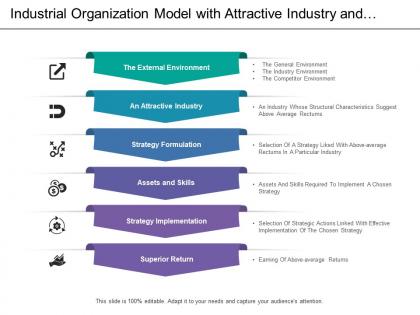
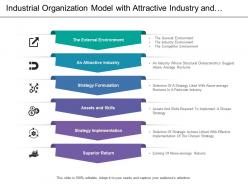
Industrial organization model with attractive industry and strategy formulation




Try Before you Buy Download Free Sample Product
 Impress Your
 Audience
 100%
100% Editable
 Save Hours
 of Time


Avoid brinkmanship with our Industrial Organization Model With Attractive Industry And Strategy Formulation. Don't allow things to get to an edge.
People who downloaded this PowerPoint presentation also viewed the following :
Industrial organization model with attractive industry and strategy formulation with all 5 slides:
The lord has given you a gift. Let our Industrial Organization Model With Attractive Industry And Strategy Formulation help you share it with others.



FAQs for Industrial organization model with attractive industry
So there are five main parts to the IO model you should focus on. Industry structure is huge - stuff like how concentrated the market is and barriers to entry. Then there's conduct, which is basically how companies actually act with their pricing and R&D spending. Performance measures the results like profits and efficiency. Basic conditions cover demand patterns and tech factors (honestly this part can get pretty dry). Government policy affects everything through regulations and antitrust stuff. The whole idea is structure influences conduct, which shapes performance. I'd start by really understanding the industry structure first - it'll make everything else click.
So the I/O model is pretty straightforward - your industry basically controls your pricing, not the other way around. Like, if you're in a cutthroat market where anyone can jump in, you'll probably have to go with rock-bottom prices just to stay alive. But say you're in pharma or something with crazy high barriers? Then you can charge whatever you want, honestly. It's kinda brutal when you realize your strategy might already be decided for you. My advice though - figure out those five competitive forces in your space first, then work with what you've got instead of swimming upstream.
So the IO model is basically your go-to for figuring out how concentrated a market is and what's stopping new companies from jumping in. Start by mapping out who the big players are and their market shares - that's your foundation. From there, you can dig into whether it's actually competitive or if a few giants run the show. The model also helps you spot barriers like crazy startup costs or regulatory hoops. Plus you'll be able to predict how firms might play against each other strategically. Oh, and it's super useful for merger analysis too - like whether a deal would create monopoly issues.
So market structure totally changes how companies act. Perfect competition? You're stuck taking whatever price the market gives you - no choice at all. Monopolies get to be the bullies, setting high prices and limiting supply because who's gonna stop them? Oligopolies are where it gets messy though. Companies constantly watch each other's moves, which leads to either brutal price wars or sneaky coordination (legally questionable but happens). Monopolistic competition gives you some wiggle room through branding and differentiation, but competitors still breathe down your neck. Figure out your market type first, then you'll know what to expect.
Look, barriers to entry are what keep your competition from wrecking your profits. Think massive startup costs, patents, crazy regulations - stuff that makes new players go "nah, too expensive." When barriers are high, existing companies can charge more because nobody's undercutting them. Low barriers? You're screwed - every week there's some new startup trying to eat your market share. My old econ professor always said to map out what's actually stopping competitors from launching tomorrow, and honestly he was right. That's your best clue for whether an industry's worth getting into.
So basically the model sees regulations as outside rules that mess with how industries work. Things like licensing create barriers for new companies trying to get in. Price controls and antitrust laws change how firms can actually compete. Honestly, regulations are like the referee setting ground rules - everyone has to play by them whether they like it or not. Companies adjust their strategies around these constraints, which affects market concentration and pricing power. When you're looking at any industry, figure out the key regulations first. They literally determine what competitive moves are even legal.
So the IO model basically says more market power = more profit. Pretty straightforward. When companies can mess with prices (through high barriers to entry, product differentiation, whatever), they're not stuck taking whatever price the market gives them. Monopolies are the obvious example here - they literally set their own prices. There's this whole structure-conduct-performance thing that explains it: market structure determines your power, power shapes how you behave, and that behavior drives your profits. Honestly, if you're trying to figure out which companies in an industry are crushing it financially, just look at concentration ratios and entry barriers first. That'll tell you everything.
The biggest issue is that IO treats companies like they're just sitting there reacting to whatever the industry throws at them. Totally ignores how firms actually shape markets through innovation or unique capabilities. Also, it's super focused on external stuff - barriers to entry, market power - but misses internal strengths that create real advantage. The whole framework feels pretty static too, which is weird when you think about how fast digital markets move. Network effects? Good luck modeling that with traditional IO. Honestly works way better for old-school manufacturing than today's platform economy. You should probably combine it with resource-based analysis.
So basically the IO model treats all those shifts as outside forces you just gotta roll with, not stuff you can control. Netflix killing Blockbuster? Perfect example. First you'd analyze how the changes mess with industry structure and competition, then figure out where you fit in this new reality. It's pretty reactive honestly - you're responding to what's already happening instead of being the one shaking things up. I'd start by figuring out which external changes are hitting your space the hardest right now. That'll give you a clearer picture of what you're actually dealing with.
Look for the usual suspects first - ROA, profit margins, market share. Those give you the foundation. Concentration ratios like CR4 are clutch for understanding how competitive things actually are. Price-cost margins show pricing power, which is pretty telling. Productivity ratios matter too, though I honestly find them less exciting to dig into. Don't try to track everything at once - you'll go crazy. Match your metrics to what you're studying. Market power analysis? Stick with concentration and margins. Efficiency stuff needs productivity measures. Start simple with profitability basics, then add the specialized metrics once you know what story you're trying to tell.
So basically you treat firms like players in a game who know their competitors will react to whatever they do. Instead of each company making decisions in a vacuum, their pricing and capacity choices become strategic moves that affect each other. It's like Nash equilibrium applied to real markets - honestly way more interesting than regular IO models. Start simple with two-player setups like Cournot competition first. You'll need payoff matrices showing different outcomes based on what strategies everyone picks. Gets complicated fast when you add multiple stages, but the predictions are so much better than traditional approaches. Makes way more sense than pretending firms ignore each other.
Airlines in the 70s-80s is your go-to example here. Government used to control everything - routes, prices, the works. Then deregulation hit and boom, new airlines everywhere, prices tanked, efficiency went way up. AT&T's breakup in '84 works too, though that one's honestly more complex than people make it sound. Both cases show how market structure totally shapes what happens when you mess with regulations. Pretty much every IO textbook hammers these examples because they're clean cases where you can actually see theory playing out in real time. Great starting points if you're diving into this stuff.
So vertical integration is basically when companies decide to make stuff in-house instead of buying from suppliers. Think Netflix - they went from just streaming other people's shows to actually making their own content. Pretty smart move tbh. It's all about transaction costs and market power in IO analysis. Companies do it to cut costs, control quality better, or make it harder for competitors to enter their market. The "make or buy" decision is huge. Sometimes controlling your supply chain just makes more sense than dealing with outside vendors who might screw you over.
So the IO model is actually pretty useful for predicting what your competitors will do. You map out things like concentration ratios, switching costs, economies of scale - basically the structural stuff that shapes how companies behave. From there you can spot patterns. Like whether pricing wars are coming, or if the market's ripe for new players vs. headed for consolidation. It's not perfect obviously, but it gives you a decent read on industry dynamics. I'd start by identifying your market's key structural elements, then use those to guess how competitors will react when things change. Works better than just winging it.
So basically flip your usual approach - look at the market first, then figure out how to adapt internally. Most people start with "what are we good at?" but this model says hold up, what's actually happening in your industry? Map out Porter's Five Forces to see the competitive landscape. Are suppliers squeezing margins? New competitors flooding in? Then shape your strategy around those realities. It's honestly more logical than just banking on internal strengths - the outside world doesn't care how good your team thinks they are at something. Find the structural opportunities or threats, then position yourself accordingly.
-
Understandable and informative presentation.
-
I discovered this website through a google search, the services matched my needs perfectly and the pricing was very reasonable. I was thrilled with the product and the customer service. I will definitely use their slides again for my presentations and recommend them to other colleagues.