


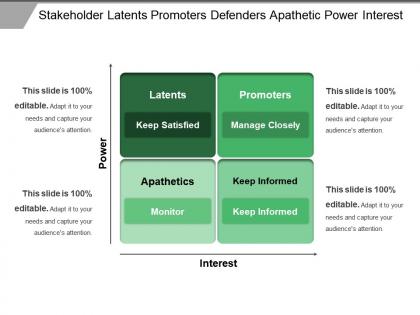
Stakeholder latents promoters defenders apathetic power interest




Try Before you Buy Download Free Sample Product
 Impress Your
 Audience
 100%
100% Editable
 Save Hours
 of Time


Folks always agree to get involved due to our Stakeholder Latents Promoters Defenders Apathetic Power Interest. It is invariably inspiring.
People who downloaded this PowerPoint presentation also viewed the following :
Stakeholder latents promoters defenders apathetic power interest with all 5 slides:
Formulate guidelines for improved functioning with our Stakeholder Latents Promoters Defenders Apathetic Power Interest. Be able to institute fresh guidelines.
FAQs for Stakeholder latents promoters defenders
Map out everyone who's involved or affected by your project first. Plot them on influence vs interest - you'll quickly see who actually has power versus who just makes noise. Survey the important ones early to get their concerns. Honestly, the power-interest matrix is a lifesaver here - helps you figure out who needs constant updates versus who gets the occasional FYI. High power/high interest people? Manage them closely. Lower priority ones just need basic info. Oh, and this isn't a one-time thing - stakeholder dynamics change constantly so revisit it regularly. Way better than just hoping for the best.
Honestly, start with the basics - track how often you're hitting deadlines and staying on budget. Engaged stakeholders mean way fewer last-minute scope changes (trust me on this one). Meeting attendance rates are surprisingly useful too, even though it sounds super dry. Quick pulse surveys work really well - just send them out randomly during the project to catch issues early. The stakeholders who are actually invested will flag problems before they blow up. Also watch how fast decisions get made... that's usually a dead giveaway of whether people actually care or they're just going through the motions.
Honestly, good communication is everything when it comes to stakeholders. Trust me on this one - I've watched projects completely implode because people weren't talking to each other properly. You've gotta be consistent and actually listen, not just update them constantly. Map out who needs what info and how often, then stick to it religiously. Be transparent about the messy stuff too, not just the wins. Oh, and respond when they reach out - seems obvious but you'd be surprised how many people drop the ball there. Regular check-ins keep everyone on the same page.
Oh man, you've got so many options now! Digital surveys are clutch for getting quick feedback. Virtual town halls reach way more people than those cramped conference rooms. Social media keeps the conversation going between meetings too. Honestly, tools like Miro and Slack are game-changers - people can jump in with ideas whenever instead of sitting through those brutal 3-hour sessions. Data analytics show you what's actually landing with people. Mobile apps let folks participate whenever they want, which is huge. My advice? Pick one tool where your stakeholders already hang out and start there. Don't overthink it.
Honestly, you've gotta speak their language. Investors want the spreadsheets and PowerPoint decks - they live for that stuff. Community folks? Hit them up on social or do town halls where they can actually ask questions. Your employees are probably drowning in emails already, so internal newsletters work, or just grab them in team meetings. I'd start by literally mapping out who your stakeholders are, then - and this might sound obvious but people skip it - actually ask a few from each group how they want to hear from you. Timing matters too. Don't send dense reports on Friday afternoons, you know?
Okay so the biggest mistakes? Waiting way too long to bring people in - like decisions are basically already made, you know? And only talking to the same obvious people every time. Oh, and treating it like some box to check off instead of actually caring about what they say. The feedback loop thing is massive though. People get so frustrated when they take time to give input and then... crickets. Nothing. To fix this stuff, start mapping out who matters way earlier in the planning phase. Think outside your usual circle. But honestly the most important part is always getting back to them about how their ideas shaped things, even if you couldn't use everything they suggested.
Set up regular check-ins with your stakeholders - surveys, focus groups, whatever works. But here's the thing: you actually have to USE what they tell you. Document their feedback and show them exactly how it changed your decisions. Otherwise they'll think you're just going through the motions and stop bothering to respond. Create a simple tracking system that connects their input to your actions. Honestly, most people skip this part and wonder why engagement drops off. Close the loop by telling them "hey, we changed X because you said Y" - that's what builds real trust for next time.
Honestly, just be real with people from the start. Don't promise stuff you can't actually deliver - that's how you lose credibility fast. Listen to different voices, not just whoever yells loudest (you know the type). Some folks might be scared to speak up depending on the power dynamics, so think about that too. I've seen too many "engagement" processes that were basically just box-checking exercises. Build trust by being consistent and following through when you say you'll do something. Oh, and transparency isn't just a buzzword - actually tell people what your org's limitations are upfront.
Honestly, visuals are a game-changer because they make complicated stuff actually make sense to everyone in the room. Charts and diagrams give people something concrete to look at instead of trying to follow abstract ideas. People remember what they see way better than what they hear anyway - saves you from explaining the same thing five times. Templates keep you organized so you don't forget important points. The best part? Visuals get people asking better questions and having more focused discussions. Oh, and process diagrams work really well for some reason. Try one next time - you'll notice people engage way more.
Check attendance rates and how fast people respond to your outreach - that's the basic stuff. But honestly? Just ask them straight up if they feel heard. That usually tells you way more than fancy metrics. Look at whether they're showing up to follow-up meetings and actually using your recommendations. Survey feedback helps too, especially the tone of responses. Don't overcomplicate it though - pick maybe 3-4 things you'll realistically track instead of trying to measure everything under the sun. Simple dashboard beats complex spreadsheets every time.
Yeah, cultural stuff makes a massive difference with stakeholders. Germans are super direct, but in Japan you've got to build relationships first - totally different game. I learned this the hard way watching projects crash because teams didn't adapt their approach. Meeting styles, communication timing, hierarchy expectations - it all varies by region. Some places want formal top-down engagement, others are way more collaborative. My advice? Do your homework on local customs and definitely find someone on the ground who knows how business actually works there. Makes all the difference.
Honestly, the main thing I've learned is you can't wait until shit hits the fan to start talking to people. Map out everyone who'll be affected - not just the obvious players but the random people on the sidelines too. Build relationships when you don't need anything yet (takes forever but totally worth it). What really works is being brutally honest about what you can and can't do instead of promising the moon. People actually respect that more than the typical corporate BS. Oh, and don't just do one-off meetings - regular check-ins keep everyone happy even when there's no drama happening.
Honestly, social media's perfect for actually talking *with* people instead of just shouting updates into the void. Pick one platform - Twitter or LinkedIn work great - and commit to showing up regularly. Share some behind-the-scenes stuff, jump into industry conversations, respond to comments quickly. The real magic happens when you ditch the corporate polish and just be genuine. I've seen organizations build way better stakeholder relationships this way than through formal meetings (which half the time people skip anyway). Don't try to be everywhere at once though. Better to nail one platform first.
Start with communication training - that's where everything clicks. Active listening, conflict resolution, tailoring messages for different people. Stakeholder mapping workshops are gold (seriously wish someone told me about these years ago). If you're dealing with diverse teams, cultural competency stuff helps a lot. Basic project management too so everyone gets timelines and what's expected. But honestly? The communication piece is what makes or breaks it. Once your team can handle those weird, uncomfortable conversations without dying inside, the rest falls into place way easier.
Honestly, make it routine instead of just doing it once. Quarterly surveys work well, plus monthly check-ins with your main people. Maybe throw a feedback form on your site too. But here's the thing - you absolutely have to circle back and show what you actually changed based on their input. Otherwise people just tune out, which I've definitely seen happen before. Coffee chats are surprisingly effective alongside the formal stuff. Oh, and assign someone to own this whole thing and track patterns. Short pulse surveys can catch issues early too.
-
Top Quality presentations that are easily editable.
-
Graphics are very appealing to eyes.